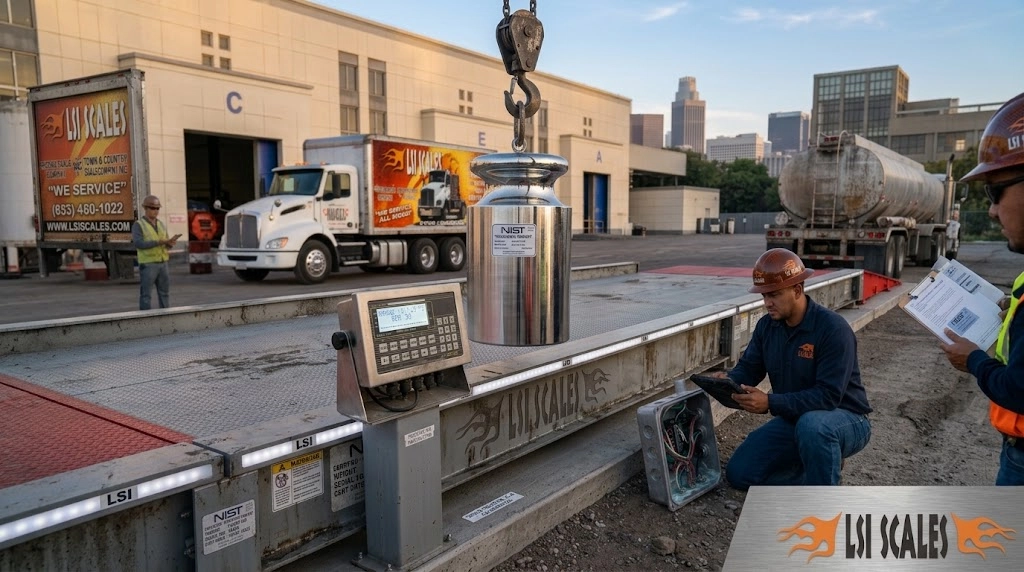
The Question Every Fleet Manager Eventually Asks
I’ve been in the weighing industry for over 50 years, and there’s one question I hear more than any other: “How often do I actually need to calibrate my truck scale?”
It’s a fair question. Calibration costs money. Every service visit means downtime, even if it’s just a few hours. And if you’re calibrating too often, you’re burning budget on unnecessary service. But if you’re calibrating too little, you’re losing money in ways you might not even notice—until a customer disputes a weight, or a state inspector finds your scale out of tolerance, or you realize months later that you’ve been giving away product on every single load.
Here’s the honest answer: there is no single correct calibration frequency. It depends on your volume, your industry, your environment, and your tolerance for risk. What I can do is give you a framework—grounded in NIST Handbook 44 standards and real-world operational data—so you can make an informed decision for your specific operation. If you’re already seeing accuracy problems, start with our guide on why a truck scale stops weighing correctly.
Table of Contents
What Actually Determines Calibration Frequency?
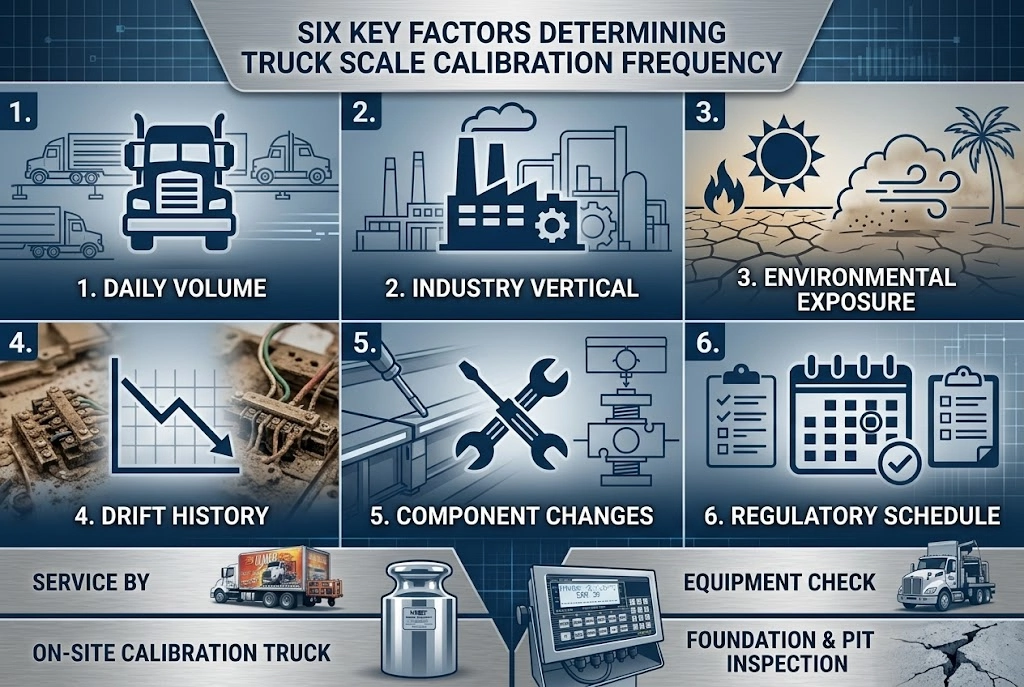
Before we get into numbers, let’s talk about what drives calibration frequency. It’s not arbitrary. It’s not “once a year because that’s what everyone does.” It’s determined by six real factors:
1. Daily Weighment Volume
The more trucks you weigh, the faster your scale drifts. A scale handling 20 trucks a day in a clean, indoor environment experiences very different wear than a scale handling 200 trucks a day in a dusty mining operation. Volume is the single biggest driver of calibration frequency. High-volume sites often pair frequent calibration with a structured preventive maintenance program to keep drift under control.
2. Industry Vertical
Different industries have different tolerance requirements and different environmental exposures:
- Mining: Extreme dust, heavy loads, high volume. Frequent calibration is non-negotiable. See our specialized mining truck scale solutions.
- Agriculture: Seasonal peaks (harvest), dust, moisture. Pre-season and post-season calibration matters. Explore options for agricultural and farm scales.
- General Logistics: Moderate volume, cleaner environments. Annual calibration is often sufficient. Review our transportation scale services.
- Construction Materials: The tightest tolerance requirements per NIST Handbook 44 (0.1% of capacity). Many aggregate operations also rely on our heavy-duty truck scales.
- Waste & Recycling: High-value transactions and strict compliance needs. See waste management scales and scrap and recycling scale solutions.
3. Environmental Exposure
California’s Central Valley gets extreme summer heat and dust. Arizona mining corridors face desert conditions. Coastal operations deal with moisture and salt air. Each environment affects scale accuracy differently—and each requires a different calibration approach. Our dual-hub coverage from California scale service and Arizona scale service locations lets us respond to these regional differences quickly.
Temperature swings cause metal expansion and contraction. Dust and debris accumulate under the scale platform. Moisture corrodes load cells and junction boxes. All of these accelerate drift. Regular inspections using our industrial scale preventive maintenance checklist help catch environmental damage before it forces an emergency recalibration.
4. Observed Drift History
If your scale has historically drifted slowly, you may be able to extend intervals. If it drifts quickly—even in a clean environment—you need more frequent calibration. This is why documentation matters. You can’t make informed decisions without data. Every calibration we perform includes as-found and as-left readings so you can track drift over time. Learn more about why scale calibration matters for accuracy and precision.
5. Component Changes
Any time a load cell, junction box, indicator, or cable is replaced, the scale must be recalibrated. This isn’t optional—it’s a regulatory requirement. The new component will have slightly different characteristics than the old one, and the scale must be adjusted to compensate. If a component fails between scheduled calibrations, our emergency truck scale repair team can replace it and recalibrate in a single visit. For extensive damage, a full scale overhaul may be the better long-term choice. When deciding between repair and replacement, see our guide on industrial scale repair or replace decisions.
6. Local Regulatory Schedule
California and Arizona have their own inspection schedules for commercial weighing devices. Your calibration frequency should align with—or exceed—your state’s inspection requirements. If your state requires annual inspection, calibrating annually keeps you ahead of the curve. For California-specific requirements, review our commercial truck scale calibration services in California. NTEP and legal-for-trade rules also play a role—see NTEP certified scale requirements for more detail.
NIST Handbook 44: The Standards Behind the Numbers
Before we talk about frequency, we need to talk about tolerance. How accurate does your scale actually need to be? That’s where NIST Handbook 44 comes in. It sets the technical standards for commercial weighing devices in the United States—and California follows it closely. Our NIST-traceable weight calibration services are built around these exact standards.
Acceptance Tolerance vs. Maintenance Tolerance
NIST Handbook 44 distinguishes between two types of tolerance:
- Acceptance Tolerance: Applied when a scale is newly installed or newly calibrated. It’s the tightest standard.
- Maintenance Tolerance: Applied to scales already in service. It’s slightly looser than acceptance tolerance.
Per NIST Handbook 44, acceptance tolerance is one-half the maintenance tolerance. This means a scale that passes acceptance tolerance has room to drift before it fails maintenance tolerance—and that drift window is exactly what calibration frequency is designed to manage. Understanding this difference is one of the most important things a fleet manager can learn about scale calibration and accuracy.
Tolerance by Application
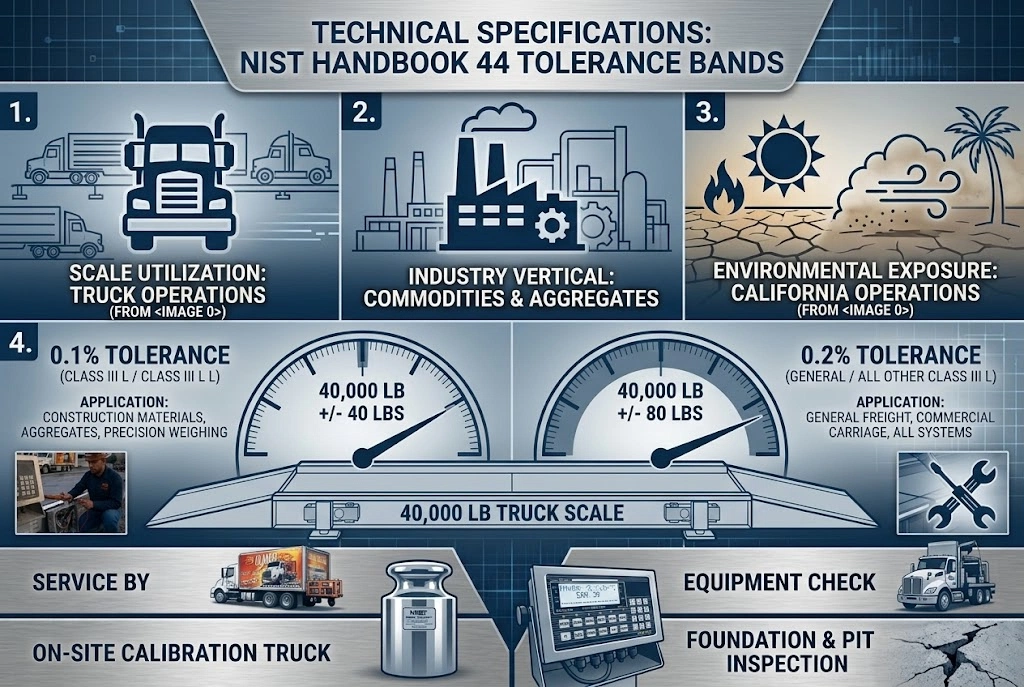
Construction Materials: The minimum maintenance and acceptance tolerance shall be 0.1% of weighing capacity, or the value of the scale division—whichever is less. This is the tightest tolerance in the handbook, and it reflects the high-value nature of construction materials. Many of these sites also use our truck scale systems designed for heavy aggregate loads.
Grain: The basic maintenance tolerance for grain-weighing systems is 0.1% of test load. Agricultural operators often combine calibration with seasonal farm scale maintenance.
All Other Systems: The basic maintenance tolerance is 0.2% of test load. This covers most general logistics and transportation scale applications.
What Does This Mean in Practice?
Let’s put this in real terms. On a 40,000-pound truck:
- 0.1% tolerance = 40 pounds of allowable error
- 0.2% tolerance = 80 pounds of allowable error
Now multiply that by 100 trucks a day. That’s 4,000 to 8,000 pounds of potential error—every single day. Over a year, that adds up to millions of pounds. And that’s within tolerance. If your scale drifts beyond tolerance, the numbers get much worse. This is also why many fleets add axle scale calibration as an extra layer of protection against overweight citations.
This is why calibration frequency matters. It’s not about avoiding fines (though that matters too). It’s about protecting your revenue and your customers’ trust. When accuracy is critical, our California commercial truck scale calibration team delivers NIST-traceable results with full documentation.
Calibration Frequency by Volume & Industry
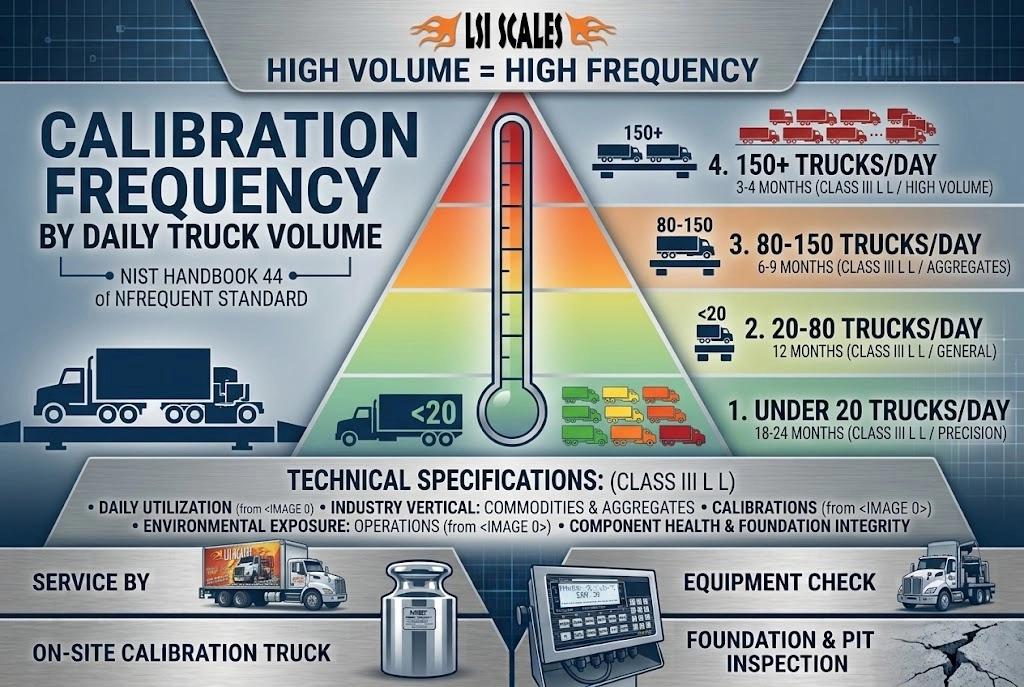
Here’s the framework we use at LSI Scales. It’s based on NIST Handbook 44 standards, California and Arizona regulatory requirements, and decades of real-world experience with truck scales across every major industry. For location-specific support, see our full service coverage map.
| Daily Volume | Environment | Recommended Frequency | Typical Industry |
|---|---|---|---|
| <20 trucks/day | Clean, indoor/covered | Every 18–24 months | Light logistics, warehousing |
| 20–80 trucks/day | Moderate dust/moisture | Every 12 months | General logistics, aggregate |
| 80–150 trucks/day | Dusty/muddy, mine/farm | Every 6–9 months | Mining, agriculture |
| 150+ trucks/day | Heavy mining, port | Every 3–4 months | Mining, port operations |
Important note: This framework assumes baseline conditions. If your scale is exposed to extreme temperatures (Arizona desert, Central Valley summer), heavy dust, or frequent overloads, you should calibrate more frequently than the table suggests. Conversely, if your scale is in a climate-controlled environment and sees light use, you may be able to extend intervals—but only with documented drift history to support that decision. High-volume mining sites in particular benefit from pairing quarterly calibration with our mining truck scale maintenance programs.
What Happens During a Calibration?
Calibration isn’t just “putting weights on the scale and checking the reading.” A proper calibration involves a series of standardized tests, each designed to verify a different aspect of scale performance. Here’s what we do at LSI Scales as part of our full weight calibration services:
Corner-Load Test
We place test weights at each corner (or section) of the scale platform to verify that the scale reads consistently regardless of where the load is positioned. If one corner reads differently than the others, the load cells need adjustment. Corner-load problems are one of the most common issues we find during emergency scale repair calls.
Linearity Test
We test the scale at multiple weight increments—typically 25%, 50%, 75%, and 100% of capacity—to verify that the scale reads accurately across its entire range. A scale can be accurate at 40,000 pounds but inaccurate at 20,000 pounds, and linearity testing catches that. This test is especially critical for operations that also use axle scales for intermediate checks.
Repeatability Test
We place the same weight on the scale multiple times and verify that the reading is consistent. If the scale reads 40,000 pounds one time and 40,020 the next, that’s a repeatability problem. Repeatability failures often point to failing load cells or junction-box corrosion—issues we address during both scheduled calibration and on-site repair.
Increasing-Load and Decreasing-Load Tests
We test the scale as weight is added (increasing load) and as weight is removed (decreasing load). Some scales read differently depending on whether the load is being applied or removed—a phenomenon called hysteresis. These tests catch it.
Time Dependence Test
We verify that the scale reading remains stable over time. If the reading drifts while a load is sitting on the platform, that’s a problem. Time dependence issues frequently appear in older systems that are candidates for a complete scale overhaul.
Discrimination Test
We verify that the scale can detect small weight changes—typically one scale division. If the scale can’t distinguish between 40,000 and 40,020 pounds, it’s not performing to specification.
Influence Factors Test
We test the scale under varying environmental conditions (temperature, voltage) to verify that external factors don’t cause significant drift. This is particularly important for outdoor installations across California and Arizona.
How much test weight is required? Per standard practice, a truck scale should be calibrated with at least 12.5% of its nominal capacity or 25,000 pounds of certified test weights—whichever is greater. This is why calibration requires specialized equipment and trained technicians. You can’t do it with a few 50-pound barbell plates. Our teams arrive with certified test-weight trucks and portable calibration kits. If your scale is temporarily out of service during calibration, we can bridge the gap with a portable truck scale rental or broader equipment scale rentals. For longer outages, compare options in our truck scale rental vs purchase guide.
Warning Signs You Need Calibration Now
Even if you’re on a regular calibration schedule, there are times when you need to calibrate immediately—regardless of when your last calibration was. Watch for these warning signs:
- Fluctuating readings: The same truck weighs differently each time it crosses the scale. See the full list of causes in truck scale not weighing correctly – 7 causes and fixes.
- Zero drift: The scale doesn’t return to zero between weighs.
- Display inconsistency: The indicator shows different numbers for the same load.
- Customer complaints: Customers dispute weights—especially if they’re consistently disputing in one direction.
- Failed daily zero check: If your operator checks zero every morning and it’s off, that’s a sign.
- Recent component change: Any load cell, junction box, indicator, or cable replacement requires recalibration. Our scale repair team handles both the replacement and the required recalibration.
- After a lightning strike: Even if the scale seems to work, accuracy may be compromised. Call for emergency service immediately.
- After a physical impact: If a truck has hit the scale or scale house, calibration is essential. Structural issues may also require scale installation or re-leveling support.
- After a state inspection failure: If you’ve failed an inspection, you need recalibration before you can legally operate. We provide full CT-109 and NIST documentation as part of every calibration.
Don’t wait for your next scheduled calibration if you see any of these signs. The cost of recalibration is far less than the cost of inaccurate billing, fines, or lost customers. For a complete overview of maintenance best practices, download or review our industrial scale preventive maintenance checklist.
Real-World Scenario: The Drift That Cost $50,000
Illustrative Industry Scenario based on real operational patterns
A mining operation in Arizona was calibrating every 12 months. That was their standard—and it had worked for years. But their operation had grown. They were now weighing 200+ trucks per day in a dusty desert environment.
By month 6, their scale had drifted 0.35%—well beyond the NIST maintenance tolerance of 0.2%. But no one noticed. The scale still displayed numbers. Trucks still crossed it. The operation continued.
The problem surfaced when a customer disputed a weight. An investigation revealed that the scale had been inaccurate for months. The operation had been overcharging some customers and undercharging others. The total estimated loss from product giveaway and customer credits: $50,000+.
What would have prevented this? A calibration schedule that matched their actual volume. At 200+ trucks per day in a dusty environment, they should have been calibrating quarterly—not annually. The additional cost of quarterly calibration: a few thousand dollars per year. The cost of NOT calibrating: $50,000+ in losses, plus the reputational damage of inaccurate weights. High-volume mining sites like this one also benefit from our dedicated mining truck scale support and on-site Arizona scale service teams.
This is why calibration frequency isn’t a “set it and forget it” decision. It needs to be reviewed as your operation changes. Pairing the right frequency with a solid preventive maintenance contract is the most effective way to protect both accuracy and uptime.
How to Build Your Calibration Schedule
Here’s a practical framework for building a calibration schedule that works for your operation:
Step 1: Document Your Baseline
Start with an initial calibration. Document the as-found condition (what the scale read before adjustment) and the as-left condition (what it reads after adjustment). This gives you a baseline to compare against. Our NIST-traceable calibration reports always include this data.
Step 2: Determine Your Volume & Environment
Use the table above to identify your recommended frequency range. Be honest about your daily volume and environmental conditions. If you’re in a dusty or hot environment, lean toward the shorter interval. Operations in the Central Valley or Arizona desert should also consider regional factors covered on our California and Arizona service pages.
Step 3: Monitor Drift
After each calibration, compare the as-found reading to the last as-left reading. If the scale drifted significantly in a short period, your interval is too long. Shorten it. If the scale barely drifted, you may be able to extend the interval—but only with data to support it. Tracking this data is one of the core benefits of a formal preventive maintenance program.
Step 4: Align with Regulatory Requirements
Check your state’s inspection schedule. California and Arizona both require annual registration and inspection of commercial weighing devices. Your calibration schedule should keep you ahead of these inspections so you’re never caught out of tolerance. For California-specific rules, see our commercial truck scale calibration California page. Understanding NTEP certified scale requirements also helps you stay fully compliant.
Step 5: Review Annually
Review your calibration frequency annually. Has your volume changed? Has your environment changed? Have you had component changes? Adjust your schedule accordingly. If volume has increased dramatically, consider whether a temporary portable truck scale rental or additional permanent capacity is needed.
Step 6: Document Everything
Keep calibration certificates, as-found/as-left data, and service reports. This documentation is your defense if you’re ever audited or cited. It also helps you make informed decisions about future calibration intervals. When choosing a calibration partner, use our guide on how to choose a scale calibration company to evaluate providers properly.
How Calibration Frequency Connects to Everything Else
Calibration frequency doesn’t exist in isolation. It’s part of a larger compliance and maintenance ecosystem:
- Preventive Maintenance: Regular maintenance catches issues before they cause drift. If your scale is well-maintained, it will hold calibration longer. Our preventive maintenance programs include calibration scheduling as part of a complete care plan. Start with the preventive maintenance checklist.
- Emergency Repair: If your scale fails calibration—or fails an inspection—you need emergency repair services to get back online fast. For extensive damage, consider a full scale overhaul.
- DOT Compliance: Inaccurate scales lead to overweight citations. Calibration frequency is your first line of defense against DOT overweight fines and supports overall transportation scale compliance.
- Portable Rental: If your permanent scale is down for calibration or repair, a portable truck scale rental or general equipment scale rental keeps you operating. Compare options in our rental vs purchase guide.
- Installation & Upgrades: When a scale is beyond economical repair, our scale installation team can replace it with a new NTEP-certified system.
When you work with LSI Scales, we help you build a complete care plan—not just a calibration schedule. We want your scale to be accurate, compliant, and reliable every day of the year. Meet the factory-trained team behind the work on our staff page.
Frequently Asked Questions
How often should I calibrate my truck scale?
It depends on volume, industry, and environment. Low-volume operations (under 20 trucks/day) can go 18–24 months. High-volume operations (150+ trucks/day) should calibrate every 3–4 months. Use the table above as a starting point, and adjust based on your actual drift history. For a deeper explanation of why intervals matter, read why scale calibration matters.
Does California require annual calibration?
California requires annual registration and inspection of commercial weighing devices. Calibration frequency is separate but should keep you ahead of inspection requirements. Many California operations calibrate every 6–12 months depending on volume. Details are on our California truck scale calibration page and certified scales in California overview.
What happens if my scale fails calibration?
If your scale fails calibration, you need repair before it can be placed back in service. Depending on the failure, this may require load cell replacement, junction box repair, or other service. We offer emergency repair services to get you back online fast. In some cases a full scale overhaul is the more cost-effective path—see repair or replace guidance.
Can I calibrate my own truck scale?
You can perform internal checks, but legal-for-trade calibration requires certified test weights and a licensed technician. Most operations hire a professional for calibration—the stakes are too high to get it wrong. Use our guide on how to choose a scale calibration company when evaluating providers.
How long does calibration take?
A standard calibration takes 2–4 hours on-site, depending on scale size and condition. If repairs are needed, it may take longer. During that window we can deploy a portable rental scale so your operation continues.
What’s the Difference Between Calibration and Inspection?
Calibration is the process of adjusting your scale to read accurately. Inspection is the regulatory process of verifying that your scale meets state requirements. Calibration is something you do proactively; inspection is something the state does to verify compliance. Both are supported by our NIST-traceable calibration services.
Ready to Build a Calibration Schedule That Works for You?
Don’t guess. Don’t rely on “once a year because that’s what we’ve always done.” Build a calibration schedule grounded in data, standards, and your actual operation.
LSI Scales has been calibrating truck scales for over 50 years. We know NIST Handbook 44 inside and out. We know California and Arizona regulations. And we know how to help you find the right balance between cost and compliance. Explore our full range of truck scale solutions, calibration services, and regional coverage from Fresno and Wittmann.
📞 Call us: (559) 446-1022
📧 Email: Contact us here
📍 Serving: California & Arizona
Or learn more about our NIST-traceable calibration services and how we help operations like yours stay compliant and accurate. You can also review California-specific truck scale calibration, our preventive maintenance programs, and the complete maintenance checklist to build a full compliance plan.