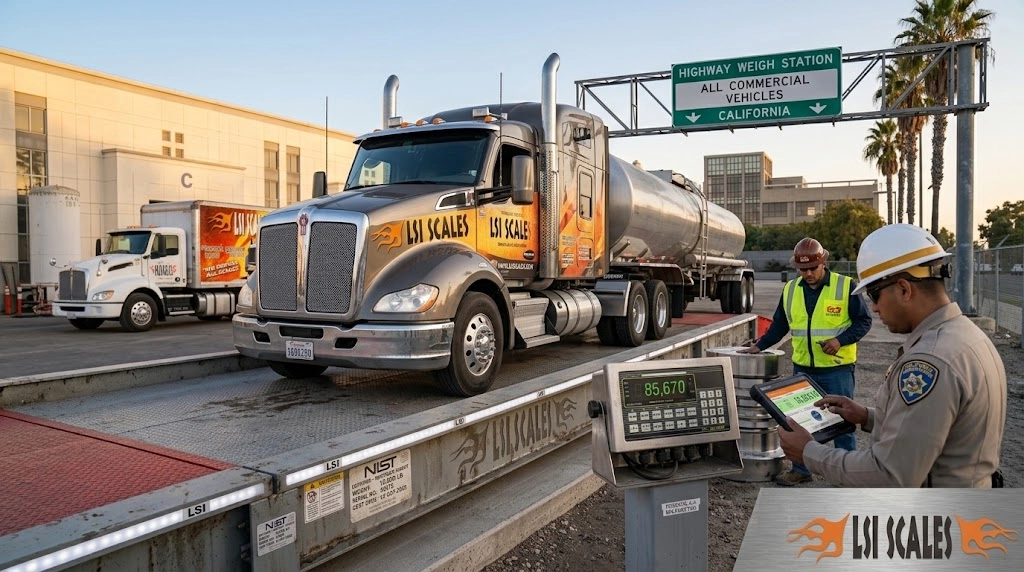
The Citation You Don’t See Coming
Table of Contents
I’ve talked to hundreds of fleet managers over the years, and there’s one thing they all have in common: nobody thinks they’re overweight until they’re pulled onto the scales.
It usually starts the same way. The shipper says the load is legal. The driver says it feels fine. The dispatch sheet says you’re under 80,000 pounds. And then the CHP officer waves you into a Commercial Vehicle Enforcement Facility, and suddenly you’re 5,000 pounds over on your steer axle—and looking at a citation that could cost thousands.
Here’s what most people don’t understand: overweight violations aren’t just about total gross weight. They’re about axle weights, bridge formula compliance, and how the load is distributed. A truck can be under 80,000 pounds gross and still be illegal because one axle is overloaded. The only reliable way to know your true axle and gross weights before you leave the yard is a properly calibrated truck scale or axle scale.
In 2026 alone, California Highway Patrol’s Commercial Operations Unit stopped 408 commercial vehicles in a single enforcement sweep and found 962 violations—81 vehicles were ordered out of service entirely. And on March 3, 2026, CHP’s Grapevine facility caught 9 trucks from the same project running between 85,000 and 88,000 pounds—all over the 80,000-pound federal limit.
This guide is for fleet managers, logistics directors, and owners who want to understand the rules before they get the citation. We’ll cover the weight limits, the fines, the enforcement, and—most importantly—how to stay compliant without slowing down your operation. For related reading, see our guide on axle scale calibration and overweight fines.
Federal Weight Limits: The Three Numbers That Matter
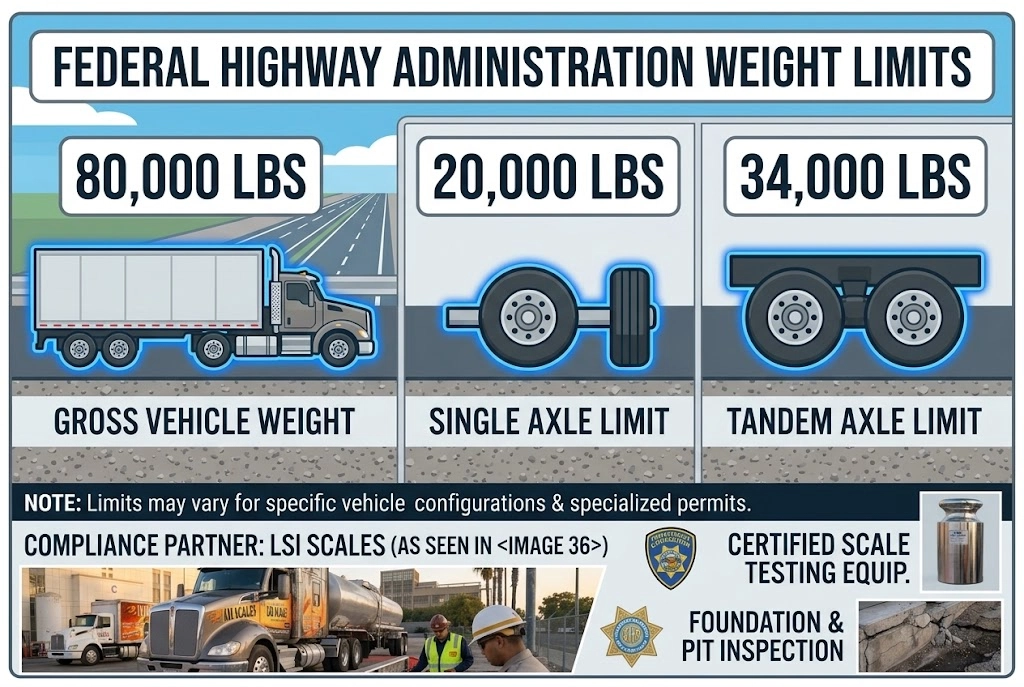
Before we get into fines, let’s talk about the limits themselves. The Federal Highway Administration sets baseline weight limits for Interstate highways, and every state—including California and Arizona—enforces them. Understanding these limits is the foundation of any DOT-compliant transportation scale program.
Gross Vehicle Weight Rating (GVWR)
The maximum gross vehicle weight for a 5-axle combination on Interstate highways is 80,000 pounds. This is the total weight of the truck, trailer, cargo, fuel, and driver combined. Exceed it, and you’re overweight—even if every individual axle is legal. A full-length commercial truck scale is the most accurate way to confirm gross weight before dispatch.
Axle Weight Limits
Even if you’re under 80,000 pounds gross, you can still be cited for axle violations:
- Single axle: 20,000 pounds maximum
- Tandem axle: 34,000 pounds maximum
These limits exist because bridges and pavements are designed for specific weight distributions. A truck that’s 79,000 pounds gross but has 25,000 pounds on a single axle is still illegal—and dangerous. Dedicated axle scales or a properly configured truck scale that reports axle groups make this verification fast and reliable.
The Federal Bridge Formula
The Bridge Formula is where things get complicated. It calculates the maximum allowable weight for any group of axles based on the distance between them. In simple terms: the more axles you have, and the farther apart they are, the more weight you can legally carry.
Here’s the actual formula:
W = 500 × (LN / (N-1) + 12N + 36)
Where W is the maximum weight in pounds, L is the distance in feet between the extremes of any group of axles, and N is the number of axles in the group.
You don’t need to memorize this. What you need to know is that your load has to be distributed correctly. And the only way to know if it is—before you hit the road—is to weigh it on a properly calibrated scale. Our NIST-traceable calibration services ensure that scale is accurate and audit-ready.
What Happens When You’re Overweight
Overweight citations aren’t just expensive. They affect your operation in multiple ways:
Immediate Citations
In California, overweight fines are calculated per pound over the limit, and penalties escalate quickly. Exceeding the legal limit by 2,000 pounds could result in a fine of $1,000 or more, plus impound fees. And that’s just for one violation. Multiple axles over? Multiple citations. Accurate pre-dispatch weighing on a certified California scale is the simplest way to avoid this.
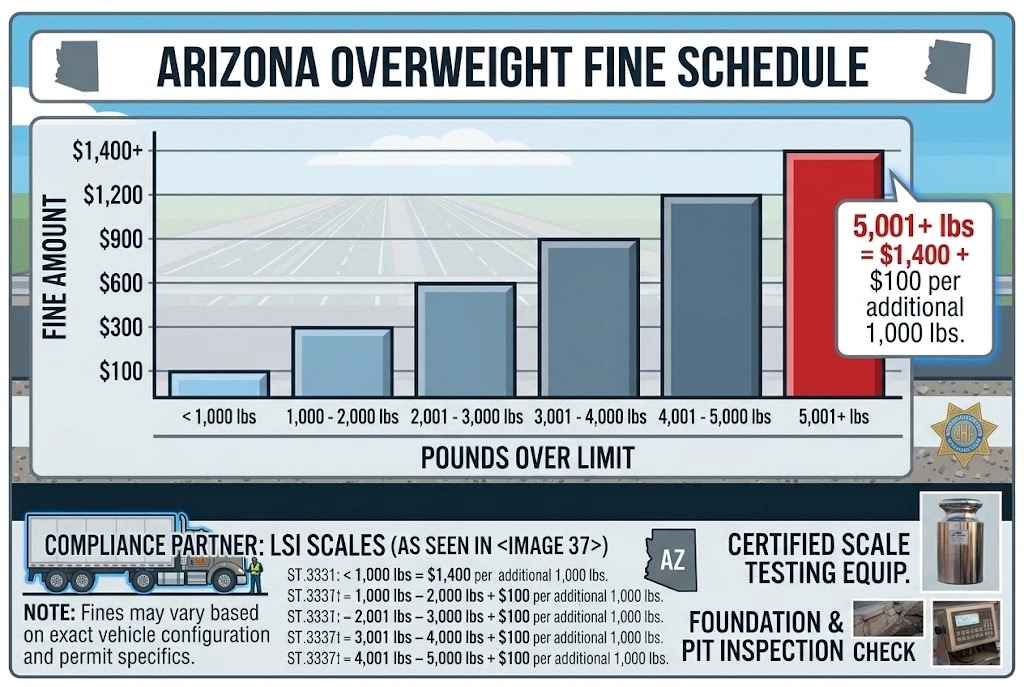
In Arizona, the civil penalty schedule is tiered:
| Pounds Over Limit | Minimum Fine |
|---|---|
| 1,001–1,250 lbs | $100.00 |
| 1,251–1,500 lbs | $200.00 |
| 1,501–2,000 lbs | $300.00 |
| 2,001–2,500 lbs | $400.00 |
| 2,501–3,000 lbs | $500.00 |
| 3,001–3,500 lbs | $840.00 |
| 3,501–4,000 lbs | $980.00 |
| 4,001–4,500 lbs | $1,120.00 |
| 4,501–4,750 lbs | $1,260.00 |
| 4,751–5,000 lbs | $1,400.00 |
| 5,001+ lbs | $1,400.00 + $100 per additional 1,000 lbs |
And these are just the fines. Arizona also requires overweight permits for legal overweight operations—single-trip permits start at $75 for overweight. Operations in mining and aggregate corridors can reduce risk with on-site verification using our Arizona scale services and mining truck scale solutions.
Out-of-Service Orders
If you’re significantly overweight—or if the officer determines the load is unsafe—your vehicle can be placed out of service. That means the truck doesn’t move until the load is adjusted or a permit is obtained. For a fleet running tight schedules, an out-of-service order can cascade into missed deliveries, angry customers, and lost contracts. Having a backup portable truck scale rental or permanent equipment scale rental ready can keep operations moving while issues are resolved.
Insurance Premium Impact
Here’s the part most people don’t think about until renewal time: overweight citations affect your insurance premiums. Carriers view repeated overweight violations as a sign of poor operational control. Your premiums go up. In some cases, your coverage can be cancelled. Demonstrating a documented compliance program that includes regular NIST-traceable calibration and load verification strengthens your position at renewal.
Repeat Offenses
In California, repeat overweight violations can escalate to misdemeanor charges. Under Vehicle Code Section 42030, a third or subsequent overweight violation within three years can be charged as a Class 2 misdemeanor. That’s not just a fine—that’s potential jail time and a criminal record. Consistent use of legal-for-trade scales and current calibration certificates is the strongest operational defense.
How Enforcement Actually Works
Understanding how enforcement works helps you avoid it. Here’s what you’re up against:
Fixed Weigh Stations and CVEF Facilities
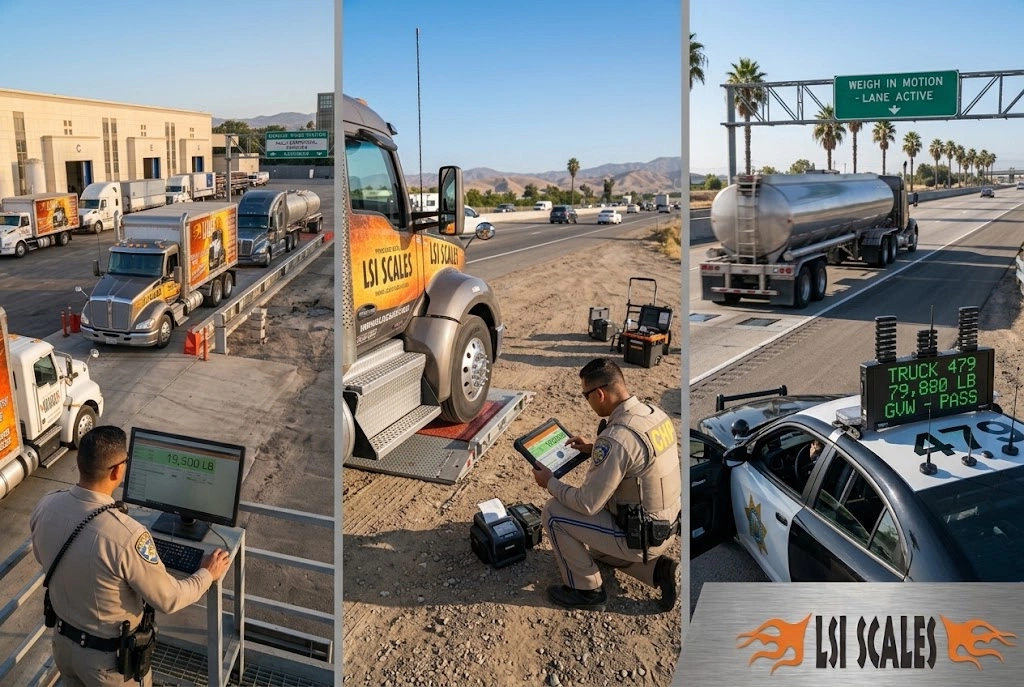
California operates Commercial Vehicle Enforcement Facilities (CVEFs) at key points on major highways. These aren’t just weigh stations—they’re full inspection facilities where officers check weight, safety equipment, driver credentials, and load securement. The Grapevine CVEF—where those 9 trucks were caught—is one of the busiest in the state. Fleets that routinely verify loads on a certified truck scale before departure dramatically reduce their exposure at these facilities.
Portable Enforcement
Not all enforcement happens at fixed facilities. CHP and ADOT officers use portable scales for roadside checks. These portable scales are calibrated and certified, and they’re legally sufficient for issuing citations. If you’re relying on a shipper’s weight ticket and haven’t verified the load yourself, a portable scale check can catch you by surprise. The same principle applies to your own operation: a legal-for-trade portable truck scale gives you the same verification capability before the officer does.
Weigh-in-Motion (WIM) Systems
Many highways now have Weigh-in-Motion sensors embedded in the pavement. These systems estimate vehicle weight as it passes over at highway speed, and they flag potentially overweight trucks for further inspection. You might not even realize you’ve been weighed until you’re pulled over. Accurate pre-trip weighing remains the only reliable countermeasure.
Enforcement Sweeps
Periodically, CHP and ADOT conduct targeted enforcement sweeps. On July 23, 2026, CHP’s Golden Gate Division stopped 408 commercial vehicles in a single operation. On July 27, 2026, Arizona law agencies checked 113 vehicles along U.S. Route 60—26 were overweight. These sweeps are publicized in advance, but that doesn’t mean the officers go easy on violators. Mining, aggregate, and logistics fleets operating in these corridors benefit from tighter calibration schedules and on-site verification—see our mining truck scale and transportation scale resources.
What “Legal-for-Trade” Actually Means
Here’s something that trips up a lot of fleet managers: the scale you use to verify your weight has to be legal-for-trade if you’re using it for commercial purposes.
What does that mean?
NTEP Certification: The scale must be certified by the National Type Evaluation Program (NTEP) and comply with NIST Handbook 44 standards. Learn more in our overview of NTEP certified scale requirements.
CTEP Approval in California: In California, commercially used scales must have a Certificate of Approval from the California Type Evaluation Program (CTEP) or a Certificate of Conformance from NTEP. Details are covered on our certified scales in California page.
NIST-Traceable Calibration: The scale must be calibrated with NIST-traceable test weights, and you need documentation showing the calibration is current. Our weight calibration services and commercial truck scale calibration in California deliver exactly this documentation.
Annual Registration: Scales used commercially must be registered with the County Department of Weights and Measures and inspected annually. Keeping calibration current is the practical way to stay ready for those inspections. For guidance on frequency, see our truck scale calibration frequency guide.
Here’s why this matters: if you’re using an uncertified scale to verify weights, and you get into a dispute with a customer or a citation dispute with the state, your scale readings won’t hold up. You need a legal-for-trade scale and current calibration documentation to defend yourself. We cover this in more detail on our certified scales in California and certified scales in Arizona pages.
How to Protect Your Operation
Preventing overweight citations isn’t complicated. It just requires the right equipment, the right processes, and the right documentation.
1. Verify Every Load Before Dispatch
Don’t rely on shipper weights. Shipper weights are estimates—they’re not legal-for-trade verification. If you’re loading aggregate, grain, scrap, or any other bulk commodity, you need to weigh the truck yourself before it leaves your yard. An on-site truck scale—permanent or portable—gives you that verification. If you don’t have a permanent scale, a portable truck scale rental or broader equipment scale rental can bridge the gap without the capital investment. Compare long-term options in our truck scale rental vs purchase guide.
2. Know Your Axle Limits
Gross weight isn’t enough. You need to know your steer axle weight, drive axle weight, and trailer axle weights. The only way to know those numbers is to weigh each axle. Full-length truck scales give you that data in one pass; dedicated axle scales provide targeted verification when needed. For industry-specific needs, see our solutions for agricultural scales, scrap and recycling scales, and waste management scales.
3. Keep Your Scale Calibrated
An inaccurate scale is worse than no scale at all. If your scale is reading 1% light, you’re loading trucks 1% heavier than you think. On an 80,000-pound truck, that’s 800 pounds—enough to put you over the limit without realizing it. Regular calibration is essential. Our NIST-traceable calibration services ensure your scale is accurate and your documentation is current. For detailed guidance on how often to calibrate based on volume and environment, see our complete truck scale calibration frequency guide. Also review why scale calibration matters for accuracy and precision.
4. Document Everything
If you’re ever cited, your documentation is your defense. Keep:
- Current calibration certificates
- Weight tickets for every load
- Driver training records
- Load planning procedures
If you can show that you have a compliant scale, current calibration, and documented load verification, you’re in a much stronger position to contest a citation or negotiate a reduction. Pairing this documentation with a formal preventive maintenance program further strengthens your compliance posture. Use our industrial scale preventive maintenance checklist as a starting point.
5. Train Your Drivers
Driver error is one of the most common causes of overweight violations. Drivers need to understand axle limits, weight distribution, and the importance of verifying loads before departure. A driver who knows what to look for can catch an overload before it becomes a citation. When equipment issues do arise, our emergency scale repair team is available 24/7 to restore accuracy quickly.
Real-World Scenario: The $12,600 Morning
Illustrative Industry Scenario based on real operational patterns
A construction aggregate hauler in Arizona was running 20 trucks per day between a quarry and a job site. The company relied on shipper weights—no on-site verification. They’d been doing it this way for years without issue.
Then came March 3, 2026.
Nine trucks from a related California project were stopped at the Grapevine Commercial Vehicle Enforcement Facility. Each truck weighed between 85,000 and 88,000 pounds—5,000 to 8,000 pounds over the 80,000-pound federal limit.
The result:
- Each truck was cited for overweight violations
- At Arizona penalty rates (for comparison), 5,000+ pounds over = $1,400 minimum + $100 per additional 1,000 pounds
- Nine trucks = $12,600+ in fines for one morning
- Plus out-of-service orders, delayed deliveries, and insurance premium impact
The fix: A portable truck scale on-site would have caught the overloads before dispatch. Cost: less than $500 per month. ROI: 25x in the first month alone. Explore current options on our portable truck scale rental and equipment scale rentals pages. For permanent solutions, review our truck scale systems and scale installation services.
This is the pattern we see over and over. Overweight citations aren’t random—they’re the predictable result of not verifying loads before they hit the road. High-volume aggregate and mining operations can further reduce risk with dedicated mining truck scale support and regional coverage from our Arizona and California hubs.
California vs. Arizona: What’s Different?
While federal weight limits apply nationwide, enforcement and penalties vary by state. Here’s what you need to know:
California
- Overweight fines calculated per pound over the limit
- 2,000 pounds over can result in fines of $1,000+
- CHP operates CVEF facilities at key highway points
- Repeat violations can escalate to misdemeanor charges
- Strict CTEP requirements for legal-for-trade scales — see certified scales in California and California truck scale calibration
Arizona
- Tiered civil penalty schedule ($100–$1,400+)
- Overweight permits available for legal overweight operations ($75+)
- ADOT enforcement along interstates and mining corridors
- Portable scale enforcement common in mining areas — supported by our Arizona scale services and mining truck scale solutions
If you operate across state lines—especially between California, Arizona, and Nevada—you need to understand the rules in every jurisdiction. The limits may be federal, but the penalties are local. Our dual-hub model from Fresno and Wittmann provides coverage across both states; see the full map on our locations page.
Frequently Asked Questions
What is the maximum legal weight for a truck in California?
80,000 pounds gross vehicle weight for a 5-axle combination on Interstate highways. Single axles are limited to 20,000 pounds, and tandem axles to 34,000 pounds. Verify both gross and axle weights on a calibrated truck scale or axle scale before dispatch.
How much can you be overweight before getting a ticket?
In California, enforcement typically begins at 1,001 pounds over the limit. Even a small overload can result in a citation. Pre-trip verification is the only reliable prevention method.
What is the fine for overweight in California?
California fines are calculated per pound over the limit. Exceeding by 2,000 pounds can result in fines of $1,000 or more, plus impound fees. Accurate scales and current NIST-traceable calibration are your best operational defense.
What is the fine for overweight in Arizona?
Arizona uses a tiered schedule: $100 for 1,001–1,250 pounds over, up to $1,400 for 4,751–5,000 pounds over. Beyond 5,000 pounds, add $100 per additional 1,000 pounds. On-site verification with our Arizona scale services helps prevent these citations.
Do I need a legal-for-trade scale to verify weights?
If you’re using the scale for commercial purposes—billing, compliance verification—yes. The scale must be NTEP-certified, NIST-compliant, and calibrated with traceable test weights. Review NTEP certified scale requirements and our California / Arizona certified scale pages.
How often should I calibrate my truck scale?
It depends on volume, industry, and environment. High-volume operations (150+ trucks/day) should calibrate every 3–4 months. Lower-volume operations can go longer. See our complete truck scale calibration frequency guide for detailed recommendations and also why scale calibration matters.
What happens if my scale is inaccurate and I get cited?
If your scale is out of calibration, your weight verification won’t hold up. You need current calibration documentation to defend against citations. Regular calibration is your best defense. If the scale fails, our emergency scale repair team can restore accuracy quickly.
Can I use a portable scale to verify loads?
Yes, as long as the portable scale is legal-for-trade and properly calibrated. Many operations use portable scales for on-site verification. For long-term needs, a portable truck scale rental or equipment scale rental can bridge the gap. Compare options in our rental vs purchase guide.
Don’t Wait for the Citation
Overweight citations are preventable. They happen because loads aren’t verified, scales aren’t calibrated, or drivers aren’t trained. All of those problems have solutions—and none of them are as expensive as the fines.
At LSI Scales, we help California and Arizona operations stay compliant with:
- NIST-Traceable Calibration — Accurate scales, current documentation, audit-ready compliance. See our calibration services and California truck scale calibration.
- Preventive Maintenance — Catch drift before it becomes a citation. Explore our preventive maintenance programs and maintenance checklist.
- Portable Scale Rentals — On-site verification without the capital investment. Available via portable truck scale rental and equipment scale rentals.
- Emergency Repair — When your scale goes down, we get you back online fast with our 24/7 scale repair service.
Don’t wait until you’re the next $12,600 morning. Let’s get your operation compliant—and keep it that way. Full regional coverage details are on our locations page. Meet the team behind the work on our staff page.
📞 Call us: (559) 446-1022
📧 Email: Contact us here
📍 Serving: California & Arizona
Schedule a Compliance Consultation
Or learn more about our transportation scales, truck scales, and how we help fleets stay DOT-compliant across California and Arizona.