Quick answer: An unattended truck scale system lets drivers weigh in and out without a scale-house operator, using a kiosk, RFID tags or plate cameras, traffic lights and ticketing software. It pays off fastest at sites with steady repeat traffic, long or late operating hours, and staffing costs per shift. In California, check the weighmaster rules first: Business and Professions Code §12737 allows unattended weighmaster certificates for construction materials such as rock, sand, gravel, ready-mix and asphalt.
An unattended truck scale system sounds simple: take the person out of the scale house and let the trucks weigh themselves. In practice, it’s a mix of hardware, software, site layout and legal rules, and getting any one of them wrong costs you more than the operator you were trying to save.
The manufacturers’ brochures make automation sound right for everyone. It isn’t. A quarry running 300 repeat trucks a day is a very different case from a recycling yard that weighs walk-in public customers. And in California, the type of material you sell decides whether an unattended system can issue a legal weighmaster certificate at all.
We’ve spent more than 50 years installing and servicing truck scales across California and Arizona. This guide covers how unattended systems work, what each part does, what California law allows, and a simple way to work out whether it pays off at your site.
Key Takeaways
- An unattended system replaces scale-house data entry with a driver kiosk or ID tag, traffic lights, remote displays and ticketing software.
- RFID works best for repeat fleets; QR codes, PINs and plate cameras suit sites with many one-off customers.
- California B&P Code §12737 allows unattended weighmaster certificates for construction materials only, and the principal weighmaster’s name and system ID must print on each certificate.
- The business case depends on trucks per day, operating hours and labor cost per shift, not on the brochure.
- Most existing scales can be retrofitted, if the scale itself is accurate and in good condition.
- An unattended scale still needs regular calibration and preventive maintenance, because nobody is watching it.
Table of Contents
How an Unattended Truck Scale Works
Every system follows the same basic flow, whatever the brand.
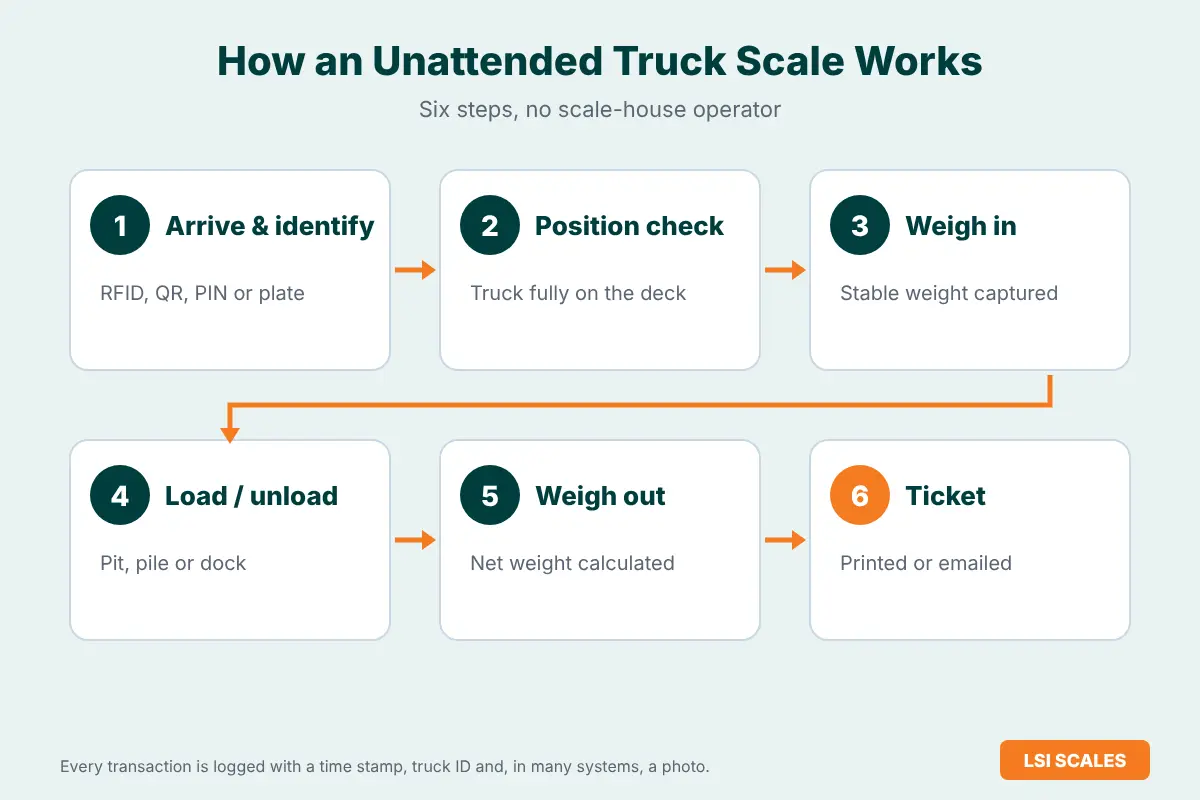
- Arrive and identify. The truck pulls onto the scale. A traffic light holds it until the system knows who it is: an RFID tag on the truck, a badge, a QR code, a PIN at the kiosk, or a license plate read by a camera.
- Position check. Sensors or loop detectors confirm the whole truck is on the deck and not hanging off an end.
- Weigh in. The indicator captures a stable weight. A remote display shows the driver the number.
- Load or unload. The truck goes to the pit, pile or dock.
- Weigh out. The truck returns. The system matches it to its inbound record, or uses a stored tare, and calculates net weight.
- Ticket. The kiosk prints a ticket or the system emails it, and the light turns green.
All of this is logged automatically, with a time stamp, the truck ID and, in many systems, a photo.
The Building Blocks
| Component | What it does | Notes for buyers |
|---|---|---|
| Certified truck scale and indicator | Produces the legal weight | Must be NTEP-approved, sealed and in tolerance; automation can’t fix a bad scale |
| Driver kiosk | Touchscreen, scanner, keypad, ticket printer | Mount at cab height; outdoor-rated for heat and dust |
| Truck ID (RFID, QR, PIN, plate camera) | Tells the system who is on the scale | See the comparison below |
| Traffic lights | Tell the driver when to pull on and off | Simple, but stops most errors |
| Position sensors / loop detectors | Confirm the truck is fully on the deck | Prevents short-weighing |
| Remote display | Shows the driver the live weight | Builds trust with drivers |
| Cameras / CCTV | Photo record of each transaction | Helps resolve disputes and deter fraud |
| Ticketing software | Stores customers, products, tares and tickets | Integrates with accounting / ERP |
| Intercom or help button | Reaches staff when something goes wrong | Essential for after-hours use |
Driver Kiosks and Mobile Apps
The kiosk is the face of the system. It’s where drivers scan a card, enter a job number or pick a product, and where the ticket comes out. Mettler Toledo, Rice Lake and Cardinal all make kiosk terminals, and some systems now let drivers use a mobile app from the cab and receive an emailed ticket instead of a printed one (Mettler Toledo).
RFID vs QR Codes vs License-Plate Cameras
| ID method | How it works | Best for | Watch out for |
|---|---|---|---|
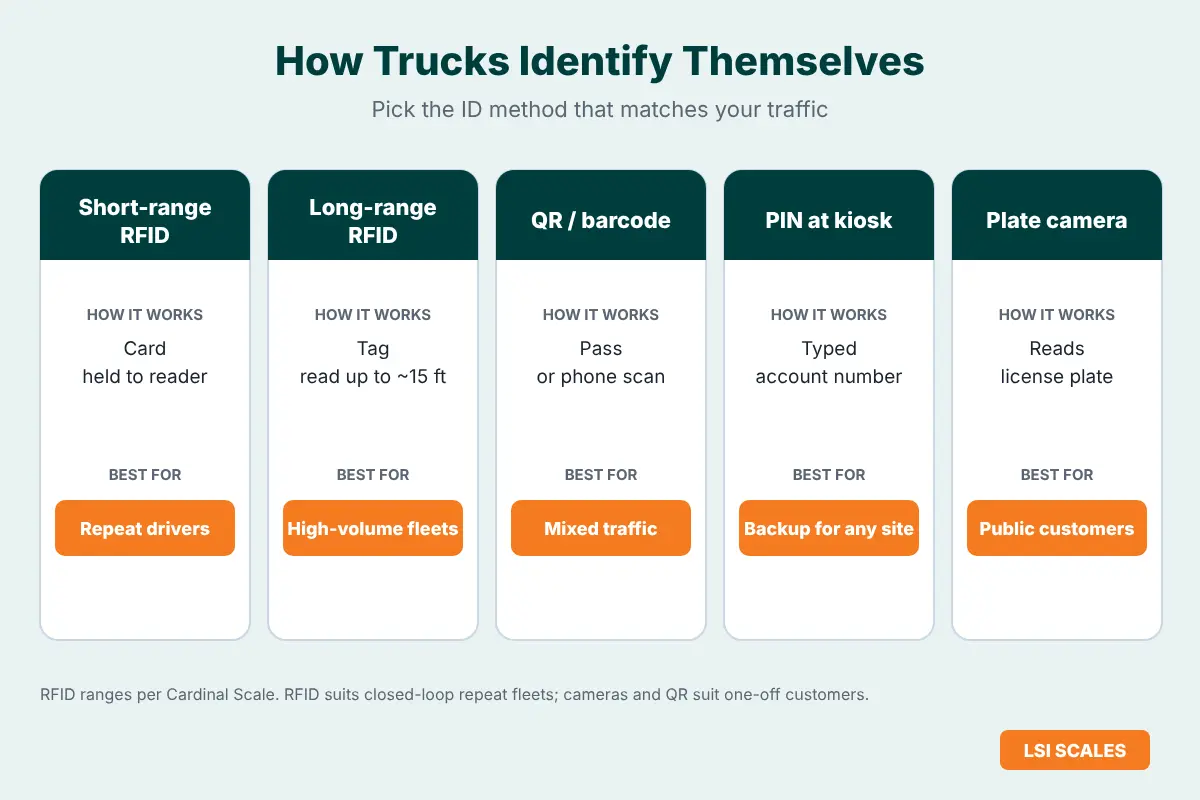
| Short-range RFID badge | Driver holds a card to the reader (about 3–5 in) | Repeat drivers, low budgets | Driver must reach the reader |
| Long-range RFID tag | Tag on the truck read from up to about 15 ft | High-volume repeat fleets | Costs more; each truck needs a tag |
| QR code / barcode | Driver scans a printed pass or phone screen | Mixed traffic, temporary customers | Passes get lost or shared |
| PIN at kiosk | Driver types an account number | Low-tech backup for any site | Slower; typing errors |
| License-plate camera (LPR) | Camera reads the plate | Public customers, no tags needed | Dirty or missing plates; lighting |
RFID read ranges from Cardinal Scale. Cardinal notes RFID is most valuable for closed-loop, repeat fleets and less useful for one-off public weighments.
Traffic Lights, Positioning and Cameras
These are the cheapest parts of the system and the ones that prevent the most problems. A red light that won’t turn green until the truck is fully on the deck stops short-weighing. A photo with every ticket ends most “that wasn’t my truck” disputes.
Ticketing Software and ERP Links
Software is where the savings really show up. Every transaction goes straight into your customer records, so nobody re-keys tickets at the end of the day. Ask any vendor how the software connects to your accounting system, and who supports it when it breaks.
Legal-for-Trade and Weighmaster Rules in California
This is the section the brochures leave out, and it should come first in your planning.
In California, anyone who weighs a commodity and issues a weight statement used to buy, sell or charge for it is a weighmaster and needs a license (B&P Code §§12700 and 12703). When payment depends on the weight, the weighmaster must issue a weighmaster certificate (§12711), and the certificate must carry the signature of the weighmaster who determined the weight (§12715(c)). An electronically imprinted name can replace a handwritten signature (CDFA weighmaster law extract).
What §12737 Allows
Since January 1, 2020, B&P Code §12737 has let a weighmaster use an unattended weighing system for vehicles carrying construction materials, including earth, stone, rock, sand, gravel, limestone, ready-mixed concrete, cementitious and recycled construction materials, and asphalt paving materials (§12737). The key conditions:
- Certificates go to buyers who opt to use the unattended system.
- The system must follow the CDFA Secretary’s regulations or policies.
- The principal weighmaster’s name and the system’s unique ID number must be imprinted on each certificate.
- Existing weighing and ticketing systems aren’t affected.
| Your situation in California | Fully unattended certificates? | What to plan for |
|---|---|---|
| Quarry, sand and gravel, ready-mix, asphalt plant | Yes, under §12737 | Weighmaster license, system ID on certificates, CDFA policies |
| Recycled construction materials | Yes, under §12737 | Same as above |
| Scrap metal, recycling, landfill tipping fees | Not covered by §12737 | A licensed weighmaster or deputy responsible for each certificate; automate data capture around them |
| Agriculture, feed and grain sales | Not covered by §12737 | Same; confirm with CDFA DMS or your county sealer |
| Weighing your own trucks (no sale based on weight) | No certificate needed | Automation is purely an efficiency decision |
This table is a planning guide, not legal advice. Always check with the CDFA Division of Measurement Standards or your county sealer before you buy.
The Scale Itself Still Has to Be Legal
Automation doesn’t change the scale rules. The weighing device must be approved, tested and sealed (§12717), and the indicator and any device that prints a weight must be NTEP-approved for legal-for-trade use. Other states treat unattended scales with extra care too. Idaho’s weights and measures office, for example, has required unattended scales to hold a continuous zero, let the driver get a ticket before leaving, and print “WEIGHT DETERMINED ON AN UNATTENDED SCALE” on each ticket (Idaho W&M).
Is It Worth It? A Decision Framework
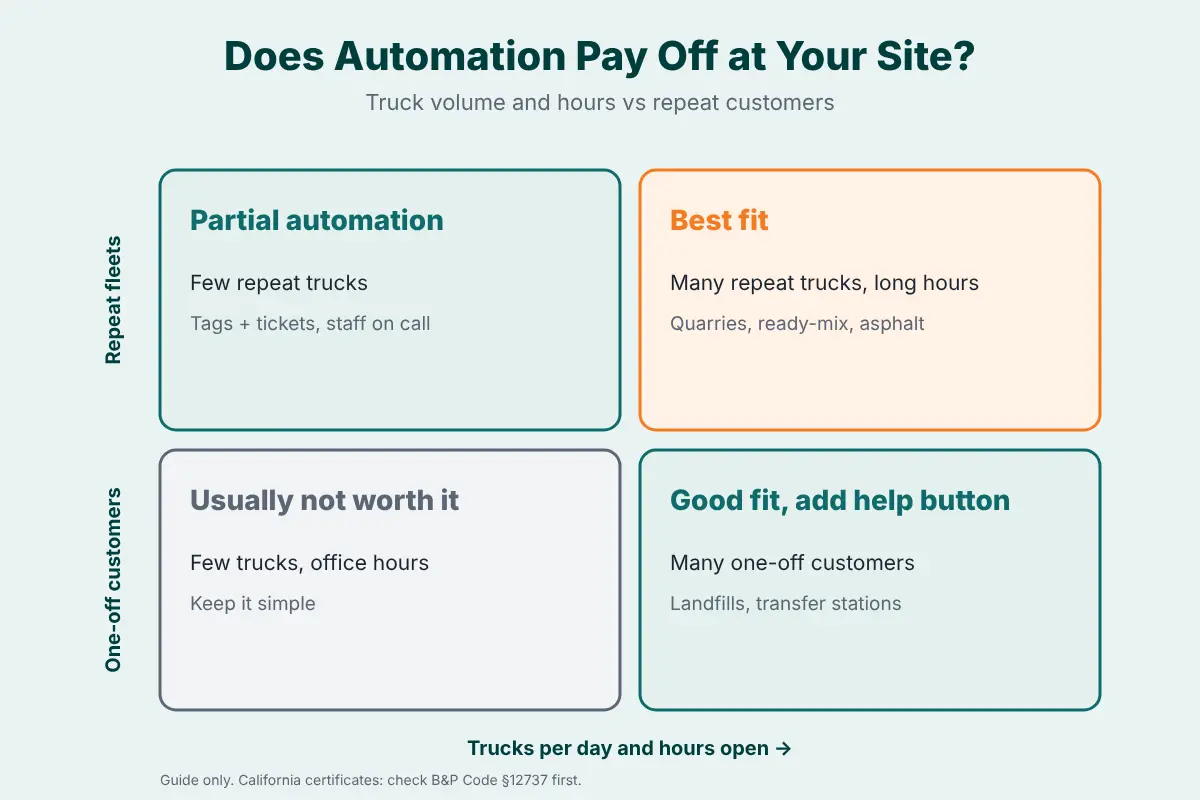
Three questions decide most cases.
Trucks per Day and Operating Hours
Automation saves the most where a person currently sits in the scale house for long hours keying in tickets. Sites open early, late or on weekends, or running more than one shift, see the biggest gains. A site weighing a handful of trucks during office hours often doesn’t need it.
Repeat Fleets vs One-Off Customers
Repeat customers with tagged trucks and stored tares get the fastest transactions. Sites serving the public need QR codes, PINs or plate cameras, plus a help button, because every new driver is a first-timer.
A Simple Payback Worksheet
Use your own numbers. The example column is there to show the math, not to quote a price.
| Input | Your site | Example inputs (illustrative) |
|---|---|---|
| Scale-house hours freed per day | 10 | |
| Loaded labor cost per hour | $35 | |
| Operating days per year | 300 | |
| Annual labor freed (hours × rate × days) | $105,000 | |
| Other yearly savings (overtime, paper, errors, disputes) | Add your own | |
| Total system cost (hardware, software, install, training) | Your quote | Your quote |
| Payback in years (cost ÷ annual savings) | Quote ÷ $105,000 |
Most sites don’t remove a person entirely; they move scale-house staff to sales, dispatch or yard work. Count only the hours you’ll actually stop paying for, or reassign to work that earns money.
Retrofit Your Existing Scale or Buy New?
Most automation projects start with the scale you already have. A retrofit adds the kiosk, ID readers, lights, sensors and software around your existing deck and indicator. It makes sense when:
- The scale passes calibration and has no structural problems.
- The indicator is NTEP-approved and can talk to modern software.
- The site has room for a kiosk at cab height on both sides, if trucks weigh in and out.
Buy new, or replace the deck first, if the scale is near the end of its life, keeps failing calibration, or is too short for your trucks. Automating an unreliable scale just means it fails with nobody watching. Our truck scale installation team can assess both options on site.
Industry Use Cases
Quarries, Sand and Gravel, Ready-Mix and Asphalt
This is where unattended weighing fits best in California. The material is covered by §12737, the same contractors’ trucks come back all day, and early starts are normal. Long-range RFID tags plus stored tares let repeat trucks weigh without the driver leaving the cab.
Landfills and Transfer Stations
High volumes and long hours make automation attractive, but tipping fees are charged on weight, and §12737 doesn’t cover refuse. Most sites automate truck ID, lights, cameras and tickets for their commercial haulers while keeping a licensed weighmaster responsible for certificates. See our waste management scales.
Scrap and Recycling Yards
Public sellers, cash payments and fraud risk make photos and a firm audit trail essential. Plate cameras and CCTV with each ticket help, but staff usually stay involved. See scrap and recycling scales.
Agriculture, Feed and Grain
Harvest brings huge peaks of repeat trucks over a few weeks. Kiosks and RFID can shorten lines at packing houses and grain receivers, with a weighmaster responsible for certificates. See agricultural farm scales.
Real-World Example: KapStone Paper Mill
KapStone Paper and Packaging’s mill in Roanoke Rapids, North Carolina, runs 24/7 and receives wood chips and round wood from many vendors across two truck scales. It used to need an attendant for every truck. Cross Engineered Solutions added loop detectors, stoplights, remote displays, two self-service kiosks with scanners and two printer kiosks, integrated with the existing Rice Lake indicators and ticketing software (case study).
The results reported:
- About 500 overtime hours saved per year (estimate)
- A chip truck completes weigh-in, dumping and weigh-out in about 15 minutes
- 24/7 delivery hours for suppliers
- An automatic, impartial record of every transaction, which reduces fraud risk
One detail worth copying: inbound round-wood trucks still see an attendant for quality checks. Good projects automate the routine work and keep people where judgment is needed.
Keeping an Unattended Scale Accurate and Online
With nobody in the scale house, problems can run for hours before anyone notices. Build these into the plan from day one:
- Calibration on a fixed schedule. Book commercial truck scale calibration with certified test weights, and after any repair or major change in traffic.
- Preventive maintenance. Clean under the deck, check load cells, cables and junction boxes, and test the kiosk, readers and lights. See our preventive maintenance plans.
- Surge and lightning protection. Kiosks and readers add more electronics to protect.
- Heat and dust. Central Valley summers and Arizona sun are hard on screens and printers; choose outdoor-rated hardware with shade.
- Alerts. Set the software to flag a zero that won’t settle, a reader that stops reading, or a printer that’s out of paper.
- A plan for downtime. Know who to call for emergency truck scale repair, and how to run tickets manually until it’s fixed.
If your fleet is adding electric trucks, store their own tares too; we explain why in our guide to electric truck weight limits.
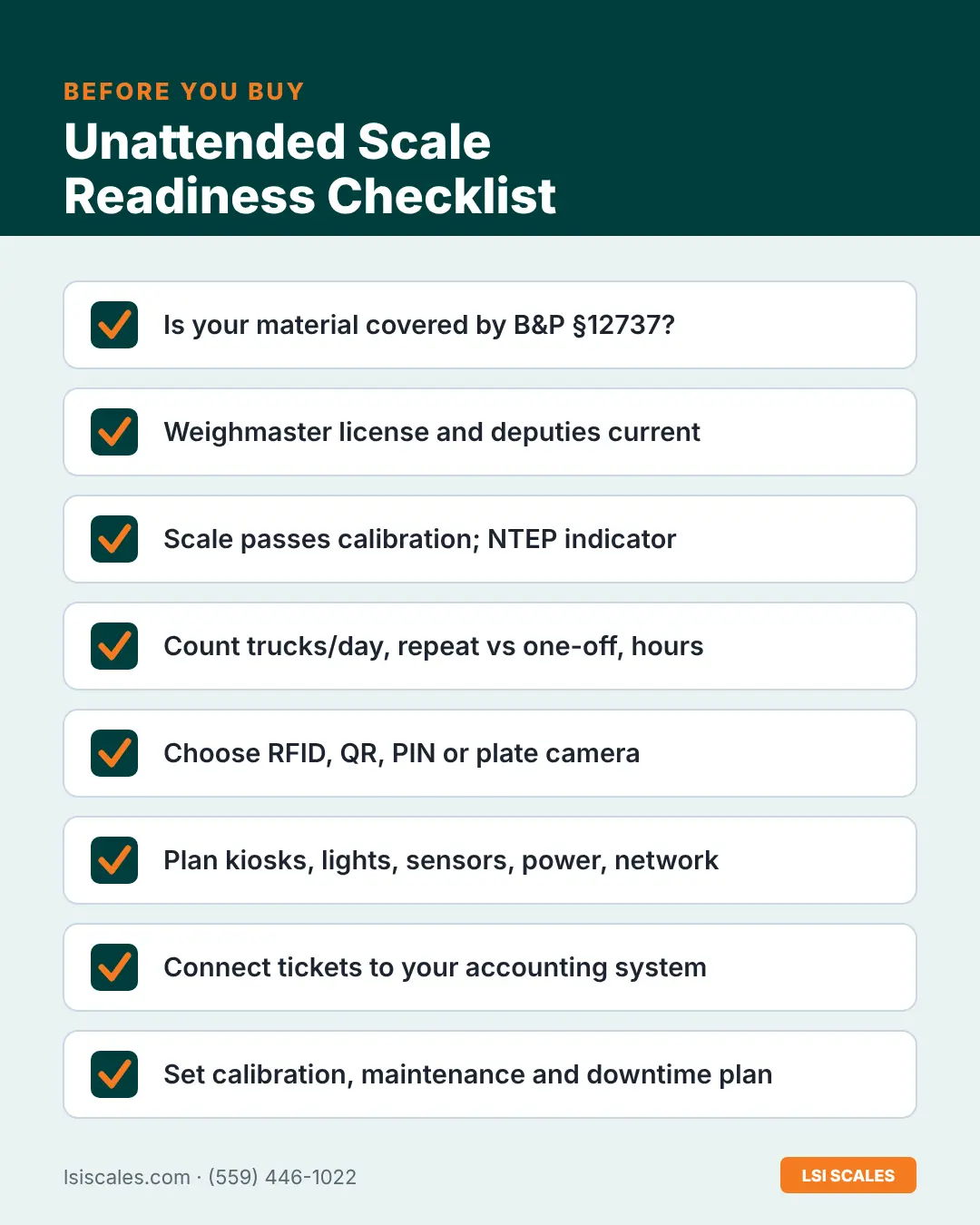
Before You Buy: A Readiness Checklist
- ✅ Confirm whether your material is covered by B&P Code §12737
- ✅ Check your weighmaster license and deputies are current
- ✅ Make sure the scale passes calibration and the indicator is NTEP-approved
- ✅ Count trucks per day, repeat vs one-off, and hours open
- ✅ Pick an ID method: RFID, QR, PIN or plate camera
- ✅ Plan kiosk positions, lights, sensors, power and network
- ✅ Decide how tickets and data reach your accounting system
- ✅ Set up calibration, maintenance and a downtime plan
Frequently Asked Questions
What is an unattended truck scale system?
A truck scale set up so drivers can weigh in and out without an operator, using a kiosk or ID tags, traffic lights, position sensors and ticketing software.
Is an unattended truck scale legal in California?
The scale must be approved, tested and sealed like any commercial scale. For weighmaster certificates, B&P Code §12737 allows unattended systems for construction materials such as rock, sand, gravel, ready-mix and asphalt.
Do I still need a licensed weighmaster?
Yes, for any sale based on weight. Under §12737 the principal weighmaster’s name and the system ID print on each certificate. For other commodities, plan on a weighmaster or deputy being responsible for each certificate.
RFID or license-plate cameras: which is better?
RFID is faster and more reliable for repeat fleets. Plate cameras and QR codes suit sites with many one-off or public customers.
Can I automate my existing truck scale?
Usually yes, if the scale is accurate, structurally sound and has an indicator that works with modern software.
How long does an unattended system take to pay back?
It depends on hours freed, labor cost and system price. Divide the total system cost by your annual savings; sites with long hours and steady repeat traffic pay back fastest.
Does an unattended scale need more maintenance?
It needs the same scale maintenance plus checks on kiosks, readers, lights and printers, and faster response because nobody is watching it.
Plan Your Unattended Scale With LSI
Before you buy a kiosk, make sure the scale under it is right. LSI Scales can assess your site, check and calibrate your scale, install or replace the deck, and keep the whole system certified and running. We serve California and Arizona, 24/7.
Sources
- California B&P Code §12737, Unattended weighing systems
- CDFA Division of Measurement Standards, Weighmaster law extract, §§12700–12737
- Cross Engineered Solutions, KapStone Paper Mill case study
- Cardinal Scale, Contactless truck scale ticketing with RFID
- Mettler Toledo, Automate your truck scale
- Idaho Weights and Measures, Criteria for unattended vehicle scales