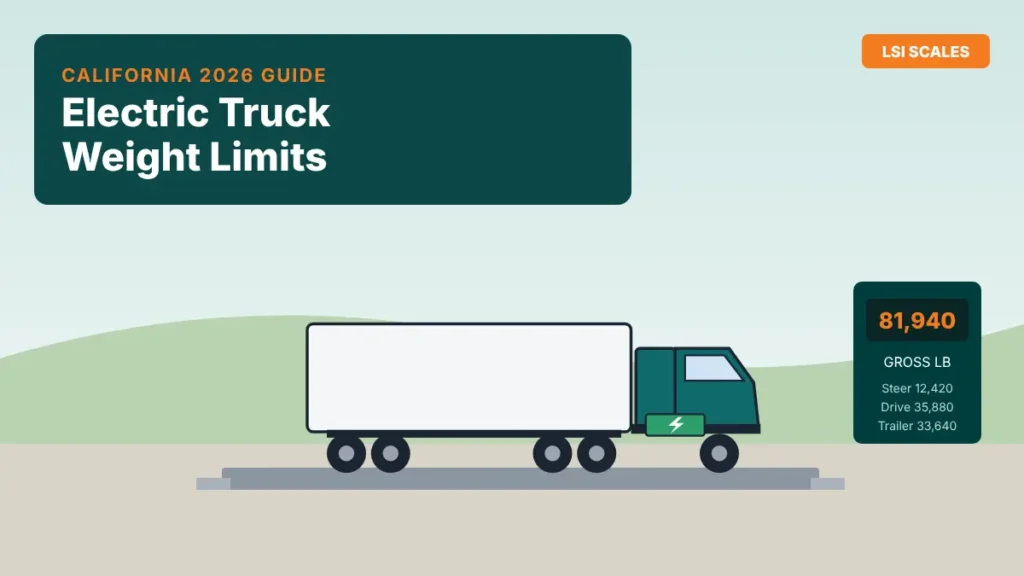
Quick answer: A battery-electric semi weighs roughly 5,000 to 7,000 lb more empty than a comparable diesel. To offset that, federal law and the California Vehicle Code let a zero-emission truck carry up to 2,000 lb extra on the power unit, with an 82,000 lb gross cap. The allowance doesn’t cover the whole battery penalty, and the extra weight lands on the tractor’s axles. Weigh EV trucks axle by axle on a certified truck scale, and re-tare them in your scale software.
The electric truck weight limit in California is one of the most misunderstood rules in trucking right now. Fleet managers hear “EVs get extra weight” and assume the problem is solved. It isn’t. The allowance is real, but it’s smaller than the battery, it only applies to the power unit, and it changes nothing about how much a single axle can carry.
The timing matters too. In September 2026, California finalized the repeal of the Advanced Clean Fleets rules that would have forced most private fleets to buy zero-emission trucks. Electric trucks are now a business decision, not a mandate. That makes it more important, not less, to know exactly what an EV does to your payload, your axle loads and the truck scale at your gate.
We’ve installed, calibrated and repaired truck scales across California and Arizona for more than 50 years. This guide covers the rules, the real weights of today’s electric trucks, and the practical scale questions most articles skip.
Key Takeaways
- Battery-electric semis weigh about 5,300 to 7,100 lb more than comparable diesels, depending on the study and battery size.
- Federal law (since February 2019) and CVC 35551(f) allow up to 2,000 lb extra on an electric power unit, with an 82,000 lb gross maximum.
- The allowance applies to axle and bridge-formula limits too, but only to the power unit’s excess.
- Most EV weight problems show up as steer and drive axle overloads, not gross overloads.
- Your truck scale’s concentrated load capacity (CLC), not just its total capacity, decides whether it can handle heavier EV axles.
- Re-tare every EV in your scale software. A diesel tare on an electric truck can be off by thousands of pounds.
Table of Contents
Why Electric Trucks Are Heavier, and by How Much
An electric semi trades a diesel engine, transmission and fuel tanks for a battery pack and electric drive. The engine comes out, but the battery that replaces it is much heavier.
Researchers presenting at the HVTT18 heavy-vehicle symposium modeled an 800 kWh truck, similar in size to a Tesla Semi. The battery alone came to about 4,300 kg (9,480 lb). Add the motor and gearbox, subtract the removed diesel engine, and the net penalty was about 3,220 kg, or roughly 7,100 lb (HVTT18 paper). The same paper lists the reference truck’s unladen weight at 26,000 lb.
Other estimates are lower. Data from the UC Institute of Transportation Studies, cited by the PrePass Safety Alliance, puts a long-haul battery-electric truck at about 5,328 lb heavier than a comparable diesel (PrePass). Regional trucks with smaller packs land at the lower end.
Real Electric Truck Weights on the Market
Manufacturer spec sheets show how much the battery size matters. Here’s Freightliner’s eCascadia, one of the most common electric tractors in California because of state HVIP vouchers (eCascadia spec sheet):
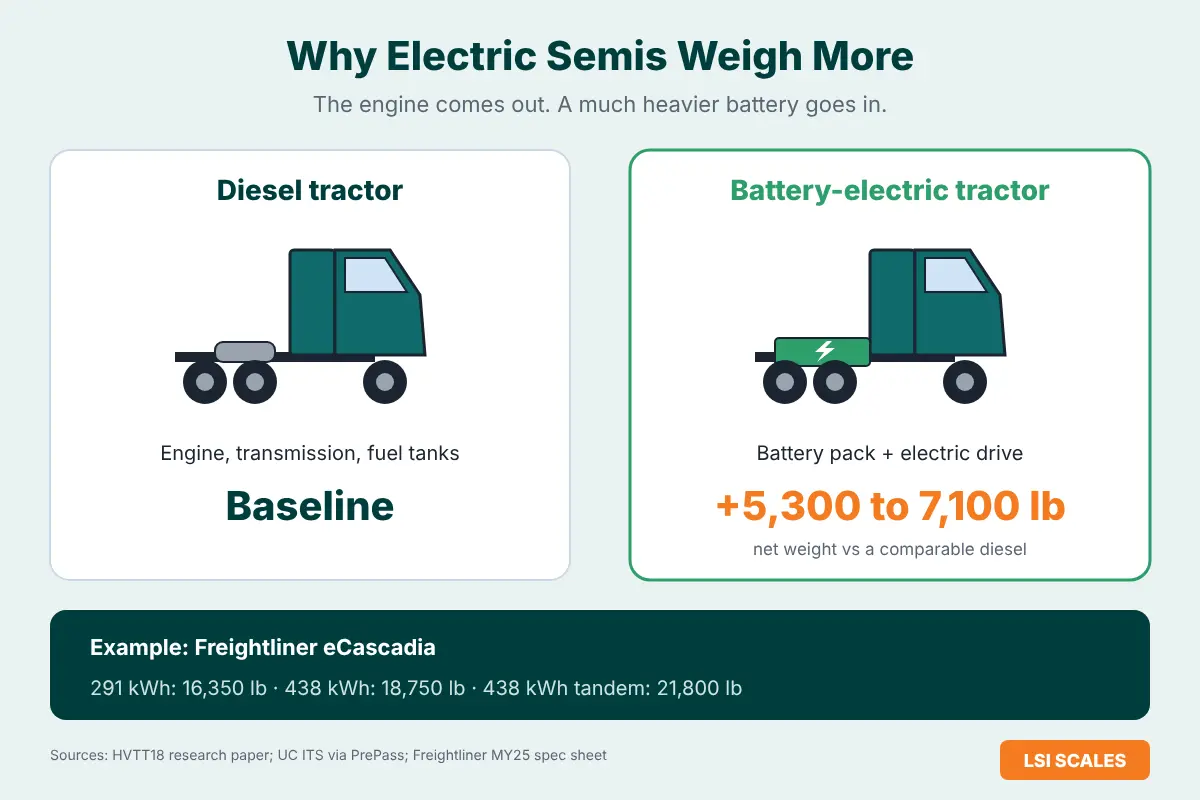
| eCascadia configuration | Listed weight | Usable battery | Typical range | Max GCW |
|---|---|---|---|---|
| Single drive (4×2) | 16,350 lb | 291 kWh | 155 miles | 65,000 lb |
| Single drive (4×2) | 18,750 lb | 438 kWh | 230 miles | 82,000 lb |
| Tandem drive (6×4) | 21,800 lb | 438 kWh | 220 miles | 82,000 lb |
Two things stand out. First, the same tractor gains 2,400 lb just by stepping up from the 291 kWh to the 438 kWh pack. Second, the bigger-battery versions are the ones rated to 82,000 lb, which is exactly where the weight allowance comes in.
Where the Extra Weight Sits
Battery packs mount on the tractor frame, between the steer axle and the drive axles. So nearly all of the added weight lands on the power unit, not on the trailer. That’s why the rules, and the overload risk, focus on the tractor’s axles.
California’s 2,000 lb Zero-Emission Weight Allowance
Two laws work together here.
Federal law. In February 2019, Section 422 of the Consolidated Appropriations Act amended 23 U.S.C. 127(s). A vehicle powered primarily by natural gas or electric battery power “may exceed the weight limit on the power unit by up to 2,000 pounds,” with a maximum gross vehicle weight of 82,000 lb (FHWA).
California law. CVC 35551(f), added by AB 2061 and in effect since January 1, 2019, says a near-zero-emission or zero-emission vehicle may exceed the weight limits on the power unit by up to 2,000 lb, “only to the extent expressly authorized by federal law” (Caltrans).
What the Allowance Covers, and What It Doesn’t
FHWA’s guidance adds the details fleet managers need:
- The extra 2,000 lb applies to single-axle, tandem-axle and Federal Bridge Formula limits, not just gross weight.
- It only covers excess weight on the power unit. The trailer’s axles get nothing extra.
- Gross weight can’t go over 82,000 lb.
- An idle-reduction or APU allowance of up to 550 lb can stack on top, for 2,550 lb in total.
- States must allow it on the Interstate and on roads with reasonable access to it.
Interstate vs State Routes
Because the California provision is tied to federal authorization, the clearest coverage is on Interstates and reasonable-access routes. If your EVs run local roads, county routes or bridges with posted limits, check the route before assuming the extra 2,000 lb applies. Posted bridge limits always win.
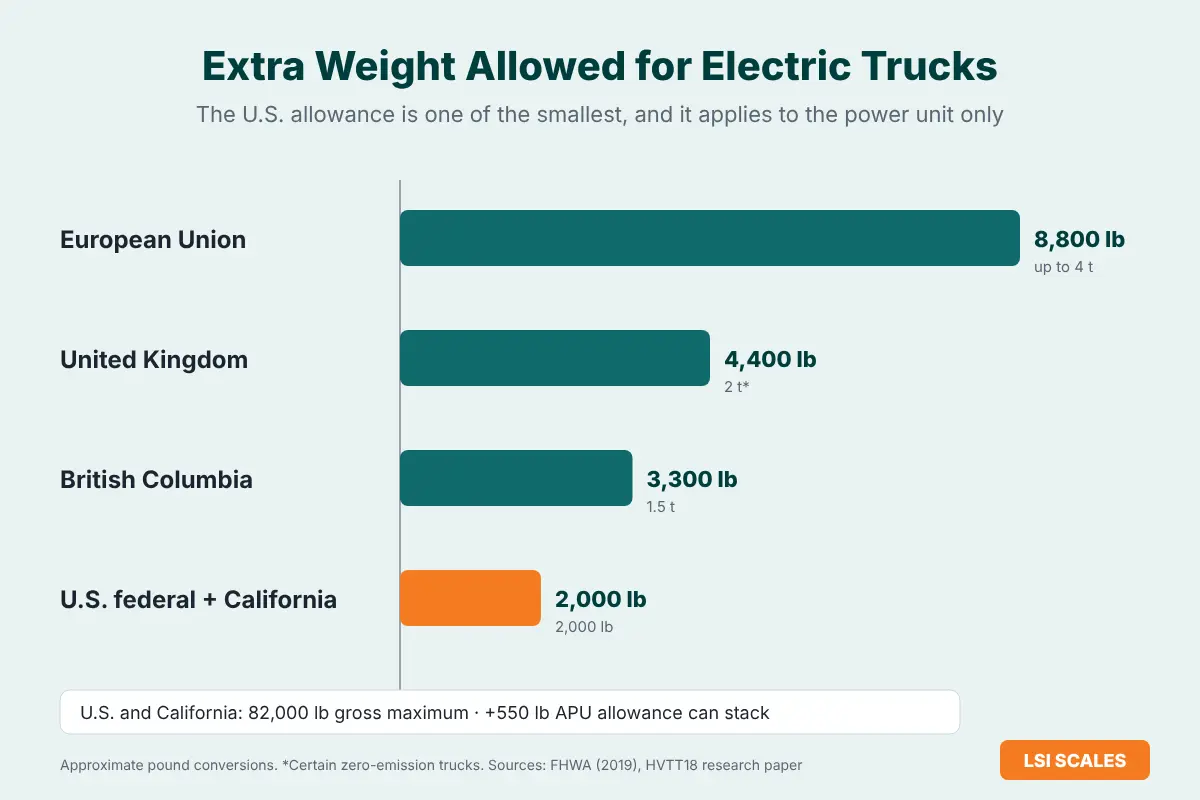
| Region | Extra weight allowed for electric trucks |
|---|---|
| United States (federal) and California | Up to 2,000 lb on the power unit; 82,000 lb gross maximum |
| British Columbia | 1.5 tonnes (about 3,300 lb) |
| United Kingdom | 2 tonnes (about 4,400 lb) for certain zero-emission trucks |
| European Union | Up to 4 tonnes (about 8,800 lb) |
| Australia | Axle-based: steer axle up to 8 t, drive axle up to 18.5 t |
Source: HVTT18 research paper, comparison of regulatory allowances. The U.S. allowance is one of the smallest, and it covers roughly a third of the battery penalty in the 7,100 lb scenario.
After the Advanced Clean Fleets Repeal: Where Electric Trucks Stand in 2026
If you stopped following California’s truck rules a year ago, a lot has changed.
- Advanced Clean Fleets (ACF), private fleets: CARB’s repeal of the High Priority and Drayage Fleet requirements took effect on September 10, 2026, after approval by the Office of Administrative Law (CCJ). These were the rules that would have required large fleets and port drayage trucks to move to zero-emission vehicles on a schedule.
- ACF, state and local government fleets: Still enforced in a scaled-back form. CARB proposed revisions in June 2026 that would extend zero-emission requirements to private contractors serving public agency fleets (Alston & Bird, June 2026).
- Advanced Clean Trucks (ACT): Congress rescinded the federal waiver in May 2025. California and 10 other states are challenging that in court, and CARB says it reserves the right to enforce the program. Its status is unsettled.
What this means for fleets: nobody in the private sector is being forced to buy an electric truck this year. But electric trucks are still being bought, especially for drayage, regional delivery, refuse and public-agency contracts, and state HVIP vouchers still bring the price down. Some of those trucks will cross your scale, whether they’re yours or a customer’s.
The Axle Problem: Steer and Drive Axle Overloads
Here’s the part that catches fleets out. A truck can be well under 82,000 lb gross and still be overweight on one axle.
California’s axle limits don’t change for electric trucks except for the power-unit allowance (Caltrans weight limitations):
- Single axle: 20,000 lb (CVC 35550(a))
- Tandem axle: 34,000 lb (CVC 35551(a))
- Steer axle: 12,500 lb under the alternate rules (CVC 35551.5(b)), or the tire manufacturer’s load rating under the general rule
- Wheel load: 10,500 lb, or 620 lb per inch of tire width, whichever is lower
The 2,000 lb allowance can stretch the power unit’s axle limits, but it can’t stretch a tire’s load rating or an axle’s manufacturer rating. On the eCascadia spec sheet, front axle ratings are listed at 12,500 to 13,300 lb, depending on configuration. Battery weight mounted ahead of the drive axles pushes more load onto the steer axle than a diesel driver is used to.
The HVTT18 study made the same point: its model looked only at gross weight and flagged axle loads, especially where the battery sits, as the critical open question.
How Overloads Happen in Practice
These are the patterns to watch for when electric tractors join a fleet:
- Same loading habits, new tractor. Loaders keep placing freight the way they did for diesels. The kingpin load, plus the battery, overloads the drive tandem.
- Fifth wheel set for a diesel. Sliding the fifth wheel shifts weight between steer and drive axles. A position that worked on a diesel may overload the steer axle on an EV.
- Old tare on file. The scale software subtracts a diesel tare, so the net looks fine while the truck is actually heavy.
- Mixed fleets, one loading chart. Diesel and electric tractors pulling the same trailers need different load plans.
Payload Math: What the 2,000 lb Allowance Really Gives Back
The allowance helps, but it doesn’t fully close the gap. Here’s an illustrative example. We’ve assumed a 33,000 lb empty weight for a typical diesel tractor-trailer; your real numbers will differ, so weigh your own rigs.
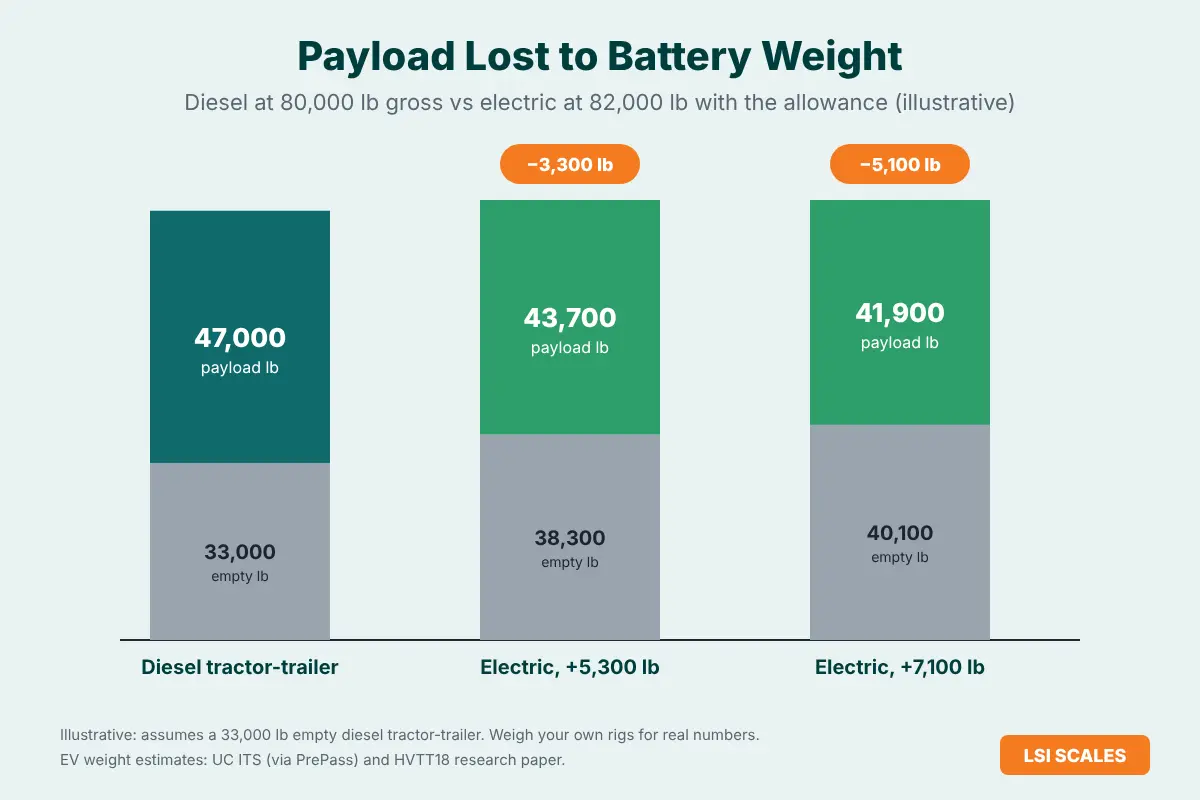
| Scenario (illustrative) | Empty weight | Legal gross | Payload | Change vs diesel |
|---|---|---|---|---|
| Diesel tractor-trailer | 33,000 lb | 80,000 lb | 47,000 lb | — |
| Electric, +5,300 lb (UC ITS estimate) | 38,300 lb | 82,000 lb | 43,700 lb | −3,300 lb |
| Electric, +7,100 lb (HVTT18, 800 kWh) | 40,100 lb | 82,000 lb | 41,900 lb | −5,100 lb |
For dense loads that always “weigh out” before they “cube out” (aggregate, grain, scrap, liquid bulk), that lost payload means more trips for the same tonnage. For light, bulky freight it may not matter at all. Either way, you can only plan around it if you know your real empty and loaded weights, axle by axle.
What Electric Trucks Mean for Your Truck Scale
Most scale owners ask one question: “Is my scale big enough for electric trucks?” The honest answer is that total capacity is rarely the issue. Gross weights are still capped at 82,000 lb on public roads. What changes is how that weight is spread across the deck, and how your software handles it.
Capacity vs Concentrated Load Capacity (CLC)
Every NTEP-approved vehicle scale has two ratings that matter:
- Nominal capacity: the most the whole scale can weigh at once.
- Concentrated load capacity (CLC): the most a single axle or axle group can put on one section of the scale. On older scales, this was called section capacity.
NIST Handbook 44 ties a vehicle scale’s maximum allowable loading to its CLC and the vehicle’s axle configuration (Table UR.3.2.1). Heavier, closely spaced axles put more stress on a single section (NIST technical note). Your scale’s CLC is on its ID plate and its NTEP Certificate of Conformance. If you weigh many heavy electric tractors, especially tandem-drive models over 21,000 lb empty, check that rating before you assume the scale is fine. We can read it for you during a service visit.
Platform Length and Axle Weighing
Electric tractors with tandem drives and long battery boxes can have longer wheelbases than the day cabs they replace. A 70 ft scale still fits a standard tractor-trailer, but if you also weigh individual axles for compliance, you need either a multi-section scale with axle readouts or a separate axle scale. For short-term needs, such as a pilot program with a few EVs, a portable truck scale rental gives you legal axle weights without new concrete.
Stored Tare and Software Updates
This is the quickest win and the most common mistake. Many sites use stored tare weights so trucks only weigh once. If an electric tractor gets a diesel tare, or a tare from a different battery configuration, every net weight it produces will be wrong.
- Weigh every new EV empty, at its normal state of charge, and store its own tare.
- Re-tare after any body, battery or equipment change.
- Label EV units clearly in the truck list so dispatchers don’t reuse an old ID.
Keep the Scale Calibrated
Heavier axles don’t hurt a well-built scale, but they make small errors cost more. A scale that reads 0.5% low on an 82,000 lb truck is off by 410 lb, enough to send a truck out overweight on one axle. Keep commercial truck scale calibration on schedule, and add a check after any major change in traffic. If you’re adding a new scale for an EV depot or yard, plan the foundation and capacity with our scale installation team. And with roadside screening expanding, see what California’s virtual weigh stations mean for overweight trucks.
Industry Scenarios
Port Drayage
Electric drayage trucks are still common around the ports of Los Angeles, Long Beach and Oakland, even after the ACF repeal. Containers are often heavy, and drivers can’t see how freight is loaded inside. Weighing before leaving the terminal area, with axle readouts, is the only way to catch an overloaded drive tandem.
Agriculture in the Central Valley
Short-haul ag routes suit electric trucks because they return to base each night. But harvest loads like tomatoes, almonds and silage are dense and variable. Growers and packing houses using agricultural farm scales should weigh EV loads on every trip during peak season.
Refuse and Public-Agency Contracts
Public fleets are still under California’s state and local government rules, and contractors may soon be too. Refuse trucks run heavy, stop often and are weighed at transfer stations every day. Sites with waste management scales should check CLC ratings and stored tares as electric collection trucks arrive.
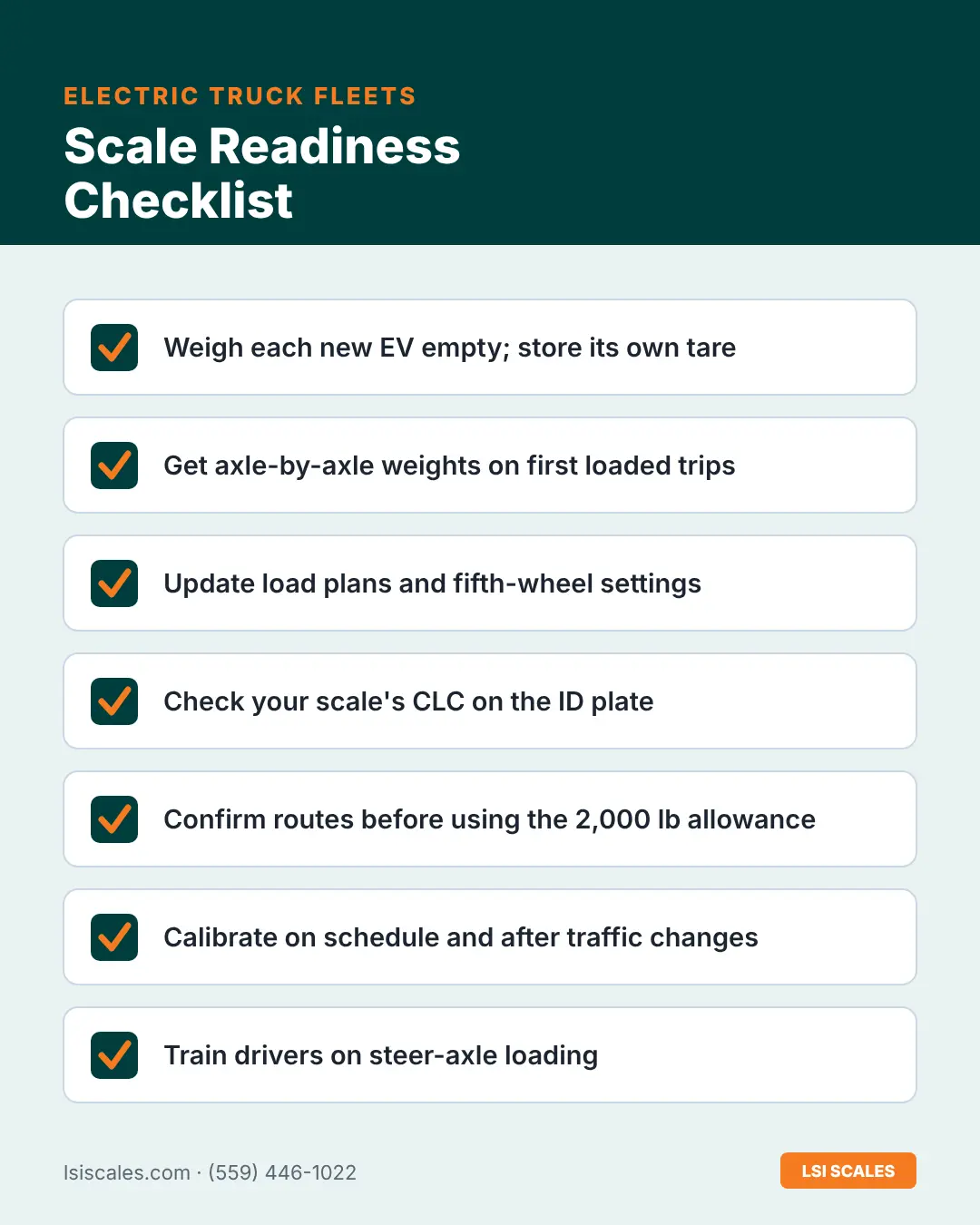
Fleet Checklist Before You Add Electric Trucks
- ✅ Weigh each new EV empty and store its own tare
- ✅ Get axle-by-axle weights on the first loaded trips
- ✅ Update load plans and fifth-wheel settings for EV tractors
- ✅ Check your scale’s CLC on the ID plate or NTEP certificate
- ✅ Confirm routes are Interstate or reasonable-access before counting on the 2,000 lb allowance
- ✅ Calibrate on schedule and after traffic changes
- ✅ Train drivers on steer-axle loading with battery weight
Frequently Asked Questions
Do electric trucks get a weight exemption in California?
Yes. Under federal law and CVC 35551(f), a zero-emission truck can carry up to 2,000 lb extra on the power unit, with a maximum gross weight of 82,000 lb.
How much heavier is an electric semi than a diesel?
Studies put it at roughly 5,300 to 7,100 lb heavier, depending on battery size. Freightliner lists its eCascadia at 16,350 to 21,800 lb, depending on battery and axle configuration.
Does the 2,000 lb allowance apply to axle limits?
Yes, FHWA says it applies to single-axle, tandem-axle and bridge-formula limits, but only for the excess weight on the power unit.
Can an electric truck exceed 82,000 lb?
No. 82,000 lb is the gross maximum under the allowance, unless the truck runs on a special permit.
Does my truck scale need more capacity for electric trucks?
Usually not for gross weight. Check the scale’s concentrated load capacity (CLC), which limits how much one axle group can put on a section.
Do I need to re-tare electric trucks?
Yes. Store a separate tare for every EV. Using a diesel tare can throw net weights off by thousands of pounds.
Are California fleets still required to buy electric trucks?
Private high-priority and drayage fleets are not, after the ACF repeal took effect in September 2026. State and local government fleets still have requirements.
Get Your Scale Ready for Electric Trucks
Electric trucks change where the weight sits, not just how much there is. LSI Scales can check your scale’s capacity and CLC, re-tare your fleet, calibrate with certified test weights and set up axle weighing. We serve fleets across California and Arizona, 24/7.
Sources
- FHWA, Consolidated Appropriations Act, 2019, Truck Size and Weight Provisions
- Caltrans, Near-Zero-Emission and Zero-Emission Vehicles
- Caltrans, Weight Limitations
- Freightliner, MY25 eCascadia spec sheet (California HVIP)
- Lasisi et al., HVTT18: Battery-electric truck weight and compliance
- PrePass Safety Alliance, The latest on electric trucks in California
- CCJ, California finalizes repeal of zero-emission truck rules, September 2026
- Alston & Bird, California clean vehicle rules update, June 2026
- NIST, Vehicle scale maximum loading and CLC