Quick answer: A virtual weigh station uses in-road weigh-in-motion sensors, cameras and LiDAR to screen trucks at highway speed, with no scale house. Caltrans is testing California virtual weigh stations from 2025 to 2027, starting at Cajon Pass on I-15. A screening hit doesn’t write the ticket; a certified static scale does. The safest move for any fleet is simple: know your axle and gross weights before the truck leaves your yard.
California virtual weigh stations are no longer a research idea. In May 2026, Caltrans published an update on its Virtual Weigh Station Pilot, a project running from July 2025 through December 2027 that is testing roadside sensors able to flag overweight trucks without pulling every rig into a scale house (Caltrans research note).
For fleet owners, that changes the math. Today, plenty of drivers count on a closed scale house or a bypass signal. As screening spreads to more roads and more hours, the trucks most likely to get pulled in are the ones nobody weighed before they left the yard.
We’ve spent more than 50 years installing, calibrating and repairing truck scales across California and Arizona. Here’s what this pilot actually is, what it can and can’t do, and how to protect your fleet before it scales up.
Key Takeaways
- Caltrans is testing virtual weigh stations from July 2025 to December 2027, starting at the I-15 Cajon Pass WIM site.
- Weigh-in-motion only screens trucks. A certified static scale sets the weight on any citation.
- NIST allows WIM screening errors of up to ±10% on gross weight and ±20% on a single axle.
- One overloaded axle can get a truck cited even when it is under 80,000 lb gross.
- Weighing every load on a certified on-site scale is the most reliable way to avoid pull-ins and fines.
Table of Contents
What Is a Virtual Weigh Station?
A virtual weigh station (VWS) is a set of sensors built into or beside a highway lane that weighs and photographs trucks as they drive past at normal speed. There’s no building and no officer on site all day. The system sends each truck’s weight, size and photo to enforcement officers in real time, and they decide which trucks to stop.
The core of every VWS is weigh-in-motion (WIM). WIM sensors sit in the pavement and estimate each axle’s load as the tire rolls over them. Cameras and license-plate readers tie that reading to a specific truck. Caltrans’ pilot is also testing LiDAR (to measure size), thermal cameras and tire-pressure sensors.
Weigh-in-Motion vs a Static Truck Scale
This is the part most articles skip. A WIM sensor and a certified truck scale are built for different jobs.
NIST Handbook 44, Section 2.25, the national code for weigh-in-motion screening systems, says these systems exist “for the purpose of screening and sorting” vehicles, to decide whether a truck needs a static weighment. The code still carries tentative status, and its Class A tolerances are wide: ±20% on a single axle, ±15% on an axle group, and ±10% on gross weight (NIST Handbook 44, Section 2.25).
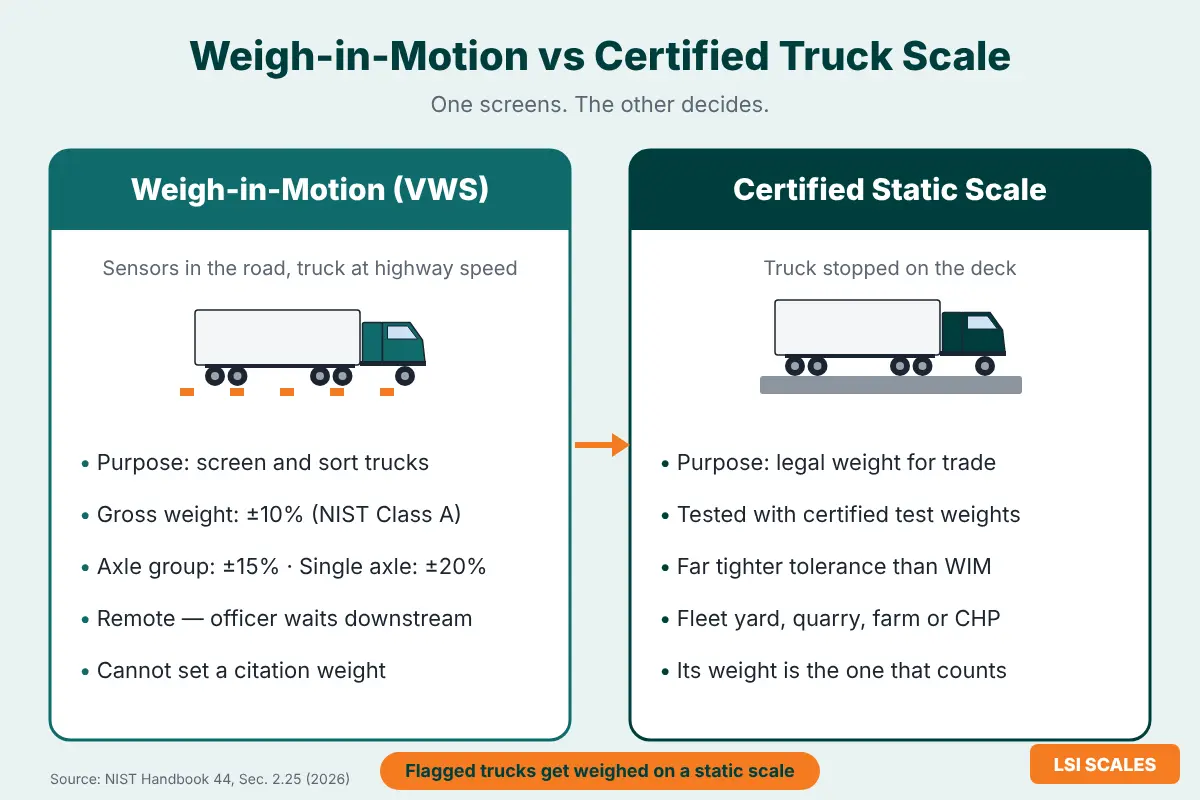
| Weigh-in-motion (VWS) | Certified static truck scale | |
|---|---|---|
| Purpose | Screen and sort trucks at speed | Legal weight for trade and enforcement |
| Truck speed | Highway speed | Stopped on the deck |
| Typical tolerance | Axle ±20%, axle group ±15%, gross ±10% (HB 44, Class A) | Far tighter; tested with certified test weights |
| Staffing | Remote; officer downstream | Scale operator or CHP at a station |
| Can it produce a citation weight? | No; it flags a truck for static weighing | Yes |
| Who uses it | Caltrans, CHP | Fleets, quarries, farms, CHP stations |
So a WIM reading is a reason to pull you in. The number that ends up on a citation comes from a static scale.
What the Sensors Measure
While the truck drives across, a VWS can capture:
- Axle loads, axle-group loads and gross weight
- Axle spacing (to check the axle-group weight chart)
- Speed, length, height and vehicle class
- A photo and plate read to identify the carrier
Caltrans’ 2025–2027 Virtual Weigh Station Pilot
Caltrans started the project because, in its own words, overweight trucks “exponentially accelerate the deterioration of pavement and bridges,” while traditional enforcement facilities are expensive and can’t be built everywhere. California already runs 54 Commercial Vehicle Enforcement Facilities and 76 smaller mini-sites, staffed by the CHP and maintained by Caltrans (Caltrans CVEF Inventory of Needs). That’s a lot of state, and a lot of road with no scale at all.
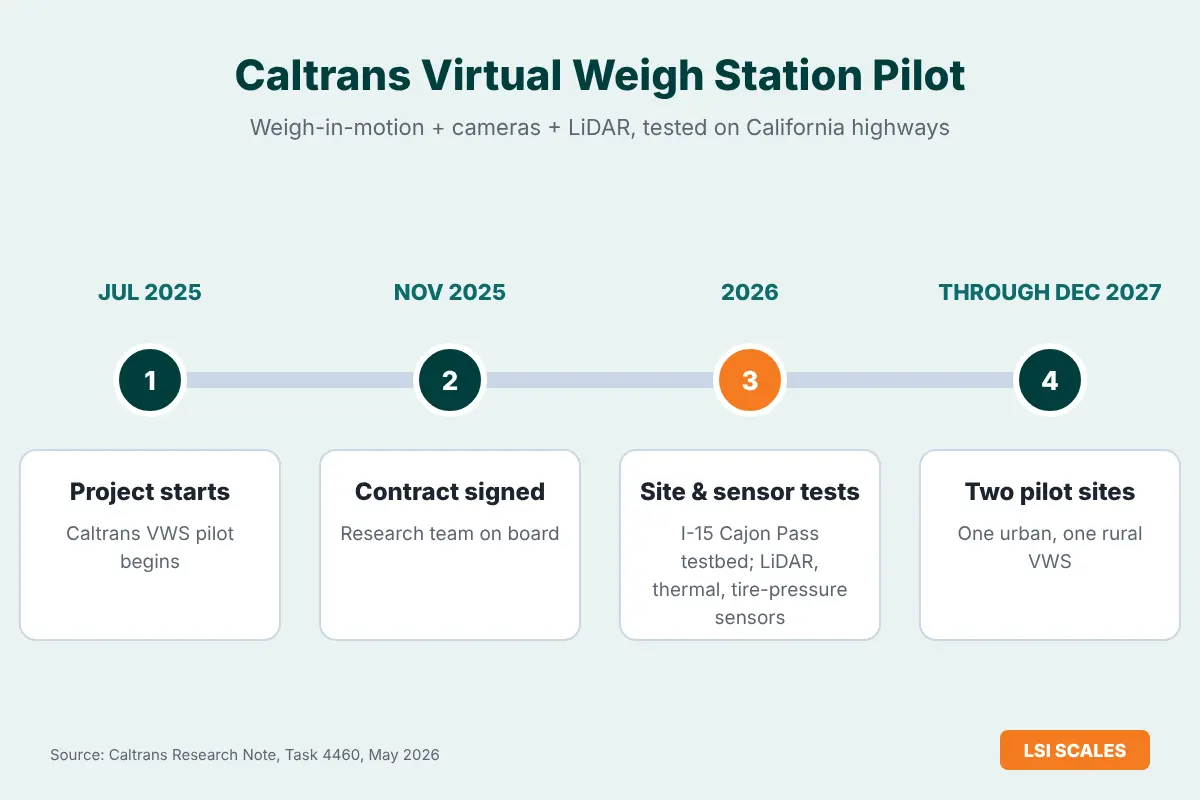
The pilot’s timeline so far:
- July 2025: Project start.
- November 2025: Research contract signed.
- 2026: Field evaluations of candidate sites; testing of thermal cameras, tire-pressure sensors, LiDAR and video.
- Through December 2027: Two pilot VWS sites, one urban and one rural, to compare performance in different traffic.
Why Cajon Pass on I-15 Came First
The research team recommended the new southbound Cajon Pass PrePass WIM site on Interstate 15 as the testbed. It’s one of the busiest freight corridors in the state, linking the Inland Empire’s warehouses with Nevada and the rest of the Southwest. If a fleet runs loads between Southern California and Las Vegas, this is the stretch to watch.
What Happens After the Pilot
The stated goal is a cost-effective system that gives law enforcement real-time weight, size and classification data, plus a database for road planning. Caltrans hasn’t announced a statewide rollout date. Other states have already moved, though: South Carolina’s State Transport Police now use WIM data streamed to officers’ tablets to target overweight trucks (Rekor, Oct 2025). Before, a typical roadside shift stopped nine trucks to find three or four overweight ones. With targeting, officers aim to stop only the trucks the data flags.
How Virtual Weigh Stations Work with PrePass and Drivewyze
California has used electronic weigh station bypass since 1994, and 36 stations use it today (Caltrans Weigh Station Bypass). Two providers run it:
- PrePass uses a transponder. Green light means bypass; red means pull in.
- Drivewyze PreClear works from a phone, tablet or ELD and shows “bypass” or “pull in.”
Both only let you bypass when your weight, size and safety record pass the screen. A virtual weigh station adds the same kind of screening to roads that have no station at all. Bypass rewards trucks that are consistently legal; it doesn’t protect a truck that is heavy today.
Can a Weigh-in-Motion Reading Get You an Overweight Ticket?
Not by itself. Under the current NIST code, WIM is a screening tool. When a VWS flags your truck, an officer stops it and weighs it on a certified static scale or a set of certified portable wheel-load scales. That second weighing is the one that counts.
Don’t read that as good news, though. Screening makes the stop far more likely to happen. Once the officer has you on a certified scale, the truck is either legal or it isn’t.
California Weight Limits at a Glance
These are the limits the static weighment is checked against (Caltrans weight limitations):
| Limit | Maximum | California Vehicle Code |
|---|---|---|
| Single axle | 20,000 lb | CVC 35550(a) |
| Tandem axle (outer axles under 8 ft 6 in apart) | 34,000 lb | CVC 35551(a) |
| Two tandem sets 36 ft or more apart | 34,000 lb each, 68,000 lb combined | CVC 35551(b) |
| Gross vehicle combination | 80,000 lb | CVC 35551 axle-group chart |
| Wheel load | 10,500 lb per wheel or wheel group; tire limit or 620 lb per inch of tire width, whichever is lower | CVC 35550 |
A truck can be under 80,000 lb gross and still get cited for one overloaded axle. That’s the most common surprise we hear about from customers. A shifted load, a full front tank or a pallet placed too far forward is enough. Our guide to California overweight fines covers what those citations cost.
What More Roadside Screening Means for California Fleets
Screening will catch the trucks that are overweight now and then, not just the ones that are always overloaded. Here’s where we expect the most pressure.
Agriculture and Harvest Loads on SR-99 and I-5
During harvest, trucks leave Central Valley fields loaded by eye. Wet tomatoes, almonds with hulls, or silage at different moisture levels change weight from load to load. A field scale or a scale at the packing house is the only reliable check. As an illustration: a grower running 40 loads a day in August with a 5% overweight rate would see two flagged trucks a day once screening reaches their route.
Aggregate, Scrap and Waste Haulers
Density is the problem here. A load of wet sand, mixed scrap or compacted refuse can look identical to a legal load and weigh thousands of pounds more. Quarries and recycling yards that already weigh outbound trucks on a certified on-site truck scale are in the best position.
Your Best Defense: Weigh Before You Roll
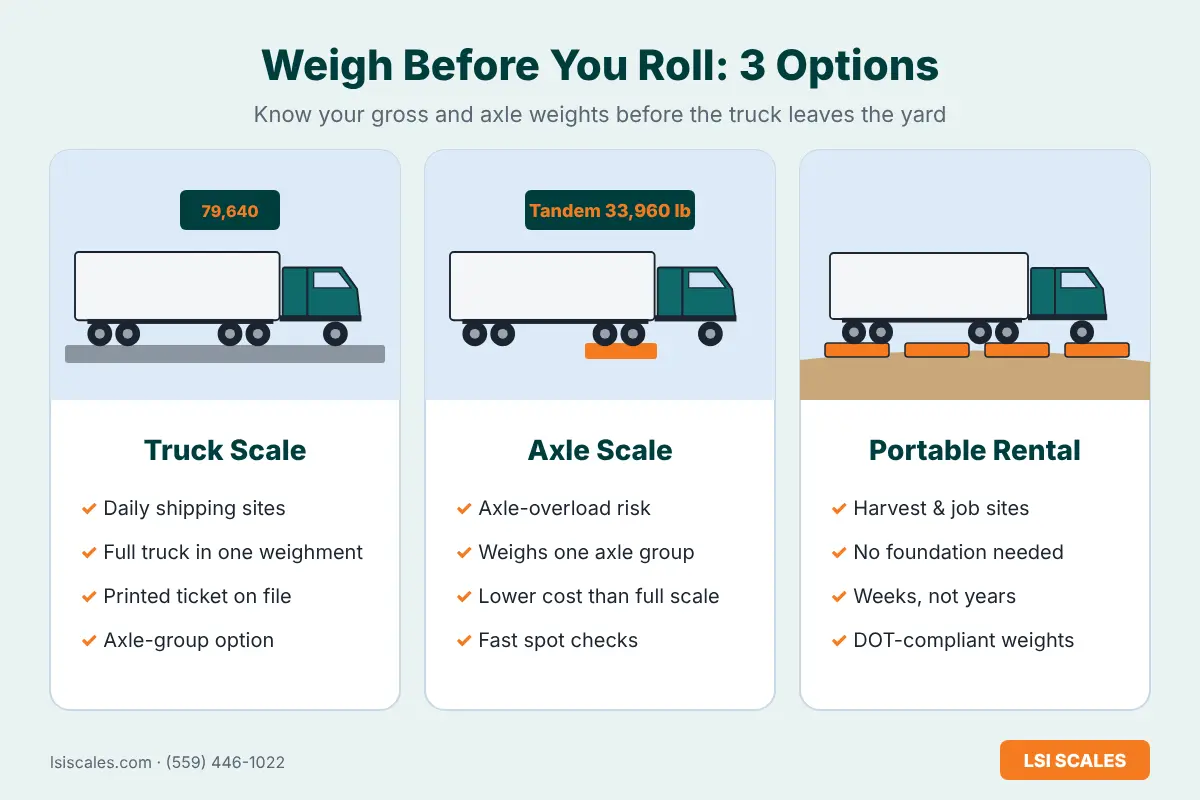
The fix is to know the number before the truck leaves the yard. You have three ways to do that.
On-Site Truck Scale, Axle Scale or Portable Rental
- Permanent truck scale: Best for sites that ship every day. It weighs the full truck at once and prints a ticket you can keep on file. Multi-platform or axle-capable systems also show axle-group weights.
- Axle scale: Weighs one axle or axle group at a time. Ideal when your main risk is axle overloads, and it costs less than a full truck scale.
- Portable truck scale rental: For harvest season, a construction job or a short-term project. You get legal weights for the weeks you need them, without pouring a foundation.
Keep Your Scale Accurate and Certified
An on-site scale only helps if it reads correctly. A scale that drifts 1% low can send out a truck that looks legal on your ticket and then fails at the CHP station. Build a calibration schedule around your traffic: see how often to calibrate, and book commercial truck scale calibration with NIST-traceable test weights. If your scale is down in peak season, emergency truck scale repair gets you weighing again.
2026 Compliance Checklist for California Fleets
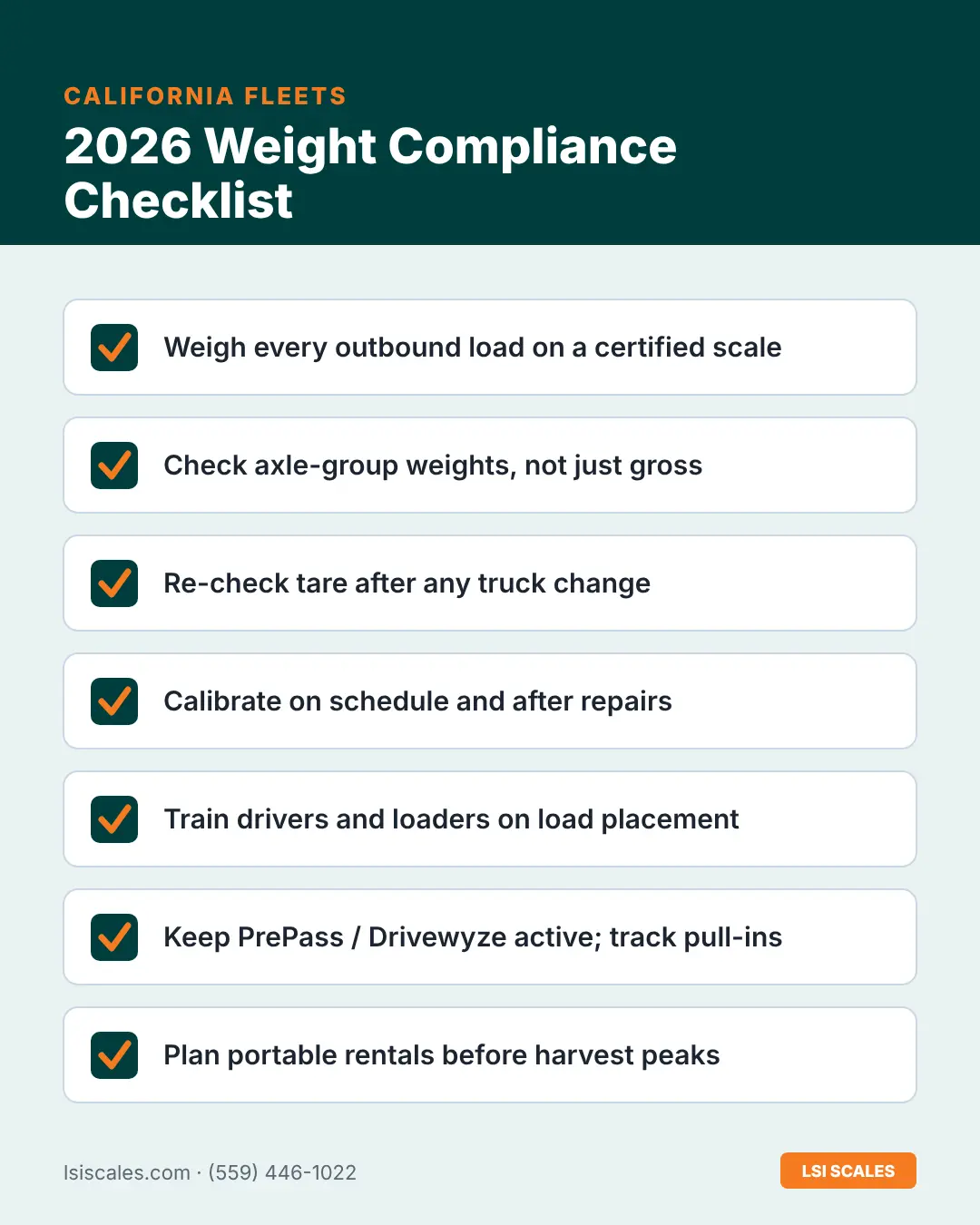
- ✅ Weigh every outbound load on a certified scale, and keep the ticket with the trip paperwork
- ✅ Check axle-group weights, not just gross
- ✅ Re-check tare weights after any change to the truck (new body, tanks, equipment)
- ✅ Calibrate on schedule and after any repair, lightning strike or flood
- ✅ Train drivers and loaders on load placement
- ✅ Keep PrePass or Drivewyze active, and track pull-in rates per truck
- ✅ Plan rental capacity before harvest or big project peaks
Frequently Asked Questions
What is a virtual weigh station?
A roadside system that uses weigh-in-motion sensors, cameras and other sensors to screen trucks at highway speed and send the data to enforcement officers, with no staffed scale house.
Where are virtual weigh stations in California?
Caltrans is piloting them from 2025 to 2027. The first recommended testbed is the southbound Cajon Pass PrePass WIM site on I-15, with one urban and one rural pilot site planned.
Can I get an overweight ticket from a weigh-in-motion reading?
Under NIST Handbook 44, WIM is for screening. A flagged truck is weighed on a certified static or portable scale, and that weight is used for any citation.
How accurate is weigh-in-motion?
The NIST Class A tolerances for WIM screening are ±20% per axle, ±15% per axle group and ±10% on gross weight, much wider than a certified truck scale.
Do I still need my own truck scale if I use PrePass?
Yes, if you ship loads daily. Bypass only works while your trucks keep passing screening. An on-site scale is how you make sure they do.
Can I rent a truck scale for harvest season?
Yes. LSI Scales rents DOT-compliant portable truck scales in California for short-term and seasonal use.
Talk to a Truck Scale Specialist
Virtual weigh stations will make overweight loads easier to catch. A certified scale at your gate makes them easier to prevent. Whether you need a new truck scale, an axle scale, a seasonal rental or a calibration check before harvest, our technicians serve fleets across California and Arizona, 24/7.
Sources
- Caltrans, Virtual Weigh Station Pilot System, Research Note Task 4460, May 2026
- NIST, Handbook 44 (2026), Section 2.25: Weigh-in-Motion Systems
- Caltrans, Weigh Station Bypass
- Caltrans, Weight Limitations, Legal Truck Access
- Caltrans, Commercial Vehicle Enforcement Facilities Inventory of Needs
- Rekor, South Carolina virtual weigh stations, October 2025