Quick answer: A pit truck scale sits down in a concrete-lined hole, so the deck is level with the ground and trucks drive straight on. A pitless (above-ground) truck scale sits on a concrete slab or piers, with a short ramp at each end. Both weigh just as accurately. Choose pitless if you have room for the ramps and want easier drainage, cleaning and service. Choose a pit if your site is too short for ramps, has a height limit, or you are reusing a pit that is still in good shape.
This guide is for site owners, plant managers and yard managers who need a new truck scale or are replacing an old one. We explain both foundations in plain language, show how they behave on real sites, and give you the questions to ask before you sign a quote. If you only have a minute, read the Key Takeaways and the site checklist.
Key Takeaways
- Accuracy is the same. A pit or pitless scale weighs equally well if the foundation is level and well built. The foundation choice is about your site, not about accuracy.
- Pitless needs room; pit needs drainage. Pitless scales need space for a ramp at each end. Pit scales need a drain or sump pump that works every time it rains.
- Cleaning is the hidden cost. Mud and debris under the deck are one of the most common causes of bad weights. Pitless scales are much easier to keep clean.
- Reusing a good foundation saves the most time and money, whether it is a pit or a slab.
- Think 20 years ahead. A truck scale is a long-term asset. Plan for the trucks and traffic you will have later, not just today.
Table of Contents
How Each Foundation Works (In Plain English)
Every truck scale has the same basic parts: a deck (also called the weighbridge) that the truck drives onto, load cells under the deck that measure the weight, cables and a junction box that collect the signals, and an indicator that shows the weight. The foundation is what holds all of this up. The only real difference between pit and pitless is where the deck sits.
Pit (in-ground) truck scale
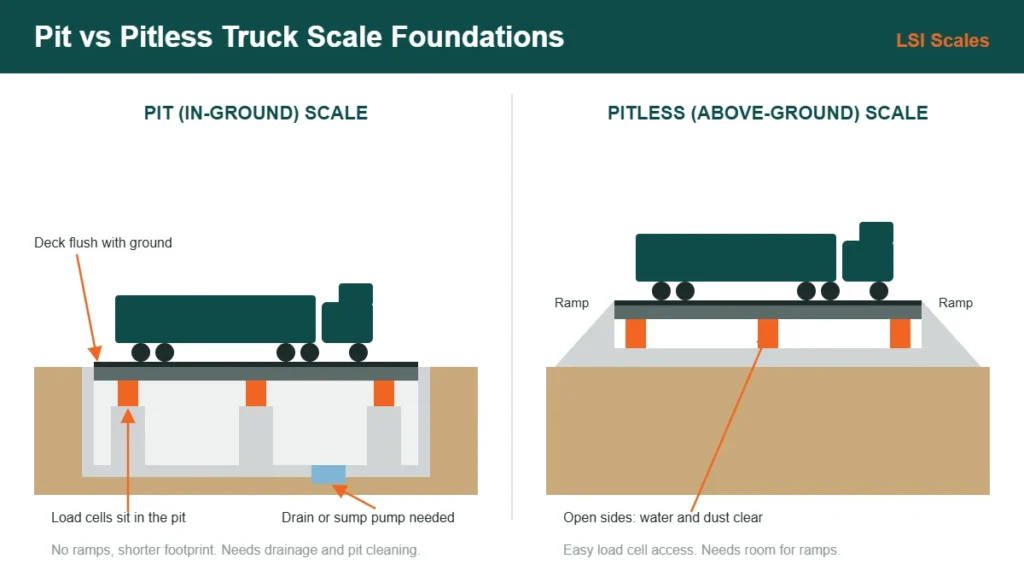
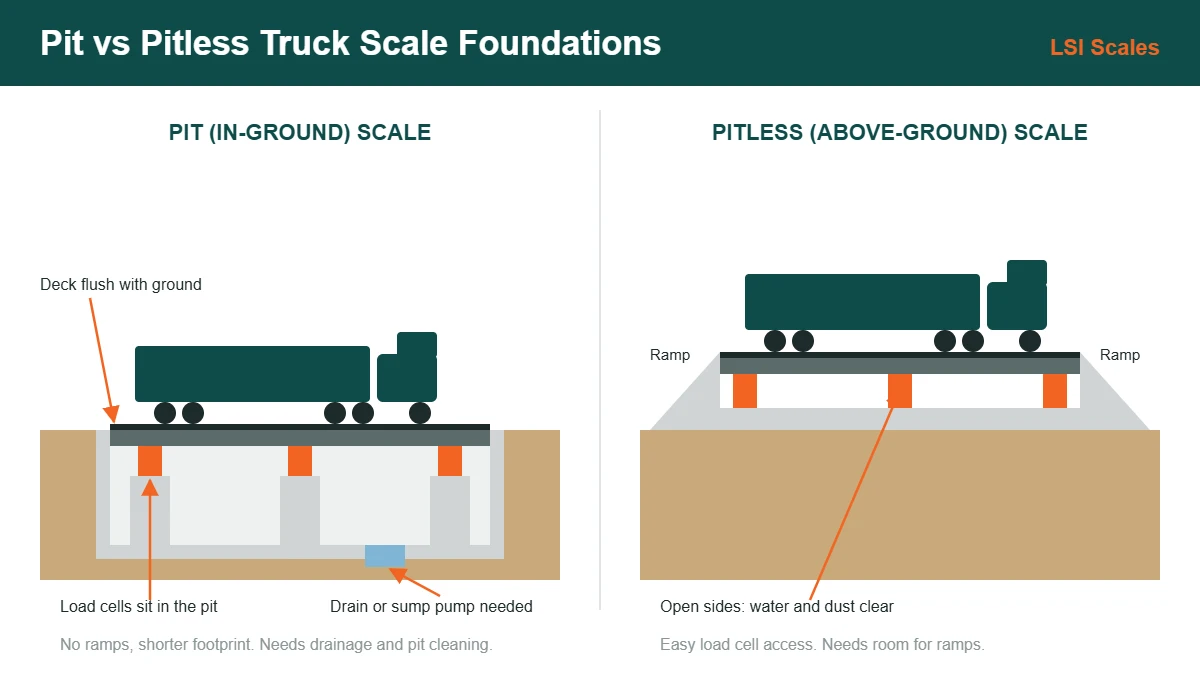
The scale sits in a hole lined with concrete walls and a concrete floor. The deck is level with the ground around it, and the load cells sit below it inside the pit. Trucks roll straight on and off with no slope. Pits were standard in the days of mechanical lever scales, because the levers needed room underground. Many older sites still have them.
Pitless (above-ground) truck scale
The scale sits on a concrete slab or a set of concrete piers at ground level. Because the deck is raised, each end has a short concrete ramp (called an approach) so trucks can drive up and off. Steel guide rails along the sides keep wheels on the deck. The sides are open, so you can see and reach the load cells, and water and dirt can flow out from underneath.
Pit vs Pitless at a Glance
| What you care about | Pit (in-ground) | Pitless (above-ground) |
|---|---|---|
| Space you need | Just the scale length | Scale length plus a ramp at each end |
| How trucks get on | Drive straight on, level with the ground | Drive up a short ramp |
| Rain and runoff | Needs a drain or sump pump that always works | Water drains out naturally |
| Keeping it clean | Dirt falls into the pit and must be dug or vacuumed out | Dirt is easier to see and clear from the sides |
| Reaching load cells | Technician works inside the pit | Technician works from the side |
| Concrete and digging | More: walls, floor and drainage | Less: slab or piers plus ramps |
| Edges | No drop-off at the sides | Guide rails stop wheels going over the edge |
| Best fit | Short sites, height limits, existing good pits | Most sites with room for ramps |
Both designs can be legal-for-trade. What makes a scale accurate is a level foundation, healthy load cells, a deck that moves freely and regular calibration.
Which One Fits Your Site? 4 Real-World Examples
Here are four common situations we see in California and Arizona, and the foundation that usually makes sense. Your site may be different, but these show how the decision really gets made.
Example 1: A farm or processing yard with plenty of open space
A Central Valley operation weighs trailers of produce or nuts during harvest. The yard is flat and open, trucks come in muddy, and the crew is busy. Usually pitless. There is room for ramps, mud can be hosed out from the sides, and nobody has to climb into a pit during the busiest weeks of the year.
Example 2: A tight recycling yard in town
The yard is boxed in by buildings and a street. There is no room for ramps at both ends without blocking traffic. Often a pit. The flush deck saves length. The key is a drainage plan that works, and a cleaning routine the crew will actually follow, because scrap and grit end up in the pit.
Example 3: Replacing a scale on an old pit that is still sound
A plant has a pit scale from decades ago. The weighbridge is worn out, but the pit walls are solid, level and dry. Usually reuse the pit. Setting a new deck on a good existing foundation is the fastest and lowest-cost way to get back to weighing, often in about a day on site. We check the pit first to make sure it fits the new scale.
Example 4: An Arizona aggregate yard with monsoon storms and dust
Heavy trucks, constant dust, and sudden monsoon storms that send water across the yard. Usually pitless, with careful grading so storm water runs away from the scale. A pit here can fill with water and silt after a single storm.
The Costs Nobody Puts in the Quote
Most people compare the price on day one. The bigger differences show up over the next 20 years. Before you decide, think about these ongoing costs:
| Ongoing cost | Pit scale | Pitless scale |
|---|---|---|
| Cleaning labour | Regular pit clean-outs; more time and effort | Quicker cleaning from the sides |
| Water removal | Sump pump to power, check and replace, or a drain to keep clear | Usually none beyond good site grading |
| Service visits | Technicians work inside the pit, which takes longer and needs safe access | Load cells reached from the side |
| Storm damage risk | Flooded pit can soak load cells and junction boxes | Lower, if the site is graded to drain away |
| Ramp upkeep | None | Ramps and approaches may need repair if they settle |
None of these make a pit a bad choice. They just need to be planned for, so you are not surprised later. For full price ranges, see our truck scale cost guide.
How Long Each Option Takes
Time without a working scale often costs more than the concrete. These are typical timelines from our own projects:
- New scale on a sound existing foundation (pit or pitless): typically about a day on site.
- New steel-deck scale on a new above-ground foundation: about a week of work, plus time for the concrete to cure before the scale is set.
- New pit: extra time for digging, forming the walls and floor, and the drainage.
- Concrete-deck scales: add the deck’s own cure time, so plan for roughly three weeks or more.
If you can’t stop weighing, ask about a portable truck scale rental to keep trucks moving while the work is done.
Drainage: The Make-or-Break Detail
A truck scale only weighs correctly when the deck “floats” freely on its load cells. Anything that touches or pushes against the deck, like packed mud, gravel, ice or standing water, can change the reading. That is why drainage matters so much.
Warning signs of a drainage problem
- Water still standing in the pit or around the scale a day after rain
- Mud lines or silt on the load cells or junction box
- Weights that drift after storms, or zero that won’t hold
- A sump pump that runs constantly, or never seems to run
- Rust or corrosion on cables, load cell mounts or the underside of the deck
If you see any of these, get the scale checked before it fails an inspection. Our guide to why a truck scale stops weighing correctly explains the most common causes.
Simple Maintenance Schedule
Use this as a starting point and adjust it for your traffic and weather.
| How often | Pit scale | Pitless scale |
|---|---|---|
| Every week | Look into the pit for water and debris; clear build-up near the deck edges | Walk around the scale; clear debris from under the deck edges |
| Every month | Clean out the pit; test the sump pump or check the drain | Clean under the deck; check ramps and guide rails |
| After heavy rain or a storm | Check for standing water and silt; look at cables and junction box | Check that water drained away and nothing washed under the deck |
| Every year (or more) | Professional calibration and inspection | Professional calibration and inspection |
For a full routine, use our preventive maintenance checklist and see how often to calibrate a truck scale.
When a Pit Is Still the Right Choice
Pitless is popular, but a pit is the better answer in some places:
- Not enough length for a ramp at both ends
- A height limit, such as a loading spout, silo or canopy above the scale
- Ground-level loading, where trucks are loaded or unloaded while on the scale
- Safety rules that call for no drop-off at the sides
- A good existing pit that can be reused, saving digging and time
Replacing an Old Pit Scale: Reuse, Repair or Go Pitless?
| What we find | Usual best option |
|---|---|
| Pit walls and floor are solid, level and dry | Reuse the pit and set a new deck |
| Cracks, worn edges or drainage problems, but layout still works | Repair the pit and fix the drainage |
| Pit floods often, walls are failing, or the site now has room for ramps | Fill or remove the pit and build a pitless foundation |
We check the old foundation during a free site survey and explain each option before you decide.
Your 6-Question Site Checklist
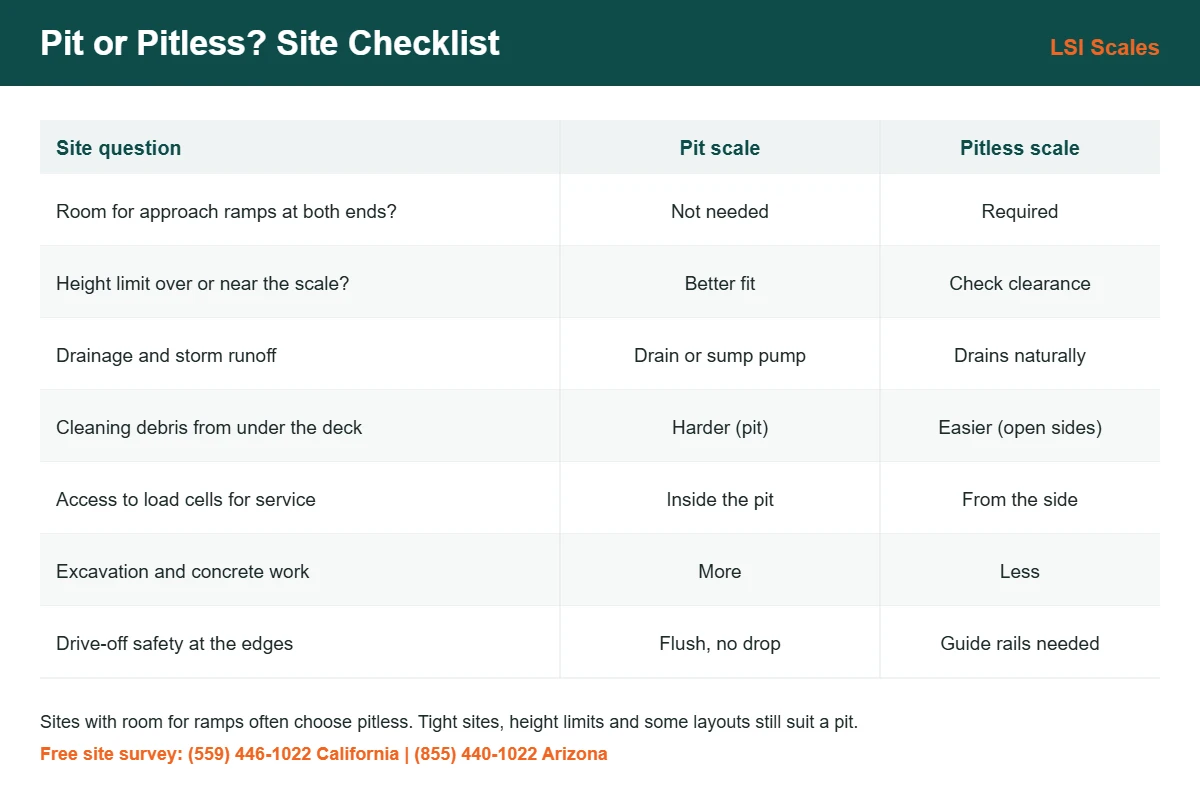
- Measure your site. Is there room for the scale plus a ramp at both ends, and space for trucks to line up and turn?
- Look up. Is there anything above the scale area, like a spout, canopy or power line?
- Watch the water. Where does rain go on your site today? Does it pool where the scale will sit?
- Decide who cleans it. Who will clean the scale, how often, and will they really do it in your busy season?
- Check what you have. If you are replacing a scale, is the old foundation still sound?
- Think ahead. Will your trucks, traffic or layout change in the next 10 to 20 years?
Mistakes to Avoid
- Choosing a pit with no real drainage plan. A pit that floods will cost you in repairs and bad weights.
- Squeezing ramps into too little space. Short, steep approaches are hard on trucks and make drivers brake on the scale.
- Forgetting truck flow. Plan where trucks wait, turn and leave, not just where the scale sits.
- Skipping cleaning in the busy season. That is exactly when debris builds up fastest.
- Pouring new concrete you don’t need. Always have the existing foundation checked first.
Questions to Ask Your Installer
- Will you check my existing foundation before quoting a new one?
- How will water drain away from the scale, and what happens in a heavy storm?
- How do your technicians reach the load cells for service?
- How long will my site be without a scale, and can you provide a rental?
- Is the scale model NTEP-approved, and will it be ready for state inspection?
- What maintenance will my team need to do, and how often?
California and Arizona Site Tips
California: irrigation runoff, winter storms and wash-down at farm and food sites make drainage the deciding factor on many Central Valley projects. Plan the grading before the concrete. Arizona: monsoon storms can send a lot of water and silt across a yard in minutes, and dust builds up quickly in the dry months. Open, pitless designs are often easier to keep clean and dry, but a pit with reliable drainage still works on the right site.
See how we plan foundations in each state: truck scale installation in California and truck scale installation in Arizona. You can also browse our range of pit and pitless truck scales.
Quick Glossary
- Deck / weighbridge: the platform the truck drives onto.
- Load cell: the sensor under the deck that measures weight.
- Junction box: collects the load cell signals and sends them to the indicator.
- Approach / ramp: the short slope trucks use to drive onto a pitless scale.
- Guide rails: steel rails along the deck edges that keep wheels on the scale.
- Sump pump: a pump that removes water from a pit.
- Legal-for-trade: a scale approved and inspected for buying and selling by weight.
Frequently Asked Questions
What is the difference between a pit and a pitless truck scale?
A pit scale sits in a concrete-lined hole with the deck level with the ground. A pitless scale sits above ground on a slab or piers, with a ramp at each end.
Is a pit or pitless truck scale more accurate?
Neither. Both weigh equally well if the foundation is level and the deck moves freely on its load cells. Accuracy depends on build quality, cleanliness and calibration.
Which costs less?
It depends on your site. Pits need more digging, concrete and drainage. Pitless scales need ramps and guide rails. Reusing a sound existing foundation is usually the cheapest option.
Does a pit truck scale need a sump pump?
A pit needs a reliable way to remove water: a gravity drain where the site allows, or a sump pump. Standing water can damage load cells and affect weights.
Can I replace my pit scale with a pitless one?
Often, yes, if there is room for ramps at both ends. We check the site, drainage and truck flow before recommending it.
Which is easier to maintain?
Pitless scales are usually easier, because dirt clears from the open sides and technicians can reach the load cells without entering a pit.
How long does it take to replace a truck scale?
On a sound existing foundation, typically about a day on site. A new foundation adds construction and concrete cure time.
Do I need a permit for a new truck scale foundation?
Requirements vary by city and county. We check what your project needs during planning.
Related Truck Scale Guides and Services
Planning a new scale, a replacement or better weighing practices? These pages cover the next questions most of our customers ask.
Get Help Choosing Your Truck Scale Foundation
Not sure which foundation fits? We’ll visit your site, check your space, drainage and existing foundation, and recommend pit or pitless with a clear, itemised quote.