Quick answer: Choose a steel deck truck scale if you need to be weighing again fast, want a lower upfront price, or may move the scale later. Choose a concrete deck truck scale if your site is wet or corrosive, loaders or forklifts will drive on the deck, or you want less deck maintenance over the long run, and you can live with several weeks of concrete cure time. Built to the same specification, both weigh equally well.
This guide is for anyone buying a new truck scale or replacing an old one. It explains the two deck types in plain language, shows which one fits common California and Arizona sites, and gives you a simple way to compare quotes. No jargon you don’t need, and no sales pitch for one deck over the other.
Key Takeaways
- Accuracy is not the deciding factor. Steel and concrete decks built to the same specification weigh equally well.
- Steel = speed and flexibility. Faster to install, lighter, usually cheaper up front and easier to relocate.
- Concrete = toughness and low upkeep. Better grip when wet, strong corrosion resistance and less deck maintenance, but the concrete must cure before you can weigh.
- Downtime often decides it. If your business can’t stop for weeks, plan for steel or arrange a rental scale.
- Compare lifetime cost, not just the quote. Coating care, repairs and downtime add up over 20+ years.
Table of Contents
How Each Deck Is Built
The deck (or weighbridge) is the part trucks drive on. It sits on load cells that measure the weight. Both deck types use the same weighing parts underneath; the difference is what the driving surface is made of and how it gets built.
Steel deck truck scale
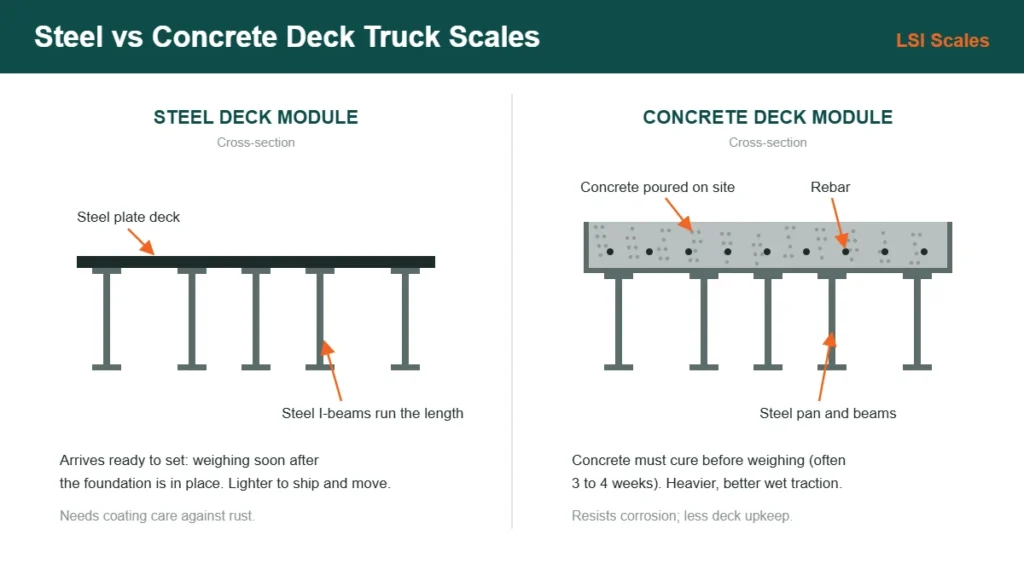
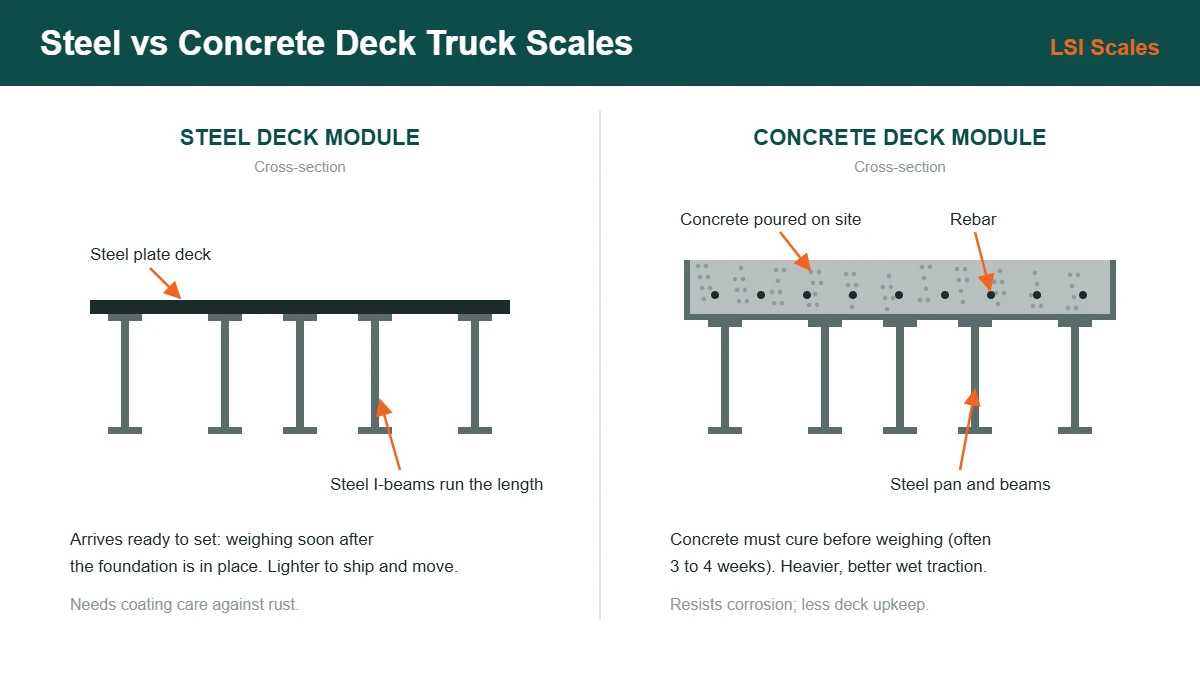
A steel deck is made of thick steel plate on top of steel beams that run the length of each section (module). The modules arrive from the factory finished and painted. They are lifted onto the foundation with a crane, connected, and calibrated. Because nothing needs to set or cure, a steel scale can be weighing very soon after the foundation is ready.
Concrete deck truck scale
A concrete deck starts as steel modules with an open top. Once the modules are set on the foundation, concrete is poured into each one, around steel reinforcing bar. Pouring on site keeps the modules lighter to ship, which Rice Lake notes also helps prevent damage in transit. The concrete then has to cure, which Rice Lake puts at roughly 21 to 28 days, before the scale is finished.
Steel vs Concrete at a Glance
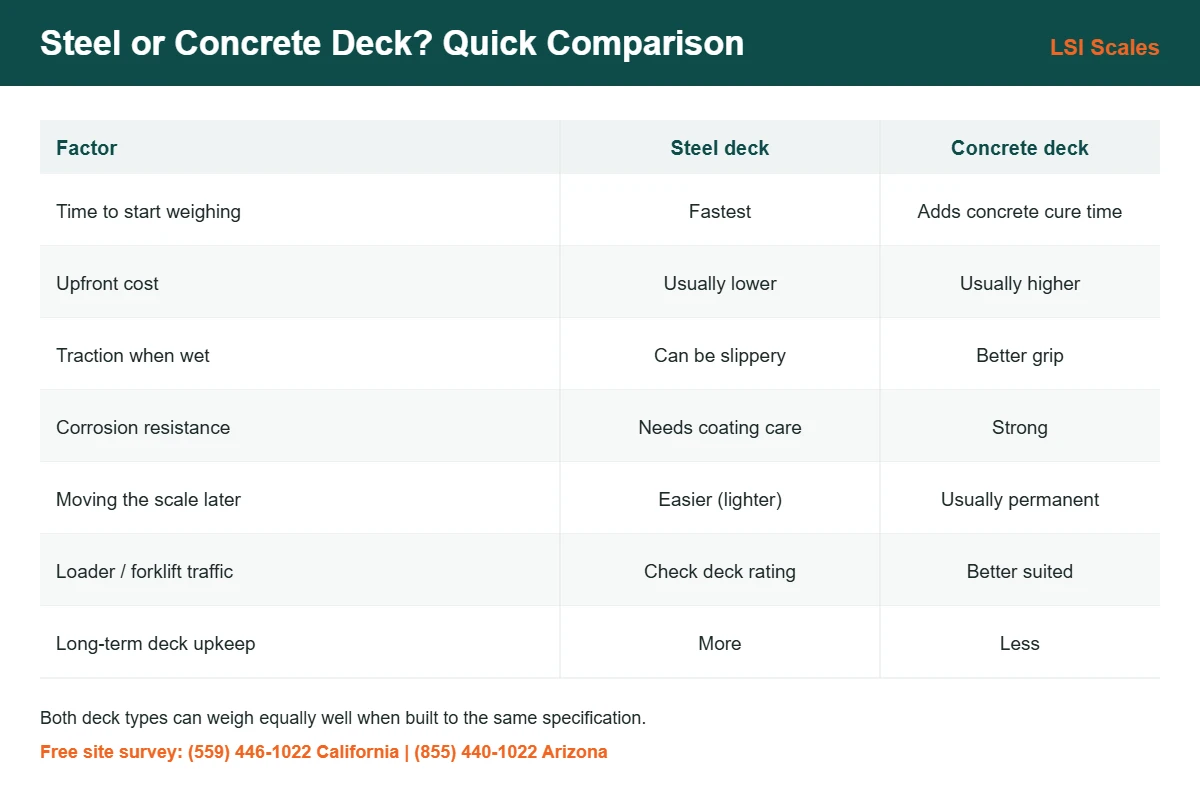
| What you care about | Steel deck | Concrete deck |
|---|---|---|
| Time until you can weigh | Fastest once the foundation is ready | Add roughly 3 to 4 weeks of cure time |
| Upfront price | Usually lower | Usually higher |
| Weight | Lighter | Much heavier |
| Grip when wet | Can be slippery | Better traction |
| Rust and corrosion | Needs coating care; some models can be galvanised | Strong resistance |
| Loaders and forklifts on the deck | Check the deck rating first | Better suited |
| Deck upkeep over the years | More (coating touch-ups) | Less |
| Moving the scale later | Easier | Usually treated as permanent |
| Weighing accuracy | Same when built to spec | Same when built to spec |
Match Your Site Conditions to a Deck
The best deck is the one that suits how your site really works day to day. Find the conditions that describe your yard:
| Your site | What it means for the deck | Usually better |
|---|---|---|
| Wash-down, irrigation runoff or wet loads | Constant moisture speeds up rust on steel | Concrete |
| Fertiliser, feed, salt or chemical spills | Corrosive residue attacks paint and steel | Concrete, or steel with strong coating care |
| Loaders, forklifts or tracked equipment cross the scale | Concentrated wheel loads stress the deck surface | Concrete |
| You can’t stop weighing for weeks | Concrete cure time means downtime | Steel |
| You may move the scale or the site in a few years | Heavy concrete decks are hard to relocate | Steel |
| Lower traffic, dry site, tight budget | Fewer stresses on the deck | Steel |
| Heavy, constant traffic for decades | Long life and low upkeep matter most | Concrete |
4 Real-World Examples
Example 1: A harvest-season farm scale
A Central Valley grower needs a new scale before harvest, and the old one is failing. Loads are often wet, and the deck gets washed down. The trade-off: concrete suits the wet conditions, but the cure time has to be finished before harvest. The answer is usually to schedule a concrete deck well before the season, or choose steel if time has run out.
Example 2: A busy aggregate yard
Loaded trucks cross the scale all day, and a loader sometimes drives over it to clear spillage. Usually concrete. It handles heavy, constant traffic and equipment loads better and needs less deck maintenance over the years.
Example 3: A distribution yard that can’t stop
Every truck leaving the yard has to be weighed, and there is no other scale on site. Usually steel, often set on the existing foundation in about a day. If concrete is preferred, a temporary portable truck scale can keep trucks moving during the cure time.
Example 4: A contractor on a leased site
The business may move within a few years. Usually steel. A lighter steel deck is far easier to lift, move and reinstall at a new yard.
Downtime: Planning the Changeover
For many sites, how long you go without a scale matters more than the deck price. Typical timelines from our projects:
| Project | Typical time on site | Before you can weigh |
|---|---|---|
| New steel deck on a sound existing foundation | About a day | Same day or next day, after calibration |
| New steel deck on a new above-ground foundation | About a week of work | After the foundation concrete cures |
| New concrete deck | Foundation work plus deck pour | After the deck concrete cures (roughly 3 to 4 weeks) |
Ask your installer for a day-by-day plan before work starts, including when the old scale comes out, when concrete is poured, and when testing happens.
Comparing Quotes: Lifetime Cost, Not Just Price
Two quotes can look very different and still be fair. Make sure you are comparing the same things:
| Cost item | Steel deck | Concrete deck |
|---|---|---|
| Deck modules | Finished steel modules | Steel modules plus concrete and rebar |
| Labour | Set and connect | Set, connect, pour and finish the concrete |
| Freight and crane | Included? | Included? |
| Downtime | Short | Several weeks of cure time |
| Rental scale during work | Rarely needed | Often worth pricing |
| Ongoing upkeep | Coating checks and touch-ups | Checks for cracks and worn edges |
Rice Lake credits concrete decks with five to seven years more life and less maintenance, and advises planning for 25 years or more of service from any truck scale with reasonable care. Over that time, upkeep and downtime can matter as much as the purchase price. For price ranges, see our truck scale cost guide.
Caring for Each Deck Type
| Task | Steel deck | Concrete deck |
|---|---|---|
| Regular cleaning | Wash off mud, spills and corrosive residue | Wash off mud and spills |
| Surface checks | Look for chipped paint, rust spots and worn tread | Look for cracks, chips and worn edges |
| Repairs | Touch up coating before rust spreads | Repair cracks and edges early |
| Under the deck | Keep clear of debris so the deck moves freely | Keep clear of debris so the deck moves freely |
| Calibration | At least yearly, more for busy trade scales | At least yearly, more for busy trade scales |
See our preventive maintenance checklist and how often to calibrate a truck scale.
Mistakes to Avoid
- Choosing concrete without planning the cure time. Weeks without a scale can hurt more than the extra cost of a rental.
- Choosing steel for a wet, corrosive site and skipping coating care. Rust spreads quickly once the coating fails.
- Letting loaders drive on a deck not rated for it. Check the deck rating before any equipment crosses the scale.
- Comparing quotes on price alone. Make sure freight, crane, concrete, downtime and calibration are all included.
- Forgetting the foundation. The deck choice and the foundation choice go together. Read our guide to pit vs pitless truck scales.
Questions to Ask Before You Buy
- How long will my site be without a working scale, day by day?
- Is the deck rated for the loaders or forklifts we use?
- What coating or corrosion protection comes with a steel deck, and how do we maintain it?
- Who pours and finishes the concrete deck, and how is it cured?
- Is the scale model NTEP-approved and ready for state inspection?
- Can you provide a rental scale during the work?
- What will my team need to do each month to keep the deck in good shape?
California and Arizona Considerations
Most deck advice online is written for snow-belt states, where road salt is the big problem. Here, the stresses are different. In California, wash-down water, irrigation runoff, wet produce loads and fertiliser spills keep decks damp and can speed up rust on steel. In Arizona, intense sun and heat break down paint over time, and monsoon storms can make a steel deck slippery. Neither rules out steel, but both mean coating care matters, and both are reasons many heavy-use sites choose concrete.
See how we plan installations in California and Arizona, or browse our range of steel and concrete deck truck scales.
Quick Glossary
- Deck / weighbridge: the platform trucks drive onto.
- Module: one section of the deck; longer scales use several.
- Load cell: the sensor under the deck that measures weight.
- Cure time: the time concrete needs to harden before it can carry trucks.
- Rebar: steel bars inside the concrete that add strength.
- Galvanising: a zinc coating that protects steel from rust.
- NTEP: the U.S. program that approves scale designs for legal-for-trade use.
Frequently Asked Questions
Which is better, a steel or concrete deck truck scale?
Neither is better everywhere. Steel installs faster, usually costs less up front and is easier to move. Concrete gives better wet traction, resists corrosion and needs less deck upkeep.
How long does a concrete deck take to cure?
Manufacturer guidance puts it at roughly 21 to 28 days before the scale is finished and in service.
Is a steel deck truck scale cheaper?
Usually, yes, because there is no deck concrete or pouring labour. Total project cost also depends on the foundation and site work.
Which deck type lasts longer?
Rice Lake credits concrete decks with five to seven years longer life and less maintenance. A well-maintained steel deck can still give many years of service.
Do steel and concrete decks weigh differently?
No. Built to the same specification, both should weigh equally well.
Can loaders or forklifts drive on a steel deck?
Only if the deck is rated for it. If equipment will cross the scale regularly, a concrete deck is usually the better choice.
Can I keep weighing while a concrete deck cures?
Yes, with a temporary portable truck scale. Ask about a rental when you plan the project.
Can a steel deck be protected from rust?
Yes. Good paint or coating, regular cleaning and quick touch-ups help, and some models are available galvanised.
Related Truck Scale Guides and Services
Planning a new scale, a replacement or better weighing practices? These pages cover the next questions most of our customers ask.
Get Help Choosing Your Truck Scale Deck
Tell us about your site, your trucks and how much downtime you can accept. We’ll recommend steel or concrete, explain the trade-offs for your conditions and send an itemised quote.