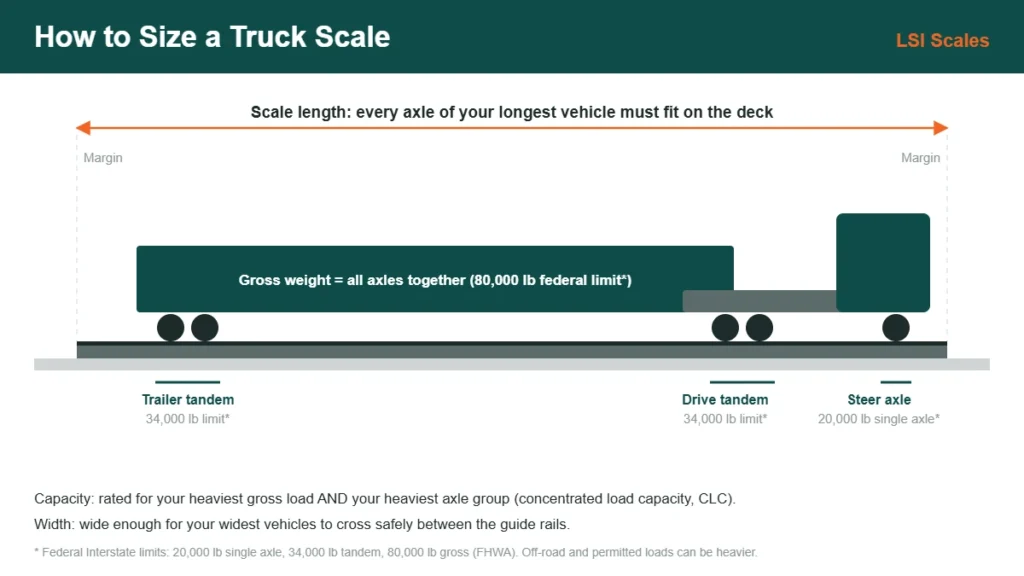
Quick answer: Size a truck scale with three numbers. Length: long enough for every axle of your longest vehicle to sit on the deck at once, plus a margin. Many sites weighing tractor-trailers use scales in the 70 to 80 ft range, and longer combinations need more. Width: usually 10, 11 or 12 ft for road trucks, wider for off-road haul trucks. Capacity: rated for both your heaviest gross load and your heaviest axle group, which manufacturers list as concentrated load capacity (CLC). Then add room for the trucks you will run in the future.
This guide is for anyone buying a first truck scale, replacing an old one, or wondering whether their current scale is still the right size. We keep it simple: what each number means, how to measure for it, what the law expects, and the sizing mistakes that cost the most to fix later. All figures come from official sources and manufacturer specifications, linked at the end.
Key Takeaways
- Length matters most. If an axle hangs off the deck, the weight can’t be certified. Measure your longest vehicle, then add a margin.
- Capacity has two parts. The total (full-scale) capacity and the concentrated load capacity (CLC) for a single axle group. Check both.
- Width is about safe, accurate weighing. Most road truck scales are 10 to 12 ft wide; off-road equipment needs more.
- Legal road limits are a floor, not a ceiling. Overweight, permitted and off-road loads still cross your scale.
- Buy for the next 20+ years. A scale that is too short or too light is expensive to replace.
Table of Contents
The 3 Numbers That Define a Truck Scale
| Number | What it means | Why it matters |
|---|---|---|
| Length | How long the deck is, end to end | Every axle must be on the deck at once for a full, legal weight |
| Width | How wide the deck is between the guide rails | Trucks need room to cross safely and stay centred |
| Capacity | How much weight the scale is rated to carry, in total and per axle group | An undersized scale wears out early or can’t weigh your heaviest loads |
Length: Every Axle on the Deck
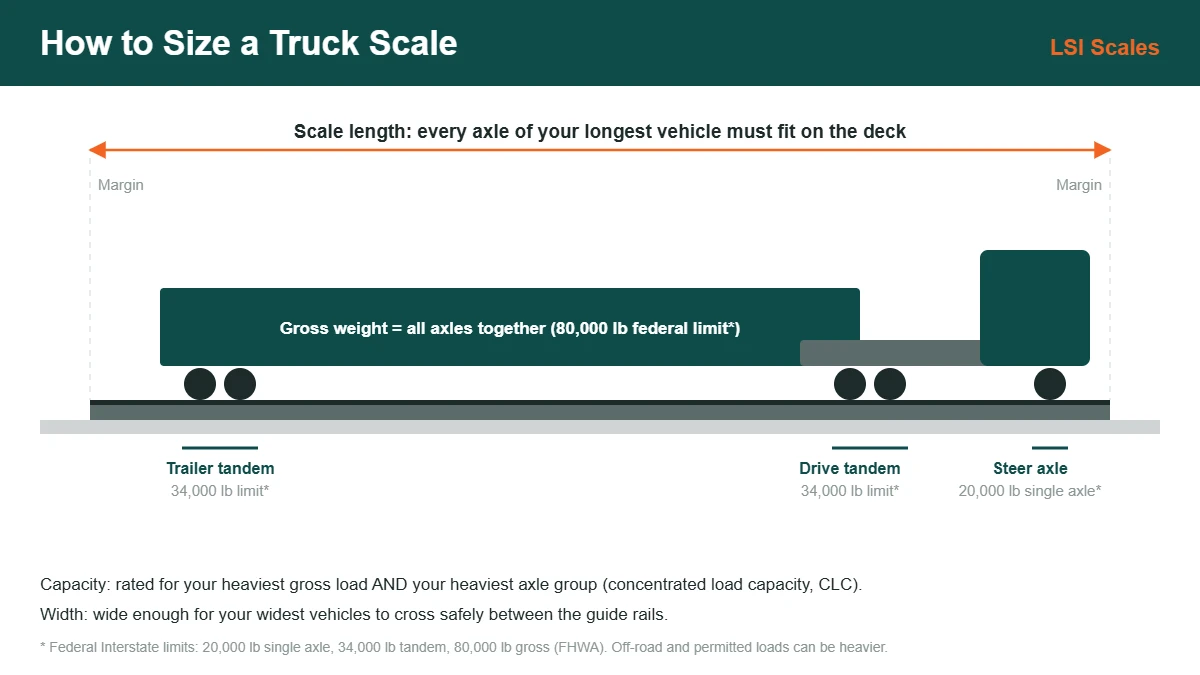
The length of your scale is the most important decision, because it is the hardest to change. For trade weighing, the whole vehicle needs to be on the scale at once. California’s weighmaster law includes a section titled “Requirement that entire vehicle rest on scale” (Business and Professions Code § 12728), and Arizona’s rules require public weighmasters to weigh a vehicle or combination on a scale with a platform that fully accommodates it as one unit.
How to measure
- Find the longest vehicle or combination you weigh today, or expect to weigh.
- Measure from the first axle to the last axle, then bumper to bumper.
- Add a margin at each end, so drivers don’t have to stop with tyres on the very edge of the deck.
- Check the result against the scale lengths the manufacturer offers. Rice Lake, for example, lists steel deck truck scales from 10 ft to 160 ft long.
Typical starting points by vehicle
Use this table as a starting point only. Always measure your own trucks, because axle spacing varies a lot between fleets.
| Vehicle | What the rules allow (California) | Typical scale length to consider |
|---|---|---|
| Pickups, farm trucks, small single-axle trucks | Short vehicles | Utility or agricultural scales; Rice Lake’s SURVIVOR AG is offered up to 43.75 ft long |
| Straight trucks and dump trucks | A single vehicle may not exceed 40 ft (CVC 35400) | Long enough for the truck plus margin; longer if trailers are added later |
| “California Legal” tractor-semitrailer | Up to 65 ft overall on California Legal routes | Commonly a 70 ft scale or longer |
| Interstate (STAA) tractor with a 53 ft trailer | Semitrailer up to 53 ft, with no overall length limit on the STAA network | Commonly 70 to 80 ft; measure your longest tractor |
| Doubles, longer combinations, permitted loads | Varies by route and permit | 80 ft, 100 ft or longer |
Why Weighing in Two Parts Is a Problem
If a truck is too long for the scale, drivers sometimes weigh the front and back separately and add the numbers together. This “split weighing” is slower, adds handling error, and doesn’t meet the whole-vehicle rules for weighmaster certificates in California and Arizona described above. If your trucks are getting longer, it is a sign the scale needs to grow too.
Width: Room to Cross Safely
Width is easier to get right, but it still matters. A deck that is too narrow forces drivers to creep across and risks wheels catching the guide rails. A deck that is wider than needed costs more steel and concrete.
- 10 or 11 ft: common for road trucks. Rice Lake offers its standard-duty OTR-SV in 10 or 11 ft widths.
- 12 ft: extra room for busy sites, wider loads or less experienced drivers. Rice Lake’s OTR steel deck comes in 10, 11 and 12 ft widths, NTEP certified up to 16.5 ft.
- 14 ft and wider: for off-road haul trucks and wide equipment. Rice Lake’s SR concrete deck model is offered in 11, 12 or 14 ft widths.
Think about the widest vehicle you weigh, how fast drivers approach, and whether trucks arrive at an angle.
Capacity Explained in Plain English
Capacity is where most buyers get confused, because a scale has more than one rating. These are the two that matter most:
- Full-scale capacity: the most total weight the scale is built to weigh across the whole deck.
- Concentrated load capacity (CLC): the heaviest load the scale is rated to carry on one axle group in one spot. Because a truck’s weight sits on its axles, not spread evenly, this rating is often the more important one for durability.
- Dual tandem axle (DTA) rating: some manufacturers also list the load the scale can carry on two tandem axle groups close together.
Here is how those ratings look on real, published models from one manufacturer. They show why two scales that look the same can be built for very different work:
| Example model (Rice Lake) | Full-scale capacity | Concentrated load capacity (CLC) |
|---|---|---|
| SURVIVOR AG utility scale | 30,000 lb | 20,000 lb |
| SURVIVOR OTR-SV standard-duty steel deck | Up to 200,000 lb | 70,000 lb |
| SURVIVOR OTR-LP low-profile | Up to 200,000 lb | 90,000 lb |
| SURVIVOR SR concrete deck | Up to 270,000 lb | 120,000 lb |
Specifications change over time, so always confirm the current ratings for the exact model and length you are quoted.
What Road Weight Limits Mean for Your Scale
On the Interstate System, federal limits are 80,000 lb gross vehicle weight, 20,000 lb on a single axle and 34,000 lb on a tandem axle group, and the Federal Bridge Formula can lower the allowed weight further depending on axle spacing.
These limits are useful for planning, but don’t size your scale to them alone. Your scale will also see trucks that arrive overweight, vehicles running on permits, and off-road equipment that never goes on a highway. A scale should be rated comfortably above the heaviest axle groups and gross loads it will actually carry. If you run alternative-fuel or electric trucks, see our guide to electric truck weight limits in California, and our guide to DOT weight limits and overweight fines.
The 4-Step Sizing Method
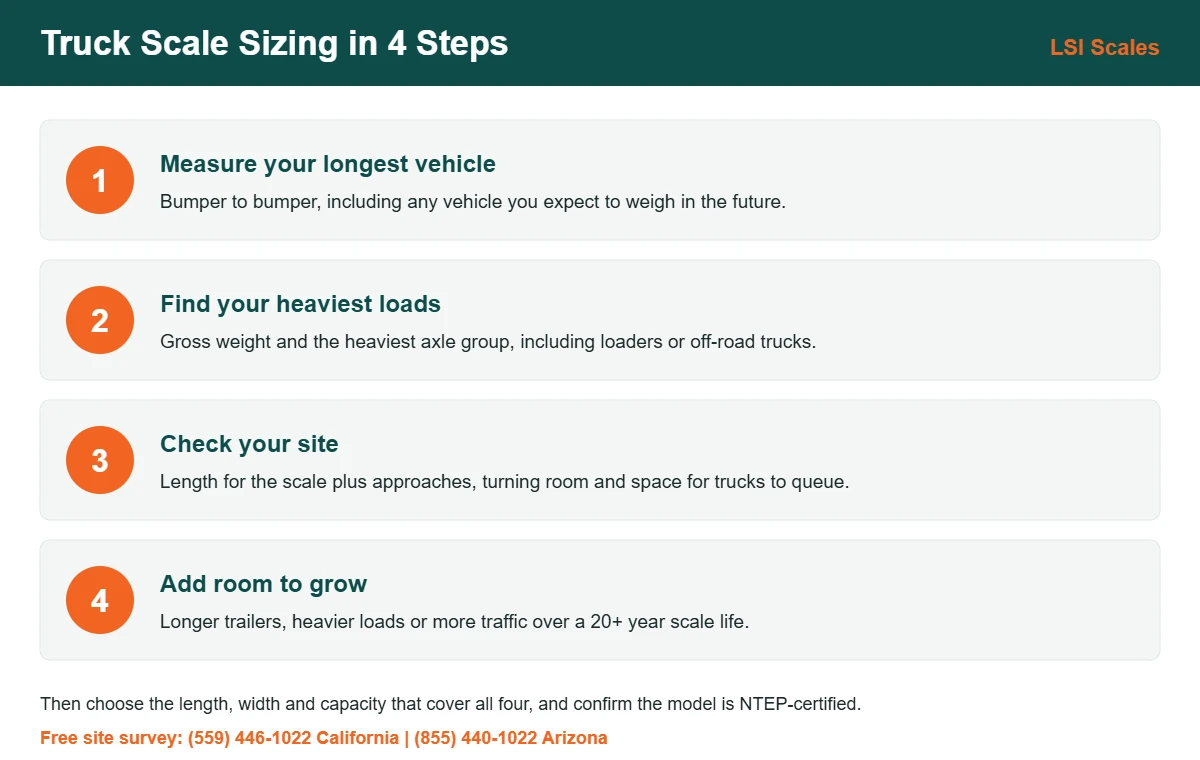
- Measure your longest vehicle. Include combinations you might run in future, not just today’s fleet.
- Find your heaviest loads. Note the heaviest gross weight and the heaviest axle group, including loaders, off-road trucks and overweight arrivals.
- Check your site. You need room for the scale, the approaches at each end, a straight run on and off, space for trucks to queue, and a spot where drivers can see the scoreboard.
- Add room to grow. Rice Lake advises planning for the largest truck you will ever weigh, because a truck scale should give 25 years or more of service with reasonable care.
Sizing by Industry
| Industry | What usually drives the size | What to watch |
|---|---|---|
| Agriculture and produce | Seasonal traffic, trailers of different lengths, grower trucks | Peak harvest queues; mixed vehicle lengths |
| Aggregates and quarries | Heavy, constant traffic and loaders crossing | High CLC; wear from constant loading |
| Mining | Off-road haul trucks | Extra width and capacity beyond road trucks; see mining truck scales |
| Scrap and recycling | Roll-off trucks, tractor-trailers and walk-in customers | Mixed traffic; long trailers |
| Waste and transfer stations | Packer trucks and transfer trailers | High daily volume; fast weighing |
| Logistics and distribution | Tractors with long trailers | Length for 53 ft trailers; queuing space |
4 Real-World Sizing Examples
Example 1: Upgrading from a short farm scale
A grower has an old scale built for straight trucks, but buyers now send tractor-trailers. Drivers are weighing in two parts. The fix: a full-length scale sized to the longest trailer combination, so every load is weighed in one pass.
Example 2: A quarry with loader traffic
Trucks are well within road limits, but a loader crosses the scale to clear spills. The fix: choose a model with a higher concentrated load capacity, not just a higher total capacity.
Example 3: A distribution yard with 53 ft trailers
The yard plans to add longer tractors. The fix: measure the longest planned tractor-trailer and choose the next length up, rather than the length that just fits today.
Example 4: A tight site
The ideal length won’t fit with full approaches at both ends. The fix: look at a pit foundation, which needs no ramps. Read our guide to pit vs pitless truck scales.
How Size Affects Cost and Installation
- Longer scales need more modules, more load cells and a longer foundation.
- Wider scales need more steel or concrete across the whole length.
- Higher-capacity models use heavier structure and load cells.
- Site work grows with the footprint: grading, approaches and drainage.
Undersizing usually costs more in the long run, because a scale that is too short or too light often has to be replaced early. For price ranges, see our truck scale cost guide. The deck type also affects cost and downtime: compare them in our steel vs concrete deck guide.
Mistakes to Avoid
- Sizing for today’s trucks only. Fleets get longer and heavier over a scale’s life.
- Looking only at total capacity. Check the concentrated load capacity for your heaviest axle groups.
- Forgetting the approaches. The scale needs straight, level approaches and space for trucks to queue.
- Choosing the narrowest deck to save money. Drivers slow down, clip guide rails and take longer to weigh.
- Accepting split weighing as normal. It is slower, less accurate and doesn’t meet whole-vehicle weighmaster rules.
Questions to Ask Your Scale Supplier
- What length do you recommend for my longest vehicle, and why?
- What are the full-scale capacity and the concentrated load capacity of this model?
- Is this model NTEP-certified at the length and width you are quoting?
- What width do you recommend for my traffic and vehicles?
- How much approach and queuing space will my site need?
- If my trucks get longer, can this scale be extended later?
California and Arizona Notes
California: truck length rules differ between “California Legal” routes and the STAA network, so fleets can include both shorter combinations and long tractors with 53 ft trailers. Size for the longest one. Businesses that issue weight certificates also need a weighmaster licence from the CDFA Division of Measurement Standards. Arizona: mining and aggregate sites often run off-road haul trucks that need extra width and capacity, while public weighmasters must weigh each vehicle or combination as one unit. See how we plan installations in California and Arizona, or browse our full range of truck scale sizes and capacities.
Quick Glossary
- Full-scale capacity: the most total weight the scale is designed to weigh.
- Concentrated load capacity (CLC): the heaviest load rated on a single axle group.
- Dual tandem axle (DTA): the rated load for two tandem axle groups close together.
- Module: one section of the deck; longer scales use more modules.
- Approach: the level area or ramp trucks use to drive on and off.
- Division: the smallest weight step the scale displays, such as 20 lb.
- NTEP: the U.S. program that approves scale designs for legal-for-trade use.
Frequently Asked Questions
How long should a truck scale be?
Long enough for every axle of your longest vehicle to sit on the deck at once, plus a margin. Many sites weighing tractor-trailers choose scales in the 70 to 80 ft range, and longer combinations need more. Always measure your own trucks.
How wide is a truck scale?
Road truck scales are commonly 10, 11 or 12 ft wide. Off-road and mining scales are often wider.
What is concentrated load capacity (CLC)?
It is the heaviest load a scale is rated to carry on a single axle group. It matters because a truck’s weight sits on its axles, not evenly across the deck.
Is a bigger capacity always better?
Not always. Choose a capacity and CLC comfortably above your heaviest real loads. Going far beyond that adds cost without much benefit.
Can I weigh a long truck in two parts?
Split weighing is slower and less accurate, and California and Arizona weighmaster rules expect the whole vehicle to be weighed as one unit.
What size scale do I need for a 53 ft trailer?
It depends on the tractor and axle spacing. Measure your longest tractor-trailer bumper to bumper and add a margin. Many sites with 53 ft trailers use 70 to 80 ft scales.
Can a truck scale be made longer later?
Some designs can be extended with extra modules and foundation work, but it is usually cheaper to choose the right length at the start. Ask your supplier before you buy.
Do federal weight limits decide my scale capacity?
No. Federal limits (80,000 lb gross, 20,000 lb single axle, 34,000 lb tandem) are a useful guide, but your scale also has to handle overweight, permitted and off-road loads.
Related Truck Scale Guides and Services
Planning a new scale, a replacement or better weighing practices? These pages cover the next questions most of our customers ask.
Get the Right Size the First Time
Send us your longest vehicle, your heaviest loads and a few photos of your site. We’ll recommend the length, width and capacity, explain why, and send an itemised quote.
Sources
- FHWA: Truck Size and Weight Laws
- FHWA: Bridge Formula Weights
- Caltrans: Quick Guide to Truck Lengths and Routes
- Caltrans: Vehicle Lengths
- CDFA Division of Measurement Standards: Weighmaster Law, BPC §§ 12700–12737
- Arizona Administrative Code R3-7-504: Scales and Vehicle Weighing
- Rice Lake: SURVIVOR OTR Steel Deck Truck Scale
- Rice Lake: SURVIVOR OTR-SV Standard Duty Truck Scale
- Rice Lake: SURVIVOR OTR-LP Specifications
- Rice Lake: SURVIVOR SR Concrete Deck Specifications
- Rice Lake: SURVIVOR AG Series
- Rice Lake: Truck Scale Designs
- NIST Handbook 44
- NCWM: National Type Evaluation Program