Scale failures rarely happen suddenly. They happen slowly — a little drift here, a loose connection there, a load cell quietly degrading under conditions it was never quite right for. By the time most operations notice, the scale has been giving bad readings for weeks, or worse, a compliance inspection has flagged it as out of tolerance.
The good news is that most industrial scale problems are preventable. Not with expensive programs or complicated procedures, but with a consistent, structured maintenance routine that catches small issues before they become operational disruptions or repair bills.
We’ve been servicing industrial weighing equipment across California, Arizona, Oregon, and Washington for over 50 years. This checklist reflects what our technicians actually look at in the field — broken down by daily, weekly, monthly, and annual intervals so it’s practical for both operators and maintenance teams to follow.
Why Preventive Maintenance Matters More for Scales Than Most Equipment
Scales are precision instruments built to perform in some of the harshest industrial environments — warehouse floors, recycling yards, food processing facilities, agricultural operations, chemical plants. That combination of precision and exposure makes them uniquely vulnerable to performance degradation without regular attention.
What makes scales particularly tricky is that a scale going out of calibration doesn’t announce itself. A conveyor with a worn belt makes noise. A motor running hot throws an alert. A scale reading three pounds light on every transaction just quietly costs you money, or quietly leads to a compliance violation, until someone looks closely enough to notice.
The real cost of skipping preventive maintenance on industrial scales shows up in several ways: calibration drift that accumulates into out-of-tolerance readings, load cell damage from undetected overloading or corrosion, indicator failure from moisture ingress, and compliance violations during Weights & Measures inspections that result in fines or forced downtime. A structured maintenance schedule catches these issues early — when they’re inexpensive to fix — rather than at the worst possible operational moment.
Daily and Weekly Scale Maintenance Checks
The checks at this frequency are operator-level tasks. They don’t require a technician, they don’t require specialized tools, and done consistently they catch the majority of day-to-day issues before they affect readings or escalate into something more serious.
Daily Checks — approximately 5 minutes per scale
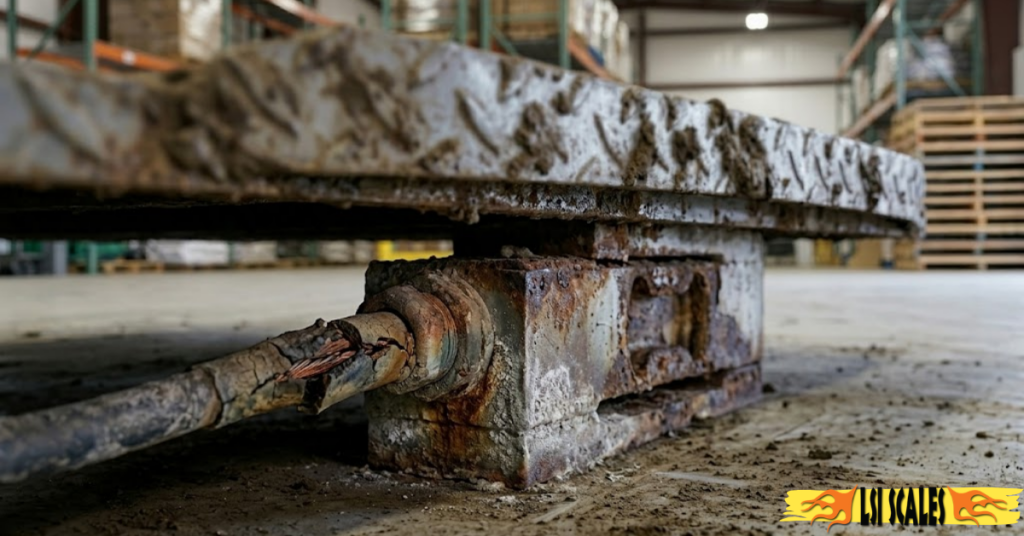
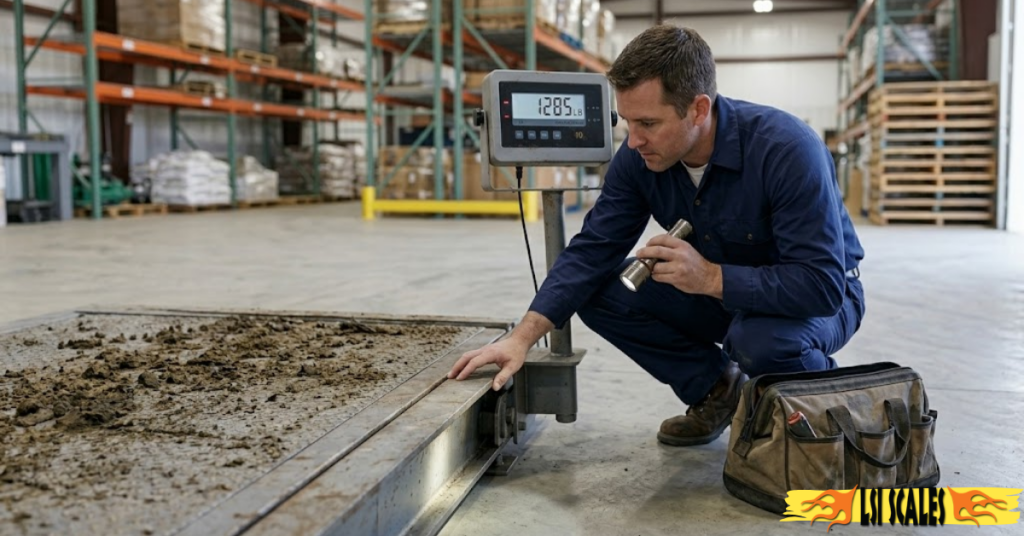
- Platform inspection. Check the platform surface for debris, product buildup, spills, or anything wedged under or around the platform edges. Anything resting on or contacting the platform — including material packed under the corner feet — adds phantom weight to every reading until it’s removed. This is the single most common source of unexplained reading errors we see in the field.
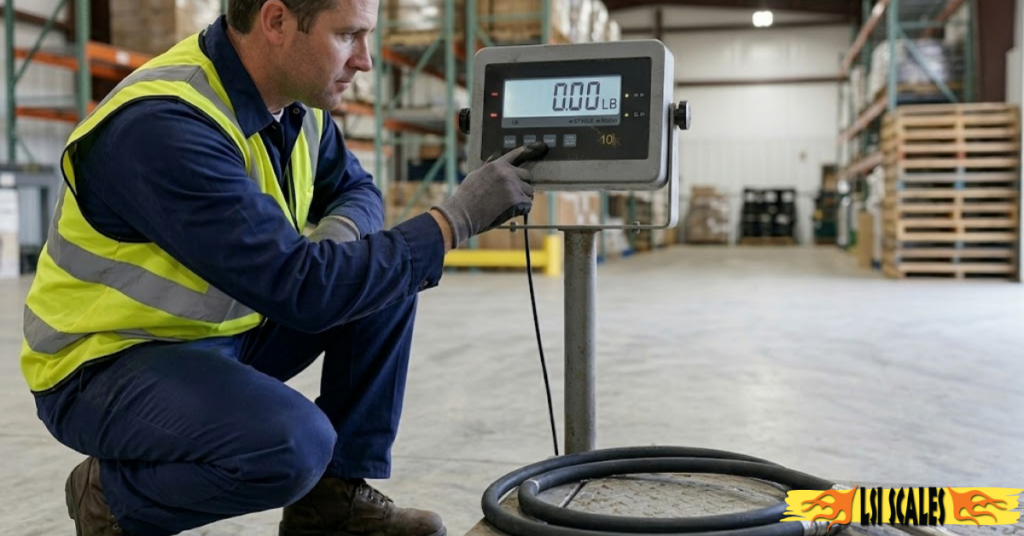
- Zero check. With nothing on the platform and the scale fully powered up and settled, the indicator should read zero. A non-zero reading at the start of the day — positive or negative — is the first reliable sign of overnight drift, platform contamination, or something resting on the deck. Note the offset value and investigate before using the scale for the day.
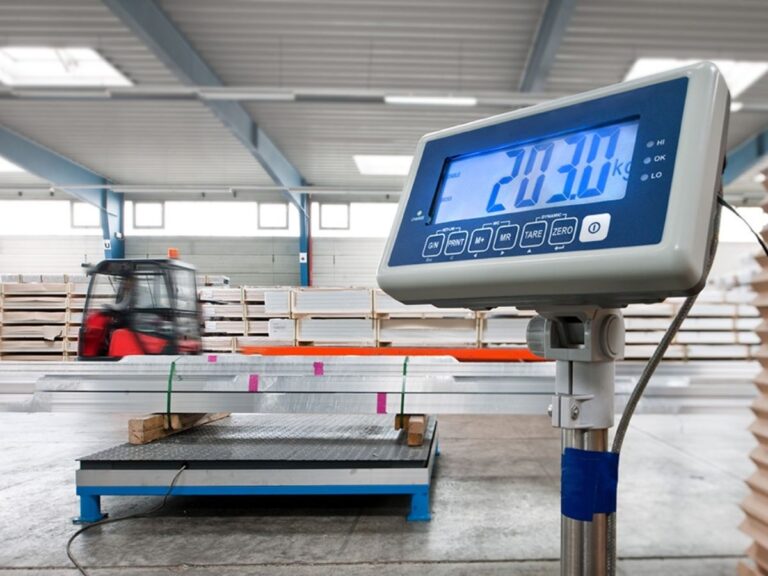
- Display check. Confirm the indicator is showing clear, stable numbers with no error codes, flickering, or delayed response. An unstable or error display is typically the first visible sign of an electrical issue — loose connection, failing indicator, or beginning load cell degradation.
- Physical damage check. Walk around the scale and look for any new physical damage to the platform, frame, cable conduit, or indicator housing. Impacts from forklifts, pallet jacks, and vehicle traffic happen — catching damage the same day it occurs prevents it from becoming a repair that takes the scale out of service.
- Level check for portable or recently moved scales. Even a small deviation from level produces inaccurate readings and uneven load distribution across the load cells. Confirm level before starting operations.
Weekly Checks — approximately 15 minutes per scale
- Thorough platform cleaning. The cleaning method depends on the scale type. Dry cloth or compressed air for bench scales and counting scales. Mild detergent and damp cloth for standard floor scales. Full washdown with water hose only for stainless steel, IP65 or IP67-rated platforms specifically designed for washdown — never wash down a standard painted steel scale.
- Load cell cable and junction box visual inspection. Check all visible cable runs for kinking, abrasion, crushing from vehicle traffic, or moisture pooling near cable entry points. On floor scales and truck scales, pay particular attention to cable routing under the platform where forklift traffic passes closest.
- Mounting hardware and leveling feet check. Vibration from nearby machinery, vehicle traffic, and normal operational loading gradually loosens mounting bolts and leveling feet. Check that all hardware is snug and the scale remains level. This takes two minutes and prevents a much larger recalibration issue developing over time.
- Span check with a known test weight. If you have access to a test weight of known value — even a single reference weight — place it on the center of the platform and compare the reading to the known mass. Note any variance in your maintenance log. A variance that’s growing week over week is a reliable early indicator of load cell drift before it becomes a calibration failure.
Monthly and Annual Scale Maintenance Checks
Monthly and annual checks go deeper than what an operator can reasonably perform during normal operations. Monthly checks can be handled by an experienced in-house maintenance team with the right equipment. Annual checks on legal-for-trade scales require a certified technician — there’s no operational or legal shortcut around that requirement.
Monthly Checks — approximately 30–45 minutes per scale
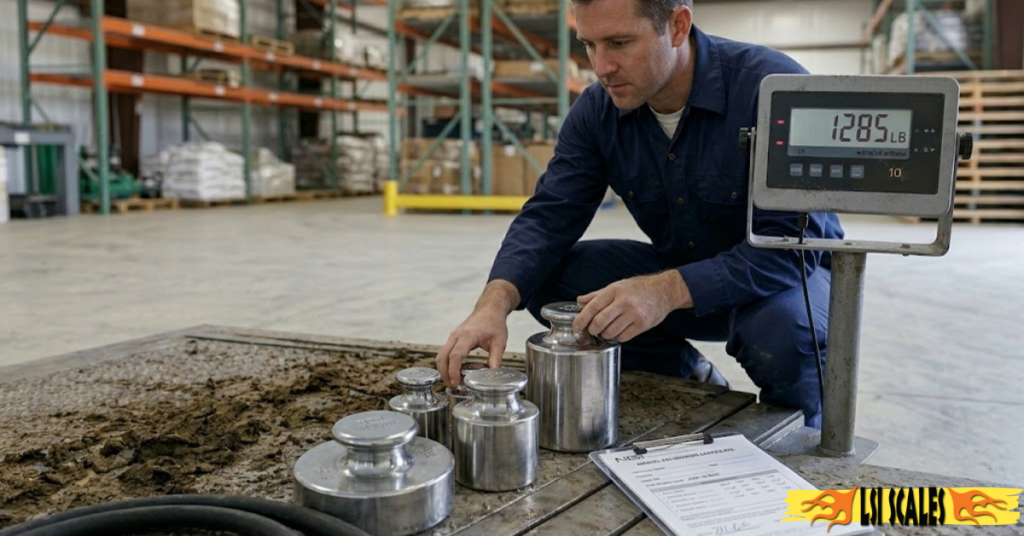
- Full calibration verification. Using NIST-traceable certified test weights, verify the scale’s accuracy at multiple points across its capacity range — not just at one weight increment. Test at approximately 25%, 50%, 75%, and 100% of rated capacity, and check corner loading by placing the test weight at each corner of the platform. A corner-loading error that differs from center readings indicates a load cell seating or mounting issue rather than a simple calibration offset.
- Load cell body inspection. Inspect each load cell for physical damage, corrosion, moisture ingress around cable entry points, and any signs of overload deformation. On floor scales and truck scales, this means getting under the platform to inspect the load cell bodies and mounting brackets directly — not just checking from the top.
- Junction box internal inspection. Open the junction box and check terminal connections for tightness, look for any signs of moisture or corrosion inside the enclosure, and verify that cable glands are properly sealed. A junction box showing moisture ingress needs to be addressed immediately — water in the junction box is one of the fastest paths to load cell failure and indicator damage.
- Overload protection component check. Floor scales and truck scales have bumper bolts, check rods, or travel stops that limit platform movement during overload events. Verify these components are in spec, undamaged, and properly adjusted. An overload protection system that’s out of adjustment can allow excessive platform travel that damages load cells over time without triggering an obvious failure event.
- Indicator full function test. Check all display functions, verify data outputs (RS232, USB, Bluetooth, or Wi-Fi as applicable), test printer connectivity if used, and confirm that any data logging or ERP integration is receiving clean data. A scale services call for an indicator issue discovered during a monthly check is far less disruptive than one triggered by a production stoppage.
- Truck scale additional checks. For truck scales specifically: inspect approach and departure ramps for surface damage and structural integrity, check pit drainage on pit-mounted scales, and look for debris or material accumulation under the deck that could contact the scale frame and affect readings.
Annual Checks — certified technician required for legal-for-trade scales
- Full calibration to NIST HB44 standards. For scales used in commerce — any scale where weight is the basis for a financial transaction — annual calibration must be performed by a licensed weights and measures inspector or an ISO 17025 accredited calibration technician. Our weight calibration services team holds the accreditation required to produce legally valid calibration documentation for California, Arizona, Oregon, and Washington.
- Individual load cell resistance and output testing. Each load cell is tested individually against its rated specification. This identifies any load cell that is degrading — producing low output, showing signal instability, or demonstrating sensitivity drift — before it fails completely during operations. Catching a failing load cell at annual service rather than mid-operation is the difference between a scheduled replacement and an emergency one.
- Indicator firmware review. Check the current firmware version against the manufacturer’s latest release. Outdated firmware can affect measurement accuracy, data output reliability, and compatibility with connected systems. Updates are typically straightforward but need to be performed by a technician familiar with the indicator model.
- Full scale overhaul assessment. A comprehensive evaluation of every serviceable component — load cells, cables, junction boxes, indicator, platform surface, structural frame, and overload protection system. The goal is to identify any components approaching end of service life and address them proactively rather than reactively. If a full scale overhaul is indicated, scheduling it during a planned maintenance window rather than after a failure saves significant operational disruption.
- Calibration documentation and service record update. Every legal-for-trade scale should have a current calibration certificate on file, along with a complete service history. This documentation is required for compliance inspections, supports insurance claims in weight-related disputes, and provides the audit trail that demonstrates due diligence in maintaining measurement accuracy. Our certified scales service includes all required documentation.
Scale-Type Specific Notes: What Changes for Each Scale
The checklist above applies broadly across industrial scale types. But each scale type has its own primary failure modes and maintenance priorities worth calling out specifically.
Floor scales are most vulnerable to debris accumulation under the platform and impact damage from forklift and pallet jack traffic. The monthly underside inspection and overload component check are particularly important here. Painted steel platforms also need regular touch-up of any coating damage to prevent corrosion from progressing into the structural frame. Our floor scale service work covers all of this.
Truck scales face the most demanding mechanical environment of any scale type — heavy repeated loading, vehicle impact on approach ramps, and constant exposure to weather and debris. Pit drainage, approach ramp condition, and load cell cable protection from vehicle traffic are the additions that matter most beyond the standard checklist. Truck scale load cells also benefit from more frequent visual inspection given the loading cycles they endure. See our truck scale services for more on what this involves.
Bench scales are most commonly damaged by overloading — placing items that exceed the rated capacity, even briefly — and by vibration transmitted through the work surface they sit on. Check the mounting surface stability weekly and verify that operators understand the scale’s capacity limit. See our bench scale service page for specifics.
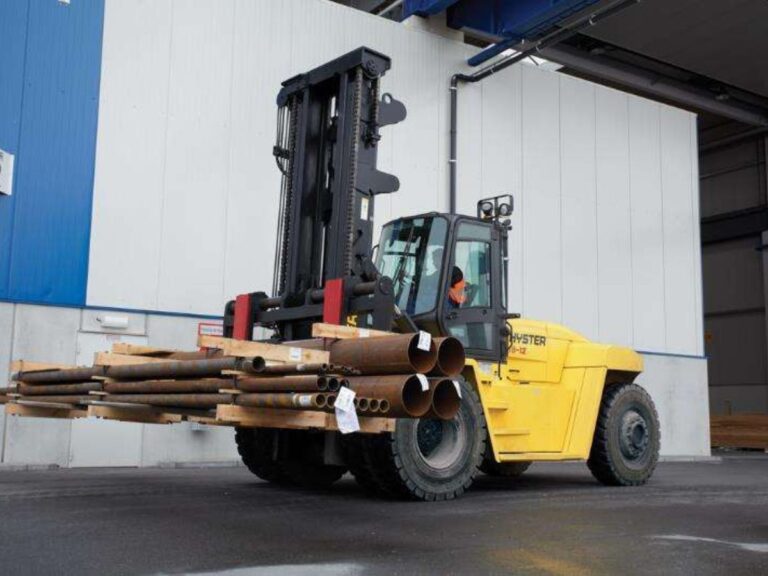
Forklift scales experience continuous vibration and shock loading during normal operation. Monthly inspection of mounting hardware integrity and load cell cable routing is more critical here than on stationary scales — vibration gradually works fasteners loose and fatigues cable insulation. Our forklift scale maintenance covers these specific requirements.
Counting scales need particular attention to platform edge cleanliness — even small debris in the platform lip affects the fine resolution these scales depend on. Monthly repeatability checks with a known sample count verify that the scale is still resolving individual unit weights accurately. See our counting scale services for more detail.
What to Document — and Why Your Maintenance Log Matters
Every maintenance check and calibration event should be recorded: date, scale ID or location, who performed the check, what was found, and what was adjusted, cleaned, or replaced. This sounds like administrative overhead, but it serves several practical purposes that operators often underestimate until they need them.
First, the maintenance log is your compliance audit trail. During a Weights & Measures inspection in California or Arizona, being able to produce a documented history of regular maintenance and calibration demonstrates due diligence — and it’s far better to have that documentation ready than to reconstruct it under pressure.
Second, patterns in the log are diagnostically valuable. A scale that needs frequent zero adjustment may have a foundation or leveling issue, not a recurring calibration problem. A load cell that keeps showing moisture in the monthly inspection despite being resealed has a deeper ingress path that needs to be found and fixed. The log reveals these patterns in a way that individual service events never can.
Third, the log supports warranty claims and insurance situations. If a scale is damaged by an event — a forklift collision, a flood, an overload incident — documented maintenance history demonstrates that the scale was properly maintained and that the damage was caused by a specific event rather than neglect.
Keep the maintenance log with the scale, not in a filing cabinet. Operators and technicians should be able to reference the last service entry at the point of use, not after a trip to the office. Contact our scale services team if you need a template or want to set up a documented maintenance program for your operation.
When to Call a Certified Technician Instead of Handling It Yourself
The daily and weekly checks in this guide are genuinely operator-level — no special tools or certifications required. The monthly checks can typically be handled by an experienced in-house maintenance team. But there are situations where calling a certified technician isn’t optional, and being clear about that boundary prevents both operational risk and compliance problems.
Call a certified technician when:
- Annual calibration is due on any legal-for-trade scale — self-calibration does not produce valid documentation for NIST HB44, CT-109 (California), or state Weights & Measures compliance purposes, regardless of how carefully it’s done
- Load cell testing or replacement is needed — this requires specialized equipment and the ability to correctly configure the replacement cell to the indicator
- Junction box wiring work is required — incorrect wiring affects load cell signal integrity and can cause permanent indicator damage
- Indicator firmware needs updating — firmware updates on commercial indicators require the correct tools and procedures to avoid corrupting calibration constants
- The scale fails a span check by more than a small, consistent offset — a consistent offset may be a simple calibration adjustment, but a non-linear or corner-specific error indicates a load cell or structural issue that needs proper diagnosis
- Any overload protection component shows damage — bumper bolts and check rods that are out of spec cannot simply be adjusted without verifying the full overload system geometry
Our scale repair and preventive maintenance programs are structured around exactly this division of responsibility — routine operator checks supported by scheduled certified service at the intervals your scale and compliance requirements demand.
A Good Maintenance Routine Is the Cheapest Scale Service You’ll Ever Buy
The daily check takes five minutes. The weekly check takes fifteen. The monthly check takes under an hour. Against the cost of an emergency load cell replacement, a compliance violation, or a scale that’s been reading wrong for three months — the investment is straightforward.
The operations that handle scale maintenance well treat it the same way they treat any other critical equipment: it goes on the calendar, gets done consistently, and gets documented. The operations that struggle tend to wait until something breaks — and by then the cost is always higher than it needed to be.
We provide scale maintenance programs and certified calibration services across California, Arizona, Oregon, and Washington. If you want to set up a structured maintenance schedule for your operation, or if you’re due for an annual service on a legal-for-trade scale, our team is available Monday through Friday, 8:00 AM to 4:30 PM, at (559) 446-1022 or lsiscales@lsiscales.com.