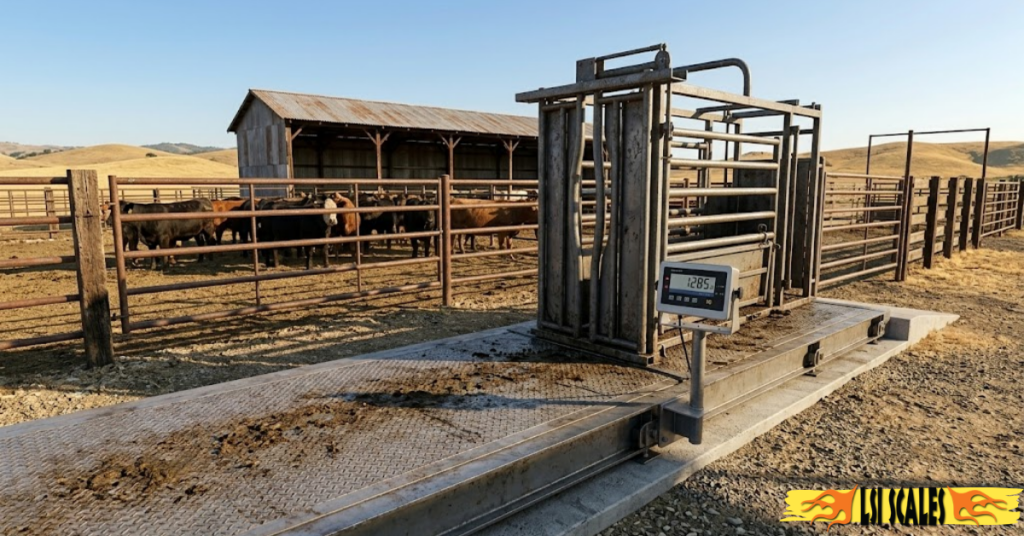
A livestock scale that’s off by ten pounds might not sound like a crisis. But run that error across a herd of two hundred cattle being dosed for parasites, and you’ve got systematic under-dosing — which means treatment failure, drug resistance, and a vet bill that dwarfs whatever calibration would have cost. Run that same error through a season of sale weights, and the financial loss adds up faster than most producers expect.
Livestock scale calibration isn’t complicated. It just needs to happen on a schedule, be done correctly, and be taken seriously as a routine part of farm and ranch management rather than an afterthought.
We’ve been calibrating and servicing cattle and livestock scales across California, Arizona, Oregon, and Washington for over 50 years. What follows is a practical guide built from real field experience — covering why calibration matters, how often to do it, what the process involves, the warning signs most producers miss, and what compliance requires in our region.
Why Accurate Livestock Scale Calibration Actually Matters
Most producers understand that accurate weight data is important. Fewer think carefully about what specifically goes wrong when a scale drifts out of calibration — and the consequences are more varied than most people realize.
Medication and treatment dosing. This is the highest-stakes consequence of an inaccurate livestock scale. Dewormers, antibiotics, anti-parasitics, and many vaccines are dosed strictly by body weight. A scale reading ten pounds low on a 500 lb animal means every dose is calculated on the wrong baseline. Under-dosing dewormers is one of the primary drivers of anthelmintic resistance in cattle operations — a serious and growing problem across the industry. Over-dosing creates its own risks, including withdrawal period violations for animals going to market.
Feed ration accuracy. Feed programs built around weight targets — particularly in backgrounding and finishing operations — depend entirely on reliable weight data. If the scale is consistently reading low, you’re feeding to a false baseline. That translates to either wasted feed or animals that aren’t reaching target weights on schedule. Either way, it costs money.
Sale weight accuracy. If you’re selling agricultural livestock by the pound — whether at auction, direct to a packer, or at the farm gate — a scale that consistently reads light is costing you revenue on every transaction. Over a full selling season, the cumulative loss is significant.
Breeding and performance records. Weight data drives breeding decisions, EPD calculations, and growth benchmarking. Bad weight data produces misleading performance records that can affect selection decisions for years. Garbage in, garbage out — it’s that straightforward.
How Often Should You Calibrate a Livestock Scale?
Most calibration guides say “periodically” or “per the manufacturer’s recommendation.” That’s not particularly helpful for a working producer. Here’s a clearer framework.
Legally regulated commercial operations. Under the USDA Packers & Stockyards Act, scales used at regulated stockyards, auction markets, and packing plants to weigh livestock for commercial transactions must be tested at least twice per calendar year by a USDA-licensed weights and measures inspector. This is a federal statutory requirement — not a guideline. Non-compliance can result in fines and suspension of operating authority. The USDA Agricultural Marketing Service (AMS) oversees inspection and enforcement for covered facilities.
On-farm use — non-commercial. For scales used on-farm for herd management, medication dosing, and internal performance tracking rather than commercial transactions, a minimum annual calibration is the general industry standard. For operations that weigh frequently — feedlots, intensive cow-calf operations, or producers doing regular health monitoring — calibrating every six months is a better practice. The more you rely on the readings, the more frequently you should verify them.
Event-triggered recalibration. Regardless of your scheduled calibration interval, certain events should trigger an immediate check:
- After any physical impact, overload, or rough handling of the scale
- After moving a portable scale to a new location
- After significant environmental events — flooding, hard freeze-thaw cycles, prolonged moisture exposure
- After replacing any load cell, cable, junction box, or indicator component
- After an animal collision or equipment impact on the scale platform
Our weight calibration services team can advise on the right calibration interval for your specific scale type and operating environment — frequency should reflect how hard the scale works and what conditions it lives in.
What the Livestock Scale Calibration Process Actually Involves
This is the section most calibration guides gloss over with vague generalities. Here’s what the process actually looks like in the field — whether you’re doing a basic check yourself or working with a certified technician.
Step 1 — Site and platform preparation. The scale must be on a firm, level surface before any calibration check means anything. For portable chute scales and load bar systems, this means solid, compacted ground — not soft soil, mud, or uneven footing. Clean the platform thoroughly before you start. Manure, mud, and debris sitting on the deck add weight to every reading and can cause inconsistent results across the platform surface. This sounds basic, but it’s one of the most common sources of error we see in the field.
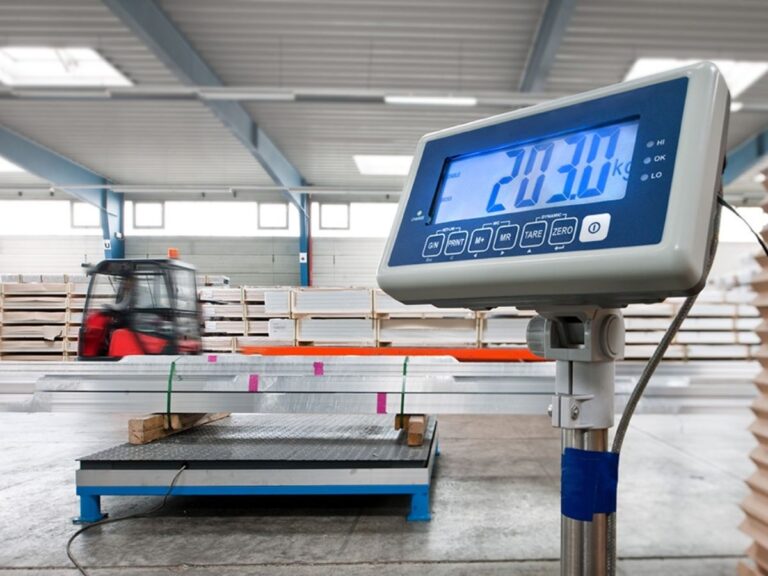
Step 2 — Zero balance check. With nothing on the platform and the scale fully powered up and settled, the indicator should read zero. If it doesn’t — if it reads a positive or negative offset with nothing on the deck — that’s the first confirmed sign of drift. Note the offset value before making any adjustments.
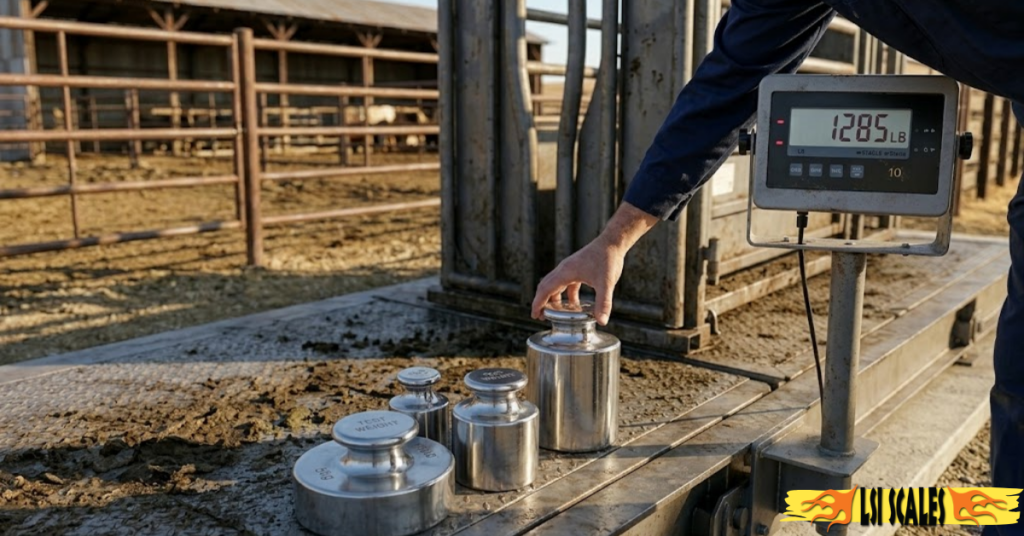
Step 3 — Span test with certified calibration weights. Place known test weights on the platform — ideally NIST-traceable calibration weights of known mass — and compare the displayed reading to the known weight. For a thorough check, test at multiple points: both corners, the center, and ideally at different weight increments across the scale’s capacity range. Corner loading errors indicate a load cell problem or uneven mounting rather than a simple calibration offset.
Step 4 — Adjustment. If the displayed reading falls outside acceptable tolerance, the calibration settings on the indicator need to be adjusted. Modern digital indicators have a calibration mode that allows span and zero adjustments. For NTEP certified scales used in legal-for-trade applications, this adjustment must be performed by a licensed weights and measures inspector or a certified technician — self-adjustment does not satisfy legal-for-trade certification requirements.
Step 5 — Documentation. Record the calibration date, the test weights used, the readings before and after adjustment, and who performed the calibration. This documentation matters for compliance audits, for tracking drift patterns over time, and for any insurance or liability situations involving weight-related disputes. Keep a calibration log with every scale in your operation.
Warning Signs Your Livestock Scale Needs Recalibration Now
A formal calibration schedule is important, but most producers also need to know what to watch for between scheduled checks. These are the field signs we see most often that indicate a scale has drifted and needs attention before the next scheduled service.
- Inconsistent repeat readings. Weigh the same animal twice in quick succession without it moving significantly — if the readings differ by more than a pound or two, the scale has a repeatability problem. This usually points to a load cell issue, a loose connection, or platform instability.
- Scale doesn’t return to zero. After removing a load, the indicator should return to zero within a few seconds. A persistent non-zero reading with nothing on the platform indicates drift, a damaged load cell, or debris on the deck.
- Readings inconsistent with visual estimates. Experienced producers develop a reliable eye for cattle weight. If the scale is consistently telling you something that doesn’t match what you’re seeing, trust the doubt and check the calibration.
- Animals not hitting growth targets. This is one of the subtler signals. If animals on a well-managed feed program aren’t gaining weight according to records, consider the scale before assuming a nutritional or health problem.
- Error codes or unstable display. Flickering readings, error codes, or a display that won’t settle are usually electronic — indicator fault, failing load cell, or a wiring issue — but they all affect calibration reliability.
- Visible physical damage. Any visible damage to the platform decking, load cell mounts, cables, or junction box should trigger an immediate service call, not just a recalibration. Our scale repair and preventive maintenance teams handle exactly these situations across our service regions.
Digital vs. Mechanical Livestock Scales: Which Holds Calibration Longer?
This is a question we hear regularly from producers who are either evaluating a new scale purchase or trying to understand why their existing scale seems to drift faster than expected. The honest answer is that it depends on the environment more than the technology.
Digital load cell scales: are more accurate and more capable than mechanical scales in almost every measurable way. They support data recording, connectivity to farm management software, and much finer readability. However, they are more sensitive to environmental stress — moisture infiltration into load cells and junction boxes, temperature cycling, electrical interference from nearby equipment, and physical shock all affect digital scale performance over time. In a farm environment, these stressors are constant. The difference between a digital scale that holds calibration well and one that drifts constantly is almost always IP rating and build quality. A properly specified, IP67-rated sealed load cell system installed correctly will hold calibration far better than a cheaper unit with inadequate environmental protection.
Our livestock scale systems are specified for the environments they operate in — not just for the weight capacity.
Mechanical scales are more tolerant of harsh environments, less sensitive to moisture and dust, and generally lower maintenance in basic operations. Their accuracy ceiling is lower than digital, and they can be harder to recalibrate precisely as mechanical components wear over time. For operations that need simple, durable, no-electronics weighing — particularly in very wet or dusty environments — mechanical systems still have a place. But for most modern farm operations where medication dosing, performance tracking, and record-keeping matter, digital is the better long-term choice.
Compliance Requirements for Livestock Scales in California and Arizona
This is the area where most calibration guides — including every competing article for this keyword — say nothing useful. Here’s what actually applies to producers operating in our service region.
USDA Packers & Stockyards Act. This federal law governs scales used at regulated facilities — stockyards, packing plants, poultry dealers, and live poultry handlers — where livestock is bought or sold by weight. Covered facilities must have their scales tested by a USDA-licensed inspector at minimum twice per calendar year. The USDA AMS maintains a directory of licensed inspectors. If you operate a regulated facility and your scales aren’t on a compliant testing schedule, you’re operating outside federal law.
California Weights & Measures. In California, scales used in commercial transactions — including livestock sold by weight at the farm gate, at auction, or direct to a packer — must be inspected and approved by the county Division of Weights and Measures. This applies whether you’re a large commercial operation or a small producer selling a handful of animals by the pound. Our certified scales in California are tested and approved to meet these requirements.
Arizona Department of Agriculture. Arizona’s Weights and Measures Services division enforces similar requirements for commercially used scales. Any scale used as the basis for a commercial transaction in AZ needs to be on a compliant inspection and calibration schedule. Our certified scales in Arizona meet these requirements.
The practical point for any producer: if weight is the basis for a financial transaction — any transaction — your state’s weights and measures regulations almost certainly apply. When in doubt, contact your county agricultural commissioner’s office or your state’s weights and measures division for guidance specific to your operation type.
A Well-Calibrated Scale Is One Less Thing to Worry About
Livestock scale calibration isn’t difficult. It requires knowing your calibration frequency, watching for the warning signs between scheduled checks, keeping proper documentation, and using a certified technician when legal-for-trade compliance is at stake.
The operations that handle this well tend to treat calibration the same way they treat any other routine maintenance — it goes on the calendar, it gets done, and nobody thinks much about it because everything works. The operations that handle it poorly tend to notice only when something goes wrong — a failed inspection, an animal health issue traced back to dosing error, or a weight dispute on a sale that could have been avoided.
We service and calibrate agricultural and livestock scales across California, Arizona, Oregon, and Washington. Our calibration team is NIST-certified and works to both the technical requirements of your scale and the compliance requirements of your state. If you’re due for a calibration check or dealing with a scale that’s giving you inconsistent readings, we’re available Monday through Friday, 8:00 AM to 4:30 PM, at (559) 446-1022 or lsiscales@lsiscales.com.