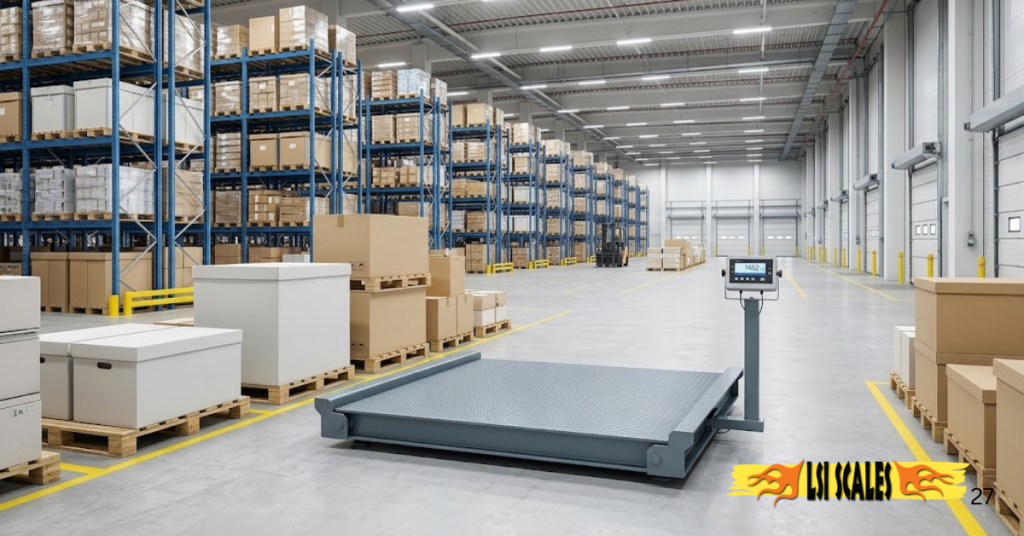
Pick the wrong floor scale and you probably won’t know it right away. The readings might look fine for a few weeks. Then the drift starts — a few pounds off here, a failed calibration check there — and before long you’re dealing with inaccurate shipments, compliance headaches, and a repair bill you weren’t budgeting for.
We’ve been installing, calibrating, and servicing industrial weighing equipment across California, Arizona, Oregon, and Washington for over 50 years. In that time, we’ve seen the same avoidable mistakes made at warehouses, distribution centers, food facilities, and manufacturing plants. Most of them come down to one thing: the scale was chosen on price or convenience rather than fit.
This guide walks through the practical factors that actually matter when choosing a warehouse floor scale — so you get it right the first time.
First, Understand What You’re Actually Weighing
Before you look at a single spec sheet, get clear on your load. What are you weighing — pallets, drums, barrels, loose materials, individual parts? How does it get loaded onto the scale — by hand, pallet jack, or forklift? Is the load uniform or does it shift and settle?
These questions shape almost every decision that follows. A logistics warehouse moving standard pallets has completely different needs from a food processor weighing bulk ingredients in stainless steel containers. A recycling facility dealing with irregular scrap loads needs a different platform size and surface than a lab-adjacent operation handling small, carefully packaged items.
It also helps to think about the surrounding workflow. Will the scale sit flush against a dock? Does it need a ramp for pallet jack access? Is space tight enough that a low-profile platform matters? The industrial and factory environments we work in all have their own constraints — getting clear on yours before you buy saves a lot of trouble later.
Weight Capacity: Go Higher Than Your Current Maximum Load
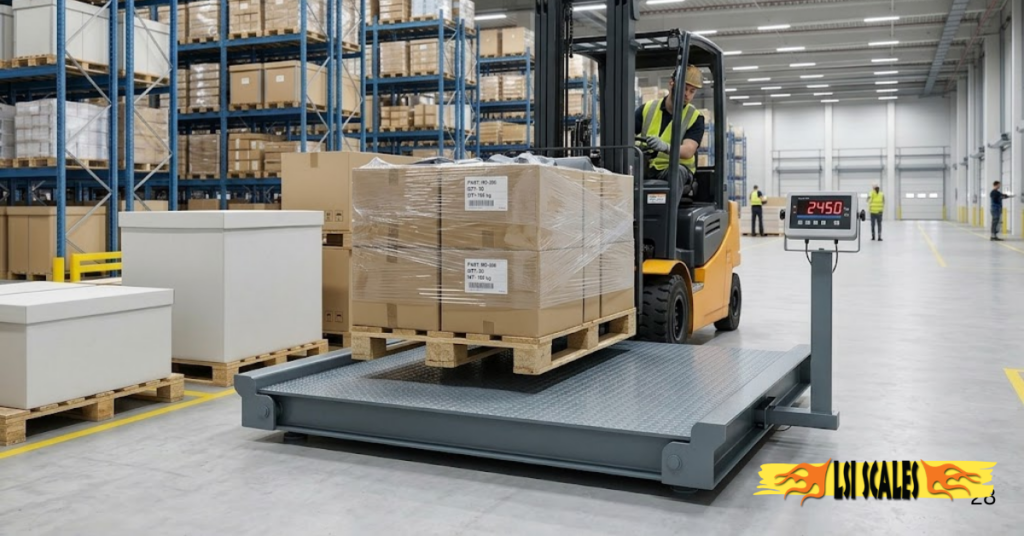
Capacity is the maximum weight a floor scale can reliably measure. Common options for industrial floor scales are 2,500 lb, 5,000 lb, 10,000 lb, and 20,000 lb — though higher capacities exist for heavy industrial applications.
A rule we always share with customers: choose a capacity that’s at least 20–25% above your heaviest regular load. If your heaviest pallet tops out at 4,000 lb, a 5,000 lb scale is cutting it close. A 10,000 lb scale gives you headroom, protects the load cells from repeated stress near their limits, and extends the working life of the equipment significantly.
Overloading is one of the most common causes of load cell damage we encounter in the field. It rarely announces itself dramatically — it just quietly degrades accuracy over time until the scale starts failing calibration checks.
How Accurate Does Your Scale Actually Need to Be?
Accuracy in floor scales is expressed as a division — the smallest readable increment. A 5,000 lb x 1 lb scale reads in 1 lb increments. A 10,000 lb x 2 lb scale reads in 2 lb increments. The tighter the division, the more precise the measurement.
If your operation buys or sells by weight, bills freight by weight, or operates in a regulated industry, you need a legal-for-trade scale — one that carries NTEP certification and meets NIST HB44 standards. This isn’t optional if commerce depends on the reading. Our certified scales and weight calibration services are built around exactly these compliance requirements.
For internal process use — checking batch weights, monitoring production, or managing inventory — a non-trade scale with good repeatability is often sufficient and more cost-effective.
Platform Size and Material: Matching the Scale to Your Workflow
The platform needs to be large enough to fully support your load — with comfortable clearance on all sides. Standard floor scale platform sizes run from 3×3 ft up to 5×7 ft, with 4×4 and 5×5 being the most common in warehouse and manufacturing settings.
If you’re loading with a pallet jack or forklift, a low-profile design makes a real operational difference. A lower deck height means less ramp angle, faster loading, and less wear on your handling equipment. If the scale sits in a busy throughput area, that adds up quickly across a working day.
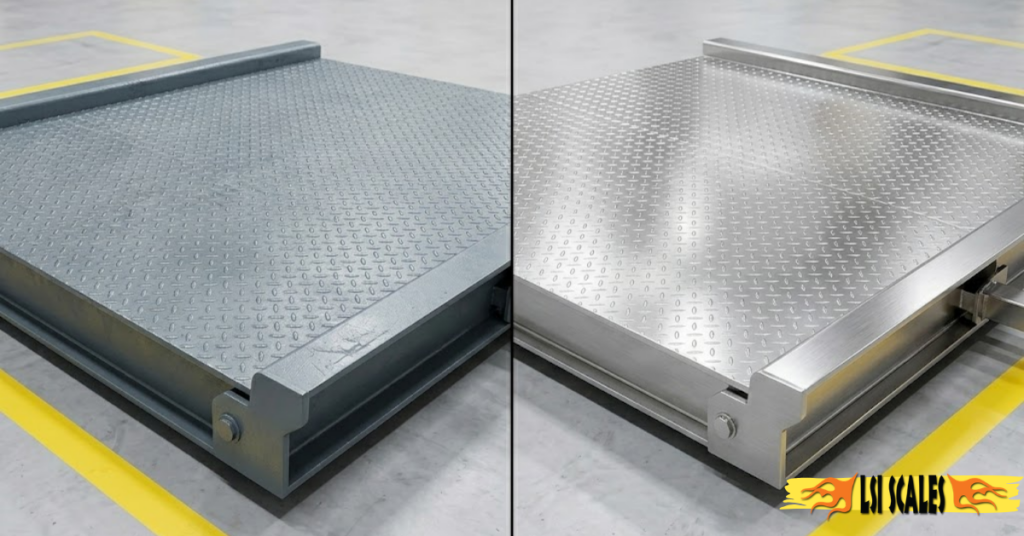
Platform material is equally important and often underestimated:
- Painted carbon steel — the standard choice for general warehouse and manufacturing use. Durable, cost-effective, performs well in dry to moderately humid environments.
- Stainless steel — required for food processing, chemical handling, pharmaceutical, and any washdown environment. Stainless resists corrosion, is easy to sanitize, and holds up to repeated moisture exposure without degrading.
For food production or chemical handling environments, stainless steel combined with IP-rated sealed components isn’t just a preference — it’s what keeps you compliant and keeps the scale functioning reliably in harsh conditions.
Environment Matters More Than Most People Realize
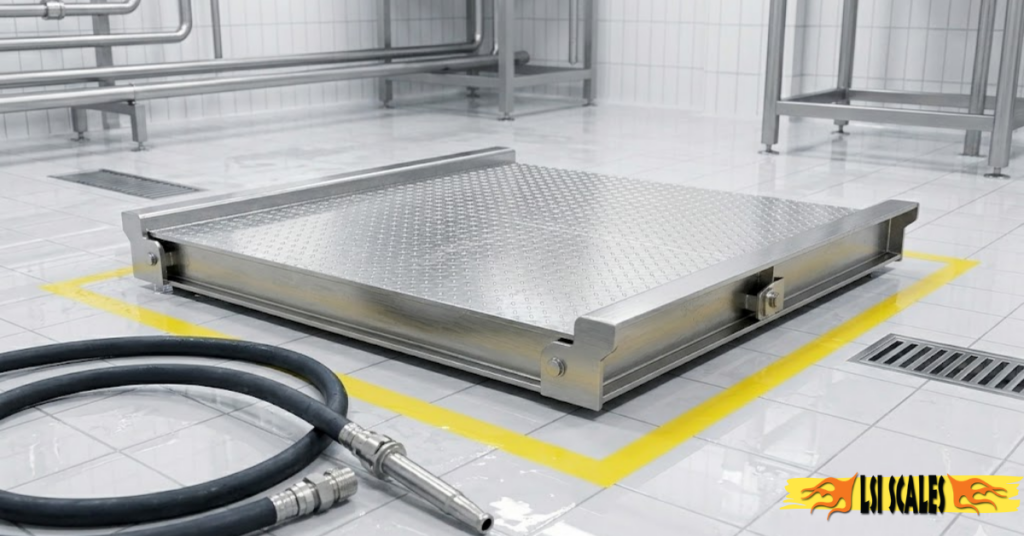
The physical environment your scale operates in affects its performance and lifespan more than most buyers account for. Moisture, dust, temperature swings, chemical vapors, vibration from nearby machinery, and direct outdoor exposure all take a toll — on the platform, the load cells, the junction box, and the indicator.
IP (Ingress Protection) ratings tell you how well a scale’s electrical components are sealed. IP65 means dust-tight and protected against low-pressure water jets — suitable for most washdown environments. IP67 means it can handle temporary submersion — appropriate for heavy washdown or outdoor agricultural use.
For hazardous environments — chemical plants, refineries, grain handling facilities where combustible dust is present — you need intrinsically safe or explosion-proof components. This is a non-negotiable safety requirement, not just a spec preference.
Outdoor operations like agricultural farm weighing or scrap and recycling need sealed junction boxes, coated or galvanized platforms, and indicators rated for temperature variation. Skipping these specs in an exposed environment is one of the leading causes of premature scale failure we see — and it’s almost always more expensive to fix than it would have been to spec correctly from the start.
Digital Indicators and Connectivity: What You Need (and What You Don’t)
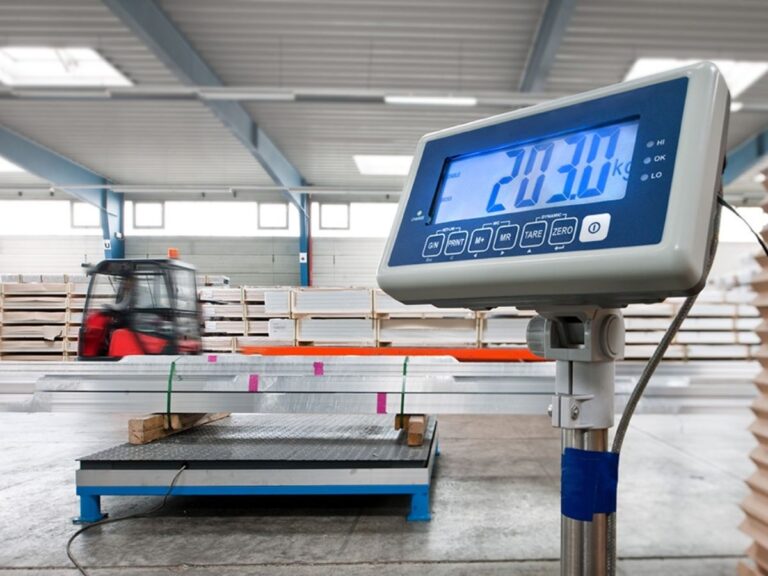
The indicator — the display unit that shows the weight reading — often gets treated as an afterthought. It shouldn’t be. The indicator is the interface between your scale and your operation, and choosing the wrong one creates friction every time someone uses it.
Basic considerations: display size and visibility for your working environment, whether you need a remote display for operator convenience, and whether the indicator needs to be wash-rated to match the platform.
On connectivity — many modern industrial floor scales offer data output via RS232, USB, Bluetooth, or Wi-Fi. If you’re integrating weight data into an ERP, WMS, or shipping software, this matters. It can eliminate manual data entry, reduce errors in freight billing, and give you real-time inventory visibility.
That said, not every warehouse needs a networked scale. If the weight reading is used locally and isn’t tied to billing, compliance reporting, or automated systems, a simple digital display with USB output is often all you need. Match the connectivity to the actual workflow — not to the most feature-rich spec available.
Don’t Overlook Installation, Calibration, and Ongoing Maintenance
This is the part that rarely appears in a floor scale buying guide — and it’s the part that matters most over time.
A floor scale that’s poorly installed will drift out of calibration faster, read inconsistently, and wear unevenly. Professional scale installation means the platform is leveled correctly, the load cells are properly seated, the junction box is positioned for protection, and the indicator is set up and zeroed to the installation environment. It’s the foundation everything else builds on.
Regular calibration isn’t optional for legal-for-trade applications — NIST HB44 requires periodic testing to maintain certification. But even for internal-use scales, calibration checks catch drift before it becomes a real operational problem. We recommend a scheduled calibration interval based on how intensively the scale is used and what environment it operates in.
Beyond calibration, a preventive maintenance program covers the things that quietly degrade performance: load cell connections, zero drift, platform debris and damage, cable integrity, and indicator firmware. Catching these on a schedule is far less disruptive — and less expensive — than waiting for a failure during a busy operational period.
One thing we’ve learned over five decades of doing this: having a certified local service provider you can call matters as much as the scale itself. When something goes wrong, fast response keeps your operation running. Our scale repair and scale services teams cover California, Arizona, Oregon, and Washington — and we’ve built our operation around being genuinely responsive when customers need us.
Buying vs. Renting a Floor Scale: A Quick Decision Guide
For most operations with a permanent weighing need, buying makes long-term financial sense. But there are situations where renting is the smarter call:
- Seasonal operations that only need weighing capacity for part of the year
- Short-term construction or project-based work
- Backup coverage while your primary scale is being repaired or overhauled
- Testing a capacity or platform size before committing to a purchase
We offer equipment scale rentals for exactly these situations — certified, maintained, and ready to deploy across our service areas.
Getting the Right Scale Starts With Asking the Right Questions
Choosing an industrial floor scale for your warehouse isn’t complicated — but it does require working through the right checklist before you commit. Load type, weight capacity, platform size and material, environment rating, compliance requirements, and your service plan all need to be accounted for.
The businesses that get this right tend to share one habit: they think about the scale as a long-term operational tool, not a one-time purchase. The spec sheet matters, but so does what happens at installation, at the first calibration, and two years down the line when a load cell needs attention.
We’ve been helping warehouses, manufacturers, food processors, and logistics operations across the West Coast work through exactly this kind of decision for over 50 years. If you’re in the middle of it, our team is straightforward to reach — Monday through Friday, 8:00 AM to 4:30 PM, at (559) 446-1022 or lsiscales@lsiscales.com.